Santa Cruz De Tenerife Cruise Port Guide
Insider tips for navigating Santa Cruz’s cruise port reveal secrets the ship won’t tell you—discover what locals actually do.
In this guide
- Cruise Port Overview: What to Expect
- Getting From the Port to Town
- The Must-Do Experience: Start Here
- History Culture and the Top Sights
- Beyond the Centre: Day Trips and Alternatives
- Shore Excursion or Going It Alone
- The Practical Details That Change Your Day in Santa Cruz De Tenerife
- Your Port Day: A Sample Itinerary
Try one free personalised day plan — built around your ship’s actual arrival and departure times. Then get every port on your cruise done the same way from £7.99 (about $10).
Cruise Port Overview: What to Expect
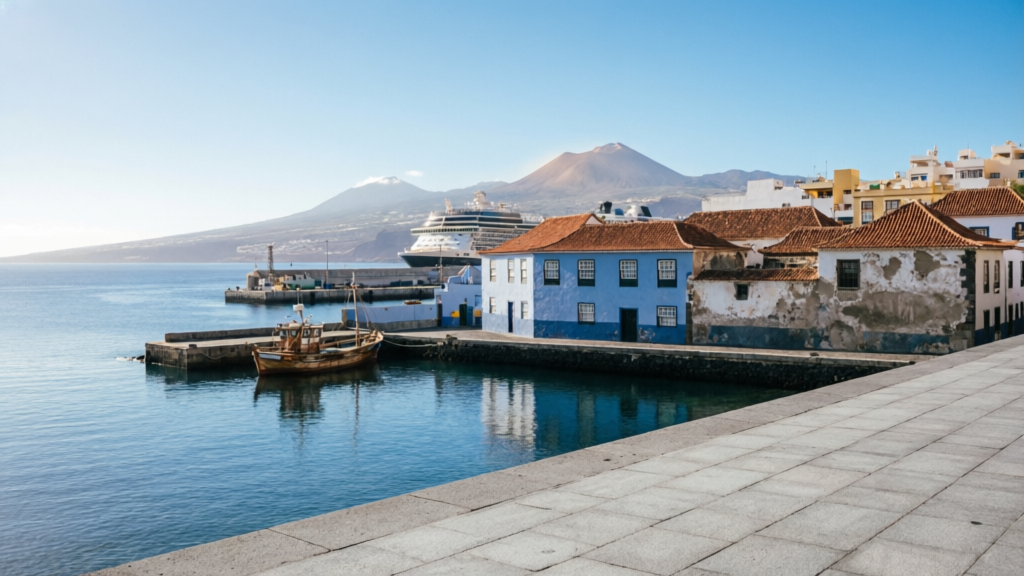
Cruise ships berth in the main port right beside the city centre, with Plaza de España a short walk from the nearer berths and a free shuttle for ships on the outer quays. The terminal itself contains only basic shops and cafés that serve their purpose without pretence. Most passengers either remain on the ship or book organised excursions, so the crowds thin out quickly.
Santa Cruz starts right outside the port gates, and you walk straight into an actual working Spanish city that operates independently of cruise tourism. This separation from the cruise circuit makes the place considerably more interesting than the terminal suggests. Consider booking shore excursions through your cruise line to maximize your time exploring the city’s highlights.
Navigation is straightforward because the city centre rises inland from the water. Your best approach is to walk uphill, explore the streets and squares as they present themselves, then head back down before departure. Comfortable shoes matter, and a maps app on your phone will save time when you take a wrong turn, which you will.
Port facilities are minimal but adequate for basic needs. The terminal has currency exchange and an information desk, though staff speak limited English. If you plan to explore independently rather than book a ship excursion, arrange your transport or tours beforehand and keep your confirmation details accessible on your phone.
Getting From the Port to Town
Depending on where your ship berths, the walk into Santa Cruz proper takes anywhere from five to twenty minutes along the port zone, and a free shuttle runs to Plaza de España from the outer quays. Nothing along this stretch warrants stopping for photos, so most people push through without lingering. Once you break through into actual neighbourhoods, the tourist crowds thin considerably and you’ll have streets that feel genuinely lived-in.
Taxis wait outside the terminal and cost a reasonable amount to reach the city centre, which works if your legs need sparing but wastes money if you’re capable of walking. The route is straightforward and entirely safe—head inland, follow the general uphill direction where other people are going, and you’ll arrive without getting lost. Your phone’s maps app matters only once you leave the main routes, so grab an offline map before you disembark. If you plan to explore beyond the city centre, consider purchasing a local eSIM data plan to avoid expensive roaming charges while navigating and staying connected throughout your visit.
Book any organised activities or tours through independent operators rather than through the cruise line, since popular walks and village visits fill up with other cruise passengers well in advance. Booking directly with local companies typically costs less than what the ship charges for the same experience and usually involves smaller groups. These operators know the city well enough to sidestep the obvious tourist traps that catch people booking last-minute through onboard desks.
The Must-Do Experience: Start Here
Most cruise passengers squander their best hours in Santa Cruz by treating it as a pit stop rather than an actual destination—and the city reveals itself only to those willing to spend more than a few minutes ashore. The waterfront walk along the Avenida Marítima shows you how the place actually functions instead of channelling you straight into the old quarter like the rest do. You’ll feel the Atlantic wind properly here, and locals genuinely outnumber tourists, so you see what Santa Cruz is rather than what’s been staged for visiting ships.
From the waterfront, move toward the Plaza de España and its surrounding neighbourhoods where the city’s real activity happens. The mix of colonial buildings and ordinary street life tells you more about Tenerife than any written guide, and you’ll find cafés where a coffee costs significantly less than near the port.
Booking a walking tour with an independent operator before your port day works better than the ship’s equivalent if you want local knowledge without the markup. Small group tours and activities run for several hours and cost less while keeping numbers low enough that you’re not trailing behind someone holding a flag.
Commit to at least two hours ashore rather than ducking back to the ship after ninety minutes. This minimum time actually allows you to move through neighbourhoods at a pace that lets things register, rather than just ticking off locations.
History Culture and the Top Sights
Santa Cruz’s history gets buried under cruise ship marketing, but the city’s actual story—of wealth, decline, and quiet resilience—matters far more than the sanitised version most guides offer. The real history isn’t in the museums; it’s in the architecture and the neighbourhoods themselves.
The Museo de la Naturaleza y Arqueología holds genuine artefacts from the Guanche people who lived here before the Spanish arrived, and unlike many port museums, it’s genuinely worth your time. The building is the former Civil Hospital, a fine neoclassical building, which tells you something about how this city layered itself over centuries. You’ll understand Tenerife’s pre-colonial past better here than anywhere else on the island, and the collection isn’t overwhelmed by coach parties even though it’s an easy walk from Plaza de España.
The Plaza de España and its surrounding colonial quarter reveal how Santa Cruz functioned as a trading hub and military stronghold. Walk the narrow streets around the Iglesia de la Concepción not because they’re particularly grand, but because ordinary Canarian life still happens here, and you’ll see how locals actually use these spaces rather than how they’ve been packaged for tourism. The architecture mixes Spanish colonial with practical working-city pragmatism; nothing feels artificially preserved.
An independent walking tour focusing on the city’s maritime and military heritage works considerably better than the ship’s generic offerings. Local guides answer your actual questions rather than delivering a rehearsed script, and small group tours fill quickly with cruise passengers booking ahead online, so secure your spot before your port day arrives.
Beyond the Centre: Day Trips and Alternatives
Most cruise passengers book the ship’s excursion to Teide National Park without realising they’ll spend more time in a coach than actually at the volcano, and the independent alternative costs considerably less while giving you genuine control over your day.
Your best option is booking a small-group tour through a local operator well ahead of your port day, since these fill quickly with cruise passengers and often depart directly from the harbour, saving you the walk inland. You’ll reach higher altitudes, spend more time exploring the crater and volcanic landscape, and return to your ship without the crowded experience of the larger ship tours. The guides actually know the mountain rather than reading from a laminated script.
Alternatively, if you want flexibility without committing to a group, hire a car for the day and drive yourself. The roads are excellent, the route straightforward, and you can stop wherever you like—the volcanic geology reveals itself in layers as you climb. Factor in time for the winding ascent; it’s worth taking slowly rather than rushing up and down.
If high-altitude excursions don’t appeal, consider staying in Santa Cruz itself and exploring the neighbourhoods beyond the cruise terminal. The Barrio de San Cristóbal neighbourhood has proper local bars, affordable seafood restaurants, and none of the port-area markup. You’ll eat better, spend less, and see how the city actually functions.
The key is deciding this before you arrive. Ship excursions trap you into their schedule; independent alternatives require advance booking but reward you with better value and genuine freedom.
Shore Excursion or Going It Alone
🗺️ Tours & Experiences at This Port
Skip the ship’s overpriced excursions — browse top-rated independent tours trusted by thousands of cruise passengers.
Shore Excursion or Going It Alone
The ship’s shore excursion desk will tell you the Teide cable car sells out and you absolutely must book with them, but what they won’t mention is that independent operators offer the same experience for considerably less, and importantly, they’re far quicker to organise since they don’t wait for 2,000 passengers to assemble on the dock.
Book your Teide tour through a local operator well in advance of your port day—the best small-group tours do fill quickly with cruise passengers, and you’ll pay a fraction of the price the ship charges for its middleman service. The cable car experience remains unchanged, but you’ll reach the summit with actual time to explore rather than rushing between departure deadlines.
If you’re not interested in high altitudes, eat lunch away from the waterfront. The restaurants immediately surrounding the cruise terminal inflate prices significantly compared to neighbourhood spots just inland. Head to Barrio de San Cristóbal or the quieter side streets near the Iglesia de la Concepción, order the daily catch at an actual local establishment, and you’ll understand why Santa Cruz functions perfectly well without cruise passengers.
The fundamental difference between the ship option and going it alone isn’t the destination—it’s control. You either accept their schedule and their markup, or you claim your morning back and keep your euros.
🗺️ Tours & Experiences at This Port
Skip the ship’s overpriced excursions — browse top-rated independent tours trusted by thousands of cruise passengers.
The Practical Details That Change Your Day in Santa Cruz De Tenerife
The cruise terminal’s Wi-Fi barely functions, but the city centre‘s works properly—this matters because you’ll want to book your afternoon activity on your phone the moment you step ashore. Santa Cruz‘s practical advantage over other Canary Islands ports is that almost nothing worth doing actually requires advance planning, which means you can stay flexible based on weather and energy levels.
The harbour area itself functions as a carefully managed tourist corridor, with staff trained to redirect you toward expensive waterfront restaurants and organised activities. Ignore this gently. Walk inland and you’ve entered the real city where locals eat, shop and work without performing for visitors.
The Auditorio de Tenerife is worth your time regardless of whether there’s a performance on. The building itself is architectural theatre, perched on the coast with Atlantic views that cost nothing to experience. Arrive early in your port day when crowds are thinnest and you’re not yet tired from walking.
Santa Cruz offers no false choice between authentic and convenient. Head to the old church quarter for lunch, wander the Mercado de Nuestra Señora de África if you want to see how the city actually functions, and leave the cruise terminal mentality behind the moment you pass through the gates. The port works best when you treat it like a city rather than an attraction.
🗺️ Tours & Experiences at This Port
Skip the ship’s overpriced excursions — browse top-rated independent tours trusted by thousands of cruise passengers.
Your Port Day: A Sample Itinerary
Most cruise passengers waste their first hour at Santa Cruz wandering the terminal precinct, which is precisely where you shouldn’t be. Head straight into the city centre instead—the walk takes barely twenty minutes and deposits you where actual life happens.
Start your morning at the old church quarter. Walk through the narrow streets, grab a coffee at a local café rather than a terminal chain, and let your eyes adjust to the fact that this is a working Spanish city, not a theme park. The architecture around Plaza de la Candelaria rewards aimless wandering, and you’ll spot the tower of the Iglesia de la Concepción without trying.
By mid-morning, head to the Mercado de Nuestra Señora de África. This isn’t a sanitised tourist market—it’s where locals buy fish, fruit and flowers, which makes it infinitely more interesting than gift shops. You can eat breakfast here cheaply, surrounded by actual commerce rather than performed authenticity.
For your afternoon, tackle the Auditorio de Tenerife if energy permits, or simply walk the seafront promenade at your own pace. If you want something more structured, independent walking tours of the historic centre book up quickly during cruise season and cost considerably less than the ship’s equivalent excursion while giving you an actual guide rather than a shepherd.
Time your return to the ship for late afternoon. You’ll have seen the city properly, eaten well without overpaying, and avoided the terminal’s manufactured enthusiasm entirely.
🗺️ Tours & Experiences at This Port
Skip the ship’s overpriced excursions — browse top-rated independent tours trusted by thousands of cruise passengers.
Book your Santa Cruz De Tenerife day
Tours for this port, compare before you book
Getting around in port
✈️ Before you sail: eSIM, insurance, luggage, flight delays
Ships In Santa Cruz De Tenerife
Upcoming calls from our sailings tracker, updated regularly.
Iona
P&O CruisesThu 8 Oct
ms Nieuw Statendam
Holland AmericaFri 9 Oct
⚓ 08:00–23:00
Ventura
P&O CruisesFri 9 Oct
Norwegian Star
Norwegian Cruise LineSat 10 Oct
⚓ 08:00–23:59
MSC Virtuosa
MSC CruisesSat 10 Oct
⚓ 08:00–18:00
Celebrity Apex
Celebrity CruisesTue 13 Oct
⚓ 07:00–16:00