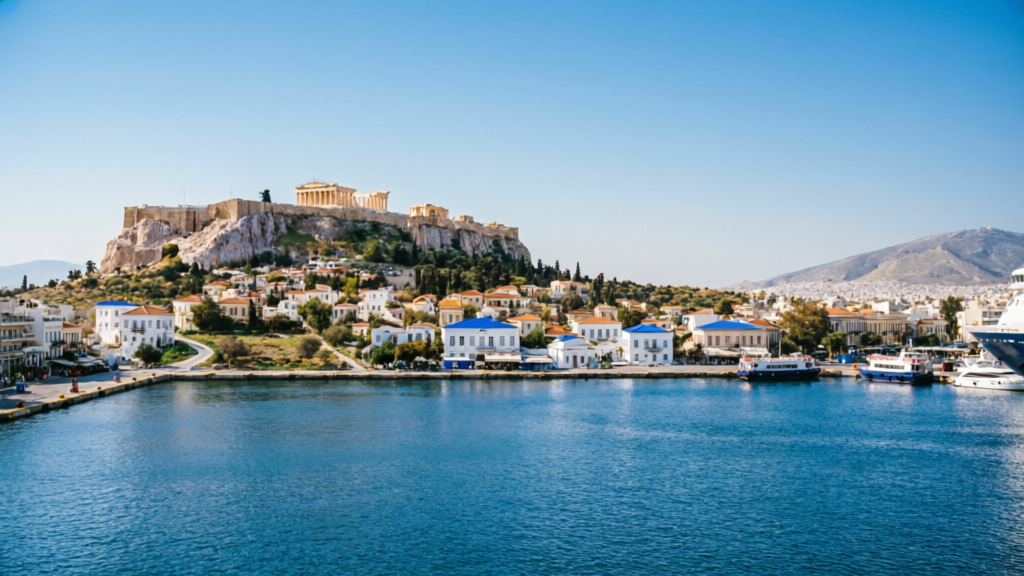
Athens Cruise Port Guide
Get insider tips for navigating Piraeus, exploring Athens independently, and discovering hidden gems that cruise lines won’t tell you about.
In this guide
Try one free personalised day plan — built around your ship’s actual arrival and departure times. Then get every port on your cruise done the same way from £7.99 (about $10).
Cruise Port Overview: What to Expect
Piraeus port is sprawling and chaotic, which means you’ll lose considerable time just navigating your way out. Your ship will dock at one of several terminals depending on the cruise line, so ask your cabin steward which one before disembarking since the walking distances vary substantially. The port authority has improved signage in recent years, though the layout still confuses most people who pass through it.
Once you know which terminal you’re leaving from, you can reach the exit fairly quickly with a map and clear purpose. The real decision isn’t how to escape the port—it’s whether you should head straight to Athens or spend time in the Piraeus neighbourhood itself. Most passengers rush inland toward the Acropolis without considering that the port area has legitimate appeal: working fishing boats, actual local tavernas, and waterfront streets where you’ll see far fewer tourists than on the main tourist routes.
If Athens is your priority, the metro connects directly from the port to Syntagma Square in the city centre. Independent guided tours of the Acropolis can be booked online well before your cruise, which costs considerably less than ship excursions and gives you far more control over your schedule. Book early during cruise season since the better operators fill their slots quickly.
Getting From the Port to Town
The metro works better than a taxi if you’re willing to navigate it properly. The station sits by the main ferry gates, a long walk or a port shuttle ride from the cruise terminals, and a single ticket takes you into central Athens far more cheaply and quickly than waiting for taxis or boarding a ship-organised bus. Getting there costs less money and less time than either alternative.
Buy your ticket from the machine before you board, since staff won’t assist you and the system confuses most people on their first attempt. The train itself fills with Athenians conducting ordinary business, which feels grounding after the port confusion. You’ll end up at Syntagma Square, within reasonable walking distance of the places worth visiting.
Walking tours run regularly from central meeting points and cost considerably less than ship-organised versions. Book several days ahead online during cruise season, as spaces fill quickly and you’ll waste time chasing availability once you arrive. This guarantees you’ll have a spot rather than showing up and finding nothing available.
If you’re staying near the port or only have limited time, the waterfront neighbourhoods of Piraeus reward exploration on their own terms. Seafood tavernas operate at prices that reflect actual value rather than proximity to tourist routes, and working harbourside cafés serve better food than places near the Acropolis. This requires minimal planning and shows you an Athens most cruise passengers never experience.
The Must-Do Experience: Start Here
Most cruise passengers queue for the Acropolis in their morning window when they should be in the Plaka instead. The old neighbourhood works best before tour groups arrive, and you’ll find actual tavernas, working craftspeople, and small museums that operate for locals rather than visitors.
Start in the streets below the Acropolis itself and wander without a map. Yes, you’ll get lost briefly, and that’s intentional. You’ll end up in areas where people buy cheese, argue about football, and the café owner knows regular customers by name—tourists register as an afterthought.
By mid-morning, book yourself onto an independent guided walk covering the Acropolis and ancient sites. These cost less than ship excursions and run in smaller groups where you can actually hear the guide instead of standing behind thirty other people. Book several days before arrival, as the decent ones fill up during cruise season. Shore excursions at major ports like Athens often operate at premium prices despite offering less personalized experiences than locally-booked alternatives.
This sequence gives you how people actually live first, then expert context second. You understand Athens as a functioning city rather than a checklist of sites, which matters considerably when you’re choosing between four hours ashore and eight. Athens rewards the longer stay, but only if you start in the right place.
History Culture and the Top Sights
The Acropolis empties before nine in the morning because most cruise passengers don’t arrive until mid-morning, which means you can walk through the ancient temple complex with minimal crowds if you skip breakfast on the ship. The Parthenon has dominated Athens’ skyline for nearly twenty-five centuries, but what matters is understanding what you’re actually seeing. What you see today is the ancient temple itself, wrecked by an explosion in 1687 and patched by modern restoration work rather than rebuilt by the Romans, and the original paint scheme was bright blues and reds—a detail most guidebooks omit, though it changes how you understand the site.
Below the Acropolis, the Ancient Agora and Temple of Hephaestus receive far fewer visitors than the main site despite being architecturally superior if you prefer intact structures over symbolic ones. The museum here is small and manageable, explaining the context in ways that make the rest of Athens’ ancient sites more comprehensible. Spending time here first improves your understanding of everything else you’ll see.
The National Archaeological Museum downtown holds Greece’s best ancient sculpture and pottery collections and requires only a modest entry fee. An hour inside rewards you substantially—the Mask of Agamemnon alone justifies the visit—without the queuing problems that plague the Acropolis. Most cruise passengers skip this entirely for the predictable shop streets, which works in your favour.
Book an independent guided tour covering these sites before you arrive rather than booking through the ship. You’ll spend less money, benefit from smaller group sizes, and avoid corporate commentary that explains nothing. The best tours fill weeks ahead during cruise season, so reserve now rather than gambling on dockside availability.
Beyond the Centre: Day Trips and Alternatives
Most cruise passengers spend their port day standing in queues at the Acropolis while a better option exists just outside the city at a fraction of the ship excursion cost. The Saronic Gulf islands—Hydra, Spetses, and Poros—are reachable by hydrofoil and offer something central Athens cannot: places where Greeks actually live and work rather than spaces built around tourism. You’ll find narrow streets, functioning harbours, no vehicle traffic, and restaurants where locals take their lunch instead of tour groups rotating through.
The ship offers organised excursions to these same islands, but they operate on fixed schedules that defeat the purpose of going. You board with hundreds of others, spend your time watching the clock, and return to the vessel within a predetermined window that leaves no room for lingering or chance encounters. Independent travel means booking your hydrofoil tickets in advance and catching an early departure, which gives you substantial time ashore without the rigid structure that makes the experience feel rushed.
Book your hydrofoil transfers before you arrive, as these routes fill quickly during the cruise season. Showing up at the dock hoping for same-day availability will cost you hours standing around. The crossing itself matters—you spend time on the water watching the mainland disappear, which shapes how you experience arriving in an actual working port rather than a space designed entirely for passenger consumption.
Shore Excursion or Going It Alone
The ship excursion to the Acropolis costs roughly three times what you’d pay booking independently, and you’ll spend half your port day travelling with fifty people you didn’t choose to meet. That’s the blunt reality, and it’s worth stating upfront because the maths are straightforward once you know them.
Your real choice isn’t between the ship’s tour and staying aboard—it’s between paying for convenience you don’t actually need and keeping money in your pocket while having better control over your day. The Acropolis is worth seeing, but the ship bundles it with a guide repeating facts you could read beforehand, a coach journey through traffic, and a strict departure time that means leaving before you’re ready. Going independently means catching the metro from the port, arriving when you choose, and spending as long as you want among the ruins without watching the tour guide’s watch.
Book your Acropolis tickets online before you arrive at port. The queue for same-day tickets can stretch for hours, and that’s time you’ve already paid for through your cruise fare. A guided tour arranged through a local operator—booked well in advance—costs considerably less than the ship’s version and often provides sharper insight because independent guides aren’t herding thirty passengers through a predetermined script.
You’ll move at your own pace, ask actual questions that interest you, and finish with time to explore the Plaka neighbourhood on your own rather than being ferried back to the vessel like clockwork. To avoid international roaming charges on your phone while navigating independently, consider purchasing a local eSIM data plan before your excursion so you can access maps and travel information without extra fees. The calculus here favours independence in nearly every way: lower cost, better experience, genuine flexibility. The ship offers ease, which some passengers genuinely value; everyone else should book ahead and take control of their afternoon.
Before You Leave the Ship: Athens Practicalities
The port authority doesn’t advertise it, but walking from your ship to the metro station costs nothing and saves you haggling over a taxi, though it takes a good half hour from the cruise terminals and Syntagma Square is still around 10 kilometres further on. The chaos you encounter stepping off the gangway—poor signage, aggressive touts, general confusion—is partly deliberate, designed to steer you toward paid transport options the cruise lines profit from recommending.
The walk itself is straightforward. Follow the port perimeter toward Piraeus town centre, keep heading uphill past the metro station, and you’ll emerge into recognisable streets. Download an offline map beforehand, not because you’ll get lost, but because it removes any anxiety about navigation and lets you walk with confidence.
Your second practical advantage: the metro card system. Buy a single journey card or a day pass at any station ticket office, tap it at the barrier, and you can travel anywhere in the city with predictable journey times that won’t be held hostage to traffic. The cost is significantly lower than what port taxi drivers will quote you, and the system works identically whether you’re a first-time visitor or a regular.
The third thing cruise staff won’t emphasise: avoid restaurants directly around the Acropolis and Plaka’s main streets. Menus printed in English and laminated photographs of dishes are reliable signals you’re about to overpay substantially for mediocre food. Walk two blocks in any direction, find where locals eat lunch, and your bill will be considerably lower for noticeably better quality.
🗺️ Tours & Experiences at This Port
Skip the ship’s overpriced excursions — browse top-rated independent tours trusted by thousands of cruise passengers.
Your Port Day: A Sample Itinerary
Most cruise passengers spend their first hour ashore queuing for expensive organised excursions when they could already be halfway up the Acropolis. Your port day works best if you move quickly and bypass the ship’s offerings entirely.
Start your morning by walking into Piraeus town centre, then head straight to the Acropolis metro station. A day pass gives you unlimited travel, and you’ll reach the Acropolis entrance well before the mid-morning crowds arrive. Getting there before ten o’clock means you’ll actually see the Parthenon instead of standing behind tour groups.
Spend your late morning and early afternoon on the Acropolis and its museum. The views across Athens justify the entry fee, and the museum’s classical sculpture collection genuinely warrants a couple of hours. Bring water—shade is sparse and the sun is intense.
For lunch, walk downhill toward Plaka but deliberately avoid the main tourist strip. Find a neighbourhood taverna where local Greeks eat, order simply, and pay far less than you would on the crowded streets nearby. Your bill will be a fraction of what ship restaurants charge for inferior food.
Your afternoon depends on what interests you. If classical history appeals, book an independent guided tour of the ancient Agora in advance, as popular guides fill quickly with cruise passengers. If you prefer something different, the National Archaeological Museum rewards a couple of hours and stays relatively quiet compared to the Acropolis. Either way, head back to Piraeus with time to spare before your ship departs.
🗺️ Tours & Experiences at This Port
Skip the ship’s overpriced excursions — browse top-rated independent tours trusted by thousands of cruise passengers.
Book your Athens day
Tours for this port, compare before you book
Getting around in port