Mykonos Cruise Port Guide
What hidden gems await beyond Mykonos’ crowded waterfront—and how can you experience them?
In this guide
Try one free personalised day plan — built around your ship’s actual arrival and departure times. Then get every port on your cruise done the same way from £7.99 (about $10).
Cruise Port Overview: What to Expect
Mykonos port disgorges thousands of cruise passengers daily into a genuinely small harbour, and once the sea bus or shuttle drops you in town you’re straight into the island’s main shopping precinct surrounded by your own tour groups. The compact town actually works in your favour if you move deliberately—everything worth your time there is walkable, so you won’t be forced into expensive ship excursions. Step back one street from the waterfront and prices drop sharply, locals reappear, and you can eat without the cruise markup.
Expect overwhelming crowds between May and September. Package tourists, day-trippers from Athens, and cruise ships create shoulder-to-shoulder conditions in the main town during midday hours, though the island has enough substance to justify a proper day if you navigate smartly. Winter transforms the place into something closer to an actual working town, with manageable crowds and noticeably lower costs.
Book any tours in advance because beach trips and catamaran excursions to nearby islands fill quickly for cruise passengers. Consider comparing shore excursions offered through independent operators, which consistently undercut ship prices and give you genuine schedule flexibility. The port runs year-round, but your timing matters substantially for crowd levels and what you’ll actually spend.
Getting From the Port to Town
Cruise ships use the new port at Tourlos, a couple of kilometres north of town, either berthing there or tendering passengers ashore. The easiest way into Mykonos Town is the sea bus that leaves from beside the pier and drops you on the old harbour, or the shuttle bus to the edge of town. Walking takes around half an hour along a road with little pavement, and taxis at the port are scarce, so most cruise passengers end up in a queue for the sea bus rather than paying inflated fares. Once in town, leave the waterfront, head into the maze of narrow streets behind the main drag, and you’ll be in proper Mykonos quickly.
Your legs are genuinely your best transport option here. Mykonos Town is small enough that you can cover every worthwhile area without exhaustion, and taxis—when you do need them—cost considerably more than they should for such short distances. If you want to reach distant beaches or smaller villages, independent shuttle operators offer better value than ship excursions, and booking ahead guarantees you a seat rather than hoping space remains when you reach the tender.
The main waterfront strip functions as an open-air shopping centre designed specifically to extract money from cruise passengers. Resist the urge to eat or drink here on your first stop and instead walk uphill into the quieter residential streets where local tavernas serve proper food at reasonable prices to people who actually live on the island. You’ll eat better, spend less, and encounter fewer people wearing lanyard badges from your own ship.
The Must-Do Experience: Start Here
Most cruise passengers waste their time on Mykonos doing exactly what the island doesn’t need them to do—shopping for sunglasses and designer knockoffs in the old town’s main streets. The actual reason to come ashore is straightforward: sit with a coffee or ouzo at a waterfront table and watch how Mediterranean light works on everything around you, making it all look deliberately composed.
Spend your morning walking through the back streets without rushing. Leave the waterfront behind and head uphill into the residential neighbourhoods where people actually live, where the narrow lanes twist without logic or signposting. Stop at a traditional taverna away from the main drag for early lunch of grilled octopus and local wine—you’ll pay less than the waterfront places and eat food that hasn’t been warming under lights since morning.
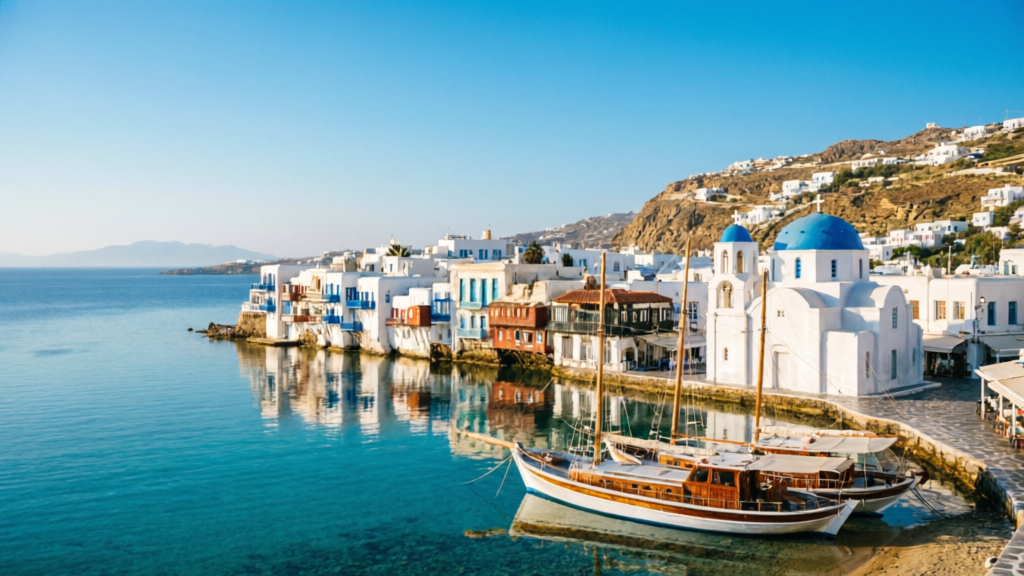
By early afternoon, head to Little Venice if you want the postcard angles, but time it between midday and late afternoon when the tour groups have moved on. The colourful buildings overlooking the water photograph well enough, and the small bars tucked beneath them serve decent drinks without the inflated prices of the main square.
If beaches matter more to you than town, book an independent beach shuttle in advance rather than relying on ship excursions. Popular operators fill quickly during cruise season, and arranging your spot beforehand means you won’t waste hours waiting at the tender office hoping for availability.
🗺️ Tours & Experiences at This Port
Skip the ship’s overpriced excursions — browse top-rated independent tours trusted by thousands of cruise passengers.
History Culture and the Top Sights
Mykonos has almost no history worth your time ashore, which is either liberating or disappointing depending on your perspective. What passes for cultural significance here is mostly twentieth-century reinvention—the island became fashionable in the nineteen-sixties and hasn’t stopped performing ever since. The Archaeological Museum exists and contains Cycladic artefacts, but it’s small, frequently closed for no apparent reason, and honestly requires more effort than most cruise passengers want to expend for modest pottery fragments.
What actually matters is the architecture itself. The whitewashed Cycladic houses with their blue shutters and doors aren’t relics—they’re living neighbourhoods where families still hang washing between buildings and argue about football outside corner shops. The rhythm of ordinary island life is the real attraction, not any particular monument.
Panagia Paraportiani church sits near the waterfront and is worth a brief look for its unusual composite design—it’s actually five churches merged into one structure over centuries. You’ll pass it naturally on your walk anyway. If you want deeper engagement with Cycladic architecture and island traditions, independent operators offer considerably more flexibility and cost less than ship excursions.
Book a guided tour ahead online through independent providers rather than relying on your cruise desk. Good guides fill quickly during cruise season, and you’ll want to secure your spot before arriving at port.
Beyond the Centre: Day Trips and Alternatives
Most cruise passengers remain in Mykonos Town, which means the island’s actual character—quiet beaches, local tavernas, villages where tourism hasn’t steamrollered everything—stays invisible to them. Ship excursions offer poor value and wandering beyond the centre requires confidence and planning, which is why most people skip it entirely.
Hiring a private driver or booking a small-group tour with a local operator beforehand costs considerably less than cruise desk offerings and actually takes you somewhere worth the effort. Ano Mera village inland has a monastery and traditional square that exist for their own reasons rather than to sell overpriced cocktails to tourists. The beaches beyond Mykonos Town are cleaner and cheaper if you want swimming without the social performance—Elia Beach and Paradise Beach each have distinct atmospheres, so you’re simply choosing between athletic and hedonistic.
Ferry connections to neighbouring islands like Delos work if you’re interested in archaeology, though the ruins themselves won’t transform your understanding of anything. Rhenia is quieter and better for a beach day if you can organise transport independently, which usually means asking locals or checking ferry schedules at the port.
Book your guide or driver through established local providers at least a week ahead because reliable operators fill quickly during cruise season, and you don’t want to arrive at port hoping something’s available. Going it alone works perfectly well too—grab a map, take a local bus, eat lunch where you see Greek families rather than tourists, and let the afternoon unfold. That’s when Mykonos actually reveals itself.
Shore Excursion or Going It Alone
The ship excursion desk will pressure you into their organised tour by claiming Mykonos is too chaotic to navigate alone—what they won’t say is that you’ll pay triple what an independent outing costs just to stand in a group wearing a lanyard. The reality is simpler than they suggest: you don’t need to see everything, and wandering without a predetermined route often yields more authentic experiences than following someone else’s schedule.
Start by grabbing a local map from the port information desk, then take the local bus inland to Ano Mera. Eat at the tavernas where the builders eat rather than the tourist-facing restaurants, and you’ve already had a more genuine morning than most cruise passengers manage in a full day. The village square has a monastery and decent food at roughly half the price you’d pay in Town, with no one attempting to upsell you on anything unnecessary.
If you want some guidance without paying ship prices, book a small-group excursion through an independent local operator before you arrive. These spots fill quickly during cruise season, especially for Delos archaeology tours or private driver arrangements, so securing a booking a week ahead online guarantees availability and substantially better rates than the cruise desk offers. The savings alone cover several proper meals elsewhere.
Your confidence level determines the right choice for your situation. You’re entirely capable of managing Mykonos independently, and the island rewards that self-reliance. But if uncertainty genuinely bothers you, a pre-booked local guide removes that friction entirely whilst still costing considerably less than what your ship charges for equivalent access.
🗺️ Tours & Experiences at This Port
Skip the ship’s overpriced excursions — browse top-rated independent tours trusted by thousands of cruise passengers.
The Practical Details That Change Your Day in Mykonos
The car park at the terminal charges rates that seem designed to punish you for existing, and they won’t mention this until after you’ve paid. Skip it entirely—taxis queue outside the gates where drivers will negotiate a flat rate into Town, which beats metered fares without question. Alternatively, booking professional drivers in advance eliminates the negotiation hassle and guarantees transparent pricing.
Mykonos runs on island time, which bears no relation to cruise schedules. Shops stay shuttered until late morning, restaurants ignore lunch requests until well past noon, and everything closes for hours in the afternoon heat. You’ll exhaust yourself trying to see three neighbourhoods badly when you could explore one properly instead.
The restaurants along the waterfront charge London prices for uninspired food, yet cruise passengers pack them because they assume proximity to the harbour means quality. Walk inland two streets and the prices fall while the cooking actually improves—locals avoid the laminated picture menus, and so should you.
Cash is non-negotiable here despite what you might expect. Card payments attract surcharges at smaller places, and the ATMs near the port levy fees that feel punitive. Withdraw what you need early from machines away from tourist areas and you’ll avoid both the charges and the queues.
The beaches near Town are overcrowded, shallow, and disappointing—don’t waste your time there. If swimming appeals to you, the bus journey to Psarou or Paradise is brief enough to make it worthwhile, and the difference in water quality justifies the detour.
Your Port Day: A Sample Itinerary
Port days in Mykonos work best when you ignore the waterfront restaurants and head straight inland through the narrow streets toward the Venetian quarter. This is where you’ll actually see how the town functions rather than how it’s been staged for visitors, with whitewashed buildings, small tavernas where locals eat, and prices that feel reasonable. The waterfront exists mainly to extract money from people who’ve just walked off a ship.
Head away from the crowds by mid-morning and catch transport to Psarou Beach or Paradise Beach, where the water is actually clean and deep enough to swim in properly. The beaches fill up quickly, but they never reach the chaos of Town itself, and you’ll want cash from an ATM rather than relying on card machines that may fail you. Pack only what fits comfortably because you’ll be walking back through town later.
Return to the area around Matoyiannis Street for lunch during the window when restaurants have opened but before the heat peaks and drives everyone inside. Order what people at other tables are eating rather than what’s printed on laminated menus, which always caters to what tourists think they want. This approach actually reveals what food here tastes like when it’s made without compromise.
Late afternoon is when the Venetian lanes become genuinely pleasant to walk through, with the sun turning the light golden and the shops open without the morning crush of other cruise passengers. The town empties out enough that you can actually move through it without constant friction. Time your return to the ship so you’ve spent the best light somewhere other than the terminal.
Independent walking tours booked in advance cost significantly less than what your ship offers and provide actual information about how people live in this place. Popular guides fill up well before the season starts, so you need to arrange this before boarding your ship. You’ll learn far more about the town’s actual structure and history than any shore excursion designed to hit five locations in four hours.
🗺️ Tours & Experiences at This Port
Skip the ship’s overpriced excursions — browse top-rated independent tours trusted by thousands of cruise passengers.
Book your Mykonos day
Tours for this port, compare before you book
Getting around in port
✈️ Before you sail: eSIM, insurance, luggage, flight delays
Ships In Mykonos
Upcoming calls from our sailings tracker, updated regularly.
Odyssey Of The Seas
Royal CaribbeanThu 8 Oct
⚓ 07:00–17:00
Norwegian Pearl
Norwegian Cruise LineFri 9 Oct
⚓ 10:00–22:00
Brilliance Of The Seas
Royal CaribbeanSun 11 Oct
⚓ 07:00–17:00
MSC Divina
MSC CruisesSun 11 Oct
⚓ 14:00–23:30
Norwegian Pearl
Norwegian Cruise LineMon 12 Oct
⚓ 07:00–17:00
Marella Discovery
Marella CruisesMon 12 Oct
⚓ 08:00–17:00