Barcelona Cruise Port Guide
Just discovered the ultimate Barcelona cruise port hack that saves hours and hundreds of euros—but most cruisers never learn it.
In this guide
Try one free personalised day plan — built around your ship’s actual arrival and departure times. Then get every port on your cruise done the same way from £7.99 (about $10).
Staying in Barcelona before or after your cruise? Answer a few quick questions and we’ll point you to the best part of town for you, including flat, step-free options, then show hotels that fit.
Cruise Port Overview: What to Expect
Barcelona is the busiest cruise port in Europe and the Mediterranean, and for most British passengers it is a turnaround port rather than a call — the day you fly in, or the day you fly home, with a few hours to fill either side.
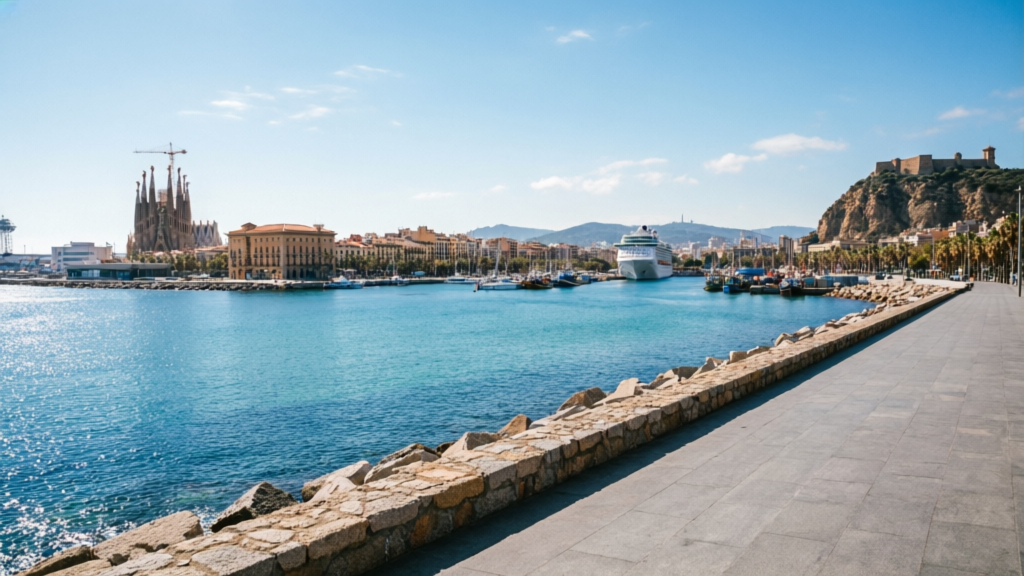
There are two completely different places to tie up, and which one you get decides the shape of your day. Almost all ships now use the Adossat quay (Moll Adossat), a long working spit below Montjuïc carrying terminals A, B, C, D (Palacruceros), E (Helix) and the MSC terminal. It sits roughly 2.5 km from the foot of La Rambla with the commercial port in between, so you do not simply step off and start sightseeing. The exception is the World Trade Center terminal, at the bottom of La Rambla itself, five minutes on foot from the Gothic Quarter. That one is being wound down, with its calls moving across to Adossat. Unless your line tells you otherwise, plan for Adossat.
The other thing that shapes the day is decided at home, not at the gangway. Barcelona’s two biggest sights both run timed entry and both sell out.
Getting From the Port to Town
From Adossat, walking is possible but not advisable. It takes between 30 and 50 minutes depending on which terminal you are at, along a port road built for lorries, with no shade and nothing to look at.
The usual answer is the blue bus, the PortBus, which runs from the Adossat terminals to Portal de la Pau, the square at the Columbus monument at the foot of La Rambla. The crossing takes about ten to fifteen minutes. There is no fixed timetable — it works around ship movements — and it fills quickly in the hour after a big ship opens its gangways, so either go early or let the first surge clear. There is a small charge each way.
Taxis wait at each terminal. The black-and-yellow cabs are metered, there is a port supplement, and the Free Now app works here if you would rather not queue.
Portal de la Pau is where the city starts. Drassanes station on metro line 3 (green) is at the monument, Liceu is halfway up La Rambla, and Passeig de Gràcia (lines 2, 3 and 4) puts you among the Gaudí houses. La Rambla itself runs about 1.2 km from the monument to Plaça de Catalunya — fifteen minutes at a march, half an hour at a proper stroll.
If you are lucky enough to be at the World Trade Center terminal, ignore all of the above and walk.
Turnaround days have a second journey to think about. Josep Tarradellas Barcelona-El Prat is about 15 km south-west of the centre. The Aerobús runs from Terminal 1 and Terminal 2 to Plaça de Catalunya in around 35 minutes, every five to twenty minutes through the day, and it takes cases without fuss. The R2 Nord train leaves from Terminal 2B and reaches Barcelona Sants in about 20 minutes and Passeig de Gràcia shortly after — the quickest option if your hotel is near either. Metro line 9 Sud serves both terminals but does not run into the centre; you change at Collblanc or Torrassa and it works out at roughly 50 minutes to Plaça de Catalunya, so it only makes sense if you are travelling light and unhurried.
The Must-Do Experience: Start Here
The Sagrada Família is the one thing to get right. With its central Tower of Jesus Christ finished and crowned, Gaudí’s basilica is the tallest church in the world, and the interior — a stone forest lit through walls of coloured glass — is the most extraordinary room most people will ever stand in.
It runs on timed entry and it does sell out, often weeks ahead in season. Book direct at sagradafamilia.org as soon as you know your port date, and pick a slot with plenty of daylight either side of it; tickets are non-refundable, so leave yourself room for a late ship. Tower lifts are a separate ticket with their own slot and are worth it for the descent alone.
Getting there from the port: blue bus to Portal de la Pau, metro line 3 to Passeig de Gràcia, then line 2 three stops to Sagrada Família. It is also about a twenty-minute walk from Passeig de Gràcia if the weather is kind. Allow ninety minutes from leaving the metro to being back on it, and more if you have tower tickets.
History Culture and the Top Sights
The Barri Gòtic, the Gothic Quarter, starts immediately east of La Rambla and is free. The cathedral is its centre, with a cloister full of orange trees and thirteen white geese, one for each year of Saint Eulalia’s life. Two hours of unhurried wandering is not wasted; an hour gets you the shape of it.
The Mercat de la Boqueria opens off La Rambla a few minutes above Liceu. It closes on Sundays, and the fish stalls do not trade on Mondays. The stalls nearest La Rambla sell fruit cups to passing tourists; the market proper — and the standing counters where people actually eat — is further back.
Passeig de Gràcia is the Gaudí street. Casa Batlló and La Pedrera stand five minutes apart and both are worth seeing from the pavement even if you do not go in; the facades are the point. Metro Passeig de Gràcia or Diagonal.
The Picasso Museum, in El Born on the other side of the Gothic Quarter, holds his early work across five medieval palaces — the Barcelona years, not the famous ones. Book ahead in season and allow an hour.
El Born, east of the cathedral, is the half of the old city most people miss. Santa Maria del Mar is the reason to go — a fourteenth-century merchants’ church built in fifty-five years flat, which is why it looks all of a piece where the cathedral looks argued over. Around it are the lanes that supplied the medieval port, still named after the trades that worked them.
Modernisme is not only Gaudí. Lluís Domènech i Montaner built the Palau de la Música Catalana in the Born and the Hospital de Sant Pau up beyond the Sagrada Família, and both can be walked round without the crush that surrounds the basilica. Sant Pau is a ten-minute walk from the Sagrada Família straight up Avinguda de Gaudí, which makes it the easiest thing in Barcelona to add to a morning you have already committed to.
Barceloneta is the other easy add. From the Columbus monument the seafront walk runs past the marina and the old fishermen’s quarter to the beach in about twenty minutes on the flat, and it is the one stretch of the city where you are never more than a street from the water.
Montjuïc, the hill above your ship, is the sleeper. The Transbordador Aeri del Port cable car crosses from the Torre Sant Sebastià in Barceloneta to Miramar in about ten minutes, straight over the harbour with your own ship below you. The funicular from Para·lel (lines 2 and 3) is the quicker, duller way up.
Beyond the Centre: Day Trips and Alternatives
Park Güell is the second timed-entry sight. Only the Monumental Zone needs a ticket, booked ahead at parkguell.barcelona; the wooded park around it is free. Metro line 4 to Alfons X or line 3 to Lesseps leaves you a twenty-minute uphill walk, and it is genuinely uphill — a taxi to the entrance is money well spent on a hot day. Allow ninety minutes to two hours all in.
Sitges is the escape if the city feels like too much. Trains on the R2 Sud line run from Plaça de Catalunya’s neighbouring stations — Passeig de Gràcia, Sants or Estació de França — and take between forty minutes and an hour depending on where you board. What you get is a whitewashed seafront town with seventeen beaches and a church on a rock, and no cruise ship in sight.
Montserrat, the monastery on the serrated mountain, is the one to think twice about. The FGC line R5 leaves from Plaça Espanya and takes about an hour to Monistrol de Montserrat, then the rack railway climbs for roughly twenty minutes more. Call it ninety minutes each way before you have looked at anything. On a full turnaround day or an overnight it is one of the great sights of Catalonia; on a seven-hour call it is a fight against the clock, and this is the trip where the ship’s coach and its guarantee start to look sensible. Independent coaches run from the city centre as well and can be booked ahead independently.
Colònia Güell is the Gaudí nobody queues for: a crypt church he built as the test bed for everything he later did at the Sagrada Família, in a mill village on the same FGC network out of Plaça Espanya as the Montserrat train. It is still a working parish church, and you can usually have it to yourself.
Shore Excursion or Going It Alone
Barcelona is one of the easiest large ports in Europe to do under your own steam. The metro is clean, cheap and signposted in three languages, the historic centre is walkable, and the two sights that matter sell their own tickets online to anybody. Booking Sagrada Família yourself gets you a slot you chose rather than the one the coach was given, and usually a longer look at it.
The ship’s tour earns its keep in three situations: Montserrat, where the travel time eats the margin for error; a turnaround day when you are dragging luggage and want it handled; and anyone who would struggle with the walk from the metro at Park Güell or the stairs on the older metro lines.
What is not worth buying is a coach transfer into the centre. The blue bus does the same job for a fraction of it, and the taxi rank is thirty seconds from the terminal door. If you do want a guided day, see what is running in Barcelona on your date and book it direct rather than at the ship’s desk.
Practical Tips: Money, Weather and Timing
Spain uses the euro. Cards work almost everywhere, including on the metro and in most market stalls, and you rarely need much cash for a day ashore. Use a bank’s own machine rather than the independent ones on La Rambla, which offer their own poor exchange rate at the screen.
Pickpocketing in Barcelona is organised, unhurried and very good. It concentrates on La Rambla, the metro between Drassanes and Catalunya, the crowd outside the Sagrada Família and the aisles of the Boqueria. Nothing in a back pocket, bag in front and zipped, phone off the café table. Cruise passengers are the obvious mark because they are the ones standing still and looking up.
Summer is hot and the centre holds the heat; July and August afternoons are genuinely unpleasant on the Gaudí walk, and there is very little shade on Passeig de Gràcia. Public drinking fountains are safe and the tap water is fine. Spring and autumn are the better calls. Sunday changes the city: the Boqueria and many smaller shops close, the churches are busy and the parks are full of families.
Catalan and Spanish are both official; English is widely spoken in the centre. Lunch runs late by British habits and most kitchens do not properly open until two.
Eat the way the city does and you will eat better. Pa amb tomàquet — bread rubbed with tomato, oil and salt — comes with everything and is the local test of a kitchen. Vermut before lunch is a genuine Barcelona habit rather than a tourist one, and Sunday late morning is when it happens. In Barceloneta the thing to order is bombas, and anywhere near the water, whatever came off the boat. Menus in three languages with photographs on them are the ones to walk past.
One note on getting about if walking is difficult: much of the old city is cobbled and stepped, several older metro stations have stairs only, and the climb to Park Güell is steep enough that a taxi to the gate is the sensible call rather than a luxury. The blue bus, the seafront and the Eixample are all flat and straightforward.
Ship wi-fi is slow and charged by the day, and roaming outside your own network can cost more again. A local eSIM data plan arranged before you sail is the cheapest way to have maps, timetables and messaging working the moment you walk down the gangway in Barcelona — and it matters most if you are travelling independently rather than following a guide.
Your Port Day: A Sample Itinerary
Ship alongside early, all aboard in the late afternoon, Sagrada Família booked for the middle of the day. Take the blue bus as soon as you are off, before the rush. Walk up La Rambla to the Boqueria for coffee at a counter, then cut into the Gothic Quarter for the cathedral and the geese. Metro line 3 from Liceu to Passeig de Gràcia, ten minutes with Casa Batlló and La Pedrera, then line 2 to the basilica for your slot. Afterwards, walk back down through the Eixample, or metro straight to Drassanes and the bus.
On a short call, drop the Sagrada Família rather than rush it: Gothic Quarter, Boqueria and the cable car over the harbour to Montjuïc make a better half day than a queue and a sprint.
On a turnaround day with a late flight, leave the cases at the hotel or the terminal, and use the hours for Park Güell or Sitges — both are easier with the whole day than squeezed into a port call.
How do I get from the Barcelona cruise terminal to the city centre?
Do I need to book Sagrada Família tickets in advance?
Is Barcelona an easy cruise port to do independently?
Book your Barcelona day
Tours for this port, compare before you book
Getting around in port
✈️ Before you sail: eSIM, insurance, luggage, flight delays
Ships In Barcelona
Upcoming calls from our sailings tracker, updated regularly.
MSC Seaview
MSC CruisesThu 8 Oct
⚓ 09:00–19:00
Costa Diadema
Costa CruisesFri 9 Oct
⚓ 14:00–19:30
Carnival Freedom
CarnivalFri 9 Oct
⚓ departs 18:30
MSC World Europa
MSC CruisesFri 9 Oct
⚓ 08:00–18:00
Celebrity Equinox
Celebrity CruisesSat 10 Oct
⚓ 05:00–17:00
Sun Princess
Princess CruisesSat 10 Oct
⚓ 06:00–17:00