Ibiza Cruise Port Guide
Learn insider tips for maximizing your Ibiza cruise port day—from avoiding tourist traps to discovering authentic experiences most visitors miss.
In this guide
- Ibiza Cruise Port: Where You Actually Tie Up
- Botafoc to Ibiza Town: Four Options, Timed
- Dalt Vila: The Climb Through the Portal de ses Taules
- What the UNESCO Listing Actually Covers
- Formentera, the Salt Pans and the Beaches You Can Reach
- Ship Tour or Independent: How to Decide at Ibiza
- Ibiza: The Things That Actually Change Your Port Day
- Two Realistic Ibiza Port Days
Try one free personalised day plan — built around your ship’s actual arrival and departure times. Then get every port on your cruise done the same way from £7.99 (about $10).
Ibiza Cruise Port: Where You Actually Tie Up
Ibiza is an alongside port. Large cruise ships berth at the Dique de Botafoc, the breakwater on the eastern arm of the bay, and passengers walk off down the gangway straight onto the quay. There is no tender operation here in normal conditions, no numbered tender tickets and no wait for a launch. Several guides to this port still describe a tender arrival; that is wrong, and it changes how you should plan, because your time ashore begins the moment the gangway opens rather than forty minutes later.
The Botafoc breakwater is a deepwater berth built for large tonnage, and the Balearic Port Authority routes almost all cruise traffic to it. Smaller ships are sometimes given a town-side berth on the Ribera quays, which sit directly opposite the old town. Which of the two you get makes a difference of roughly three kilometres on foot, so check the berth printed on your daily programme before you decide whether to walk anywhere.
Cruise traffic has risen sharply, and the Port Authority staggers arrival times deliberately so that passengers do not all come ashore in the same hour. On the busiest days of the season three ships share Botafoc, two large vessels inside the dock and one smaller ship on the breakwater itself. Botafoc is the physical constraint on any further growth, and the approach road, the Passeig d’Ibosim, carries all of that traffic.
The terminal building itself is modest: a hall, toilets, a taxi rank outside the door and a coach apron for tours. Do not plan to spend time in it. The useful geography is elsewhere. Talamanca beach lies about 1.2 km north along the shore, and Ibiza Town’s old quarter lies across the water to the south-west. Independent shore excursions collect from the same quay apron as the ship’s own coaches, a few metres from the gangway.
Botafoc to Ibiza Town: Four Options, Timed
Walking. From the Botafoc terminal to the centre of Ibiza Town is about 3 to 3.5 km by road, a walk of 35 to 45 minutes. To the Portal de ses Taules, the main gate of the old town, it is nearer 3.8 km and the final section climbs. The route follows the Passeig d’Ibosim round the head of the bay past the Marina Botafoc moorings. It is a road walk rather than a seafront promenade. It is perfectly possible, but it costs you an hour and a half of a short call, there and back.
The water shuttle. A small passenger boat crosses the bay from a jetty roughly 200 m from the terminal building and lands on the town quay beside the Estacio Maritima, a crossing of about 15 minutes with regular departures from each side. That is comfortably the quickest way in, and it puts you within about 400 m of the Portal de ses Taules. It is a seasonal cruise-day service run by a local boat operator rather than a guaranteed port facility, so confirm at the terminal desk that it is running on your date before you count on it for the return leg.
The ship’s shuttle bus. Most lines run a coach from the quay to a drop-off on the town waterfront. It is the slowest option when the bay road is busy, but it is the only transfer your ship is obliged to wait for, which is the argument for using it on the way back.
Taxi. There is a metered rank immediately outside the terminal. The drive round the bay takes 8 to 12 minutes in ordinary traffic and longer when three ships are in. Ibiza’s taxi supply is tight in summer: getting one at the quay is easy, getting one back from town on a busy afternoon is not, so plan the return around the boat or the ship’s bus.
If your ship has been given a Ribera berth instead, ignore all of the above. The Portal de ses Taules is then a walk of roughly 600 m, five to ten minutes, straight across the Mercat Vell square, and the Formentera ferry terminal is closer still.
Dalt Vila: The Climb Through the Portal de ses Taules
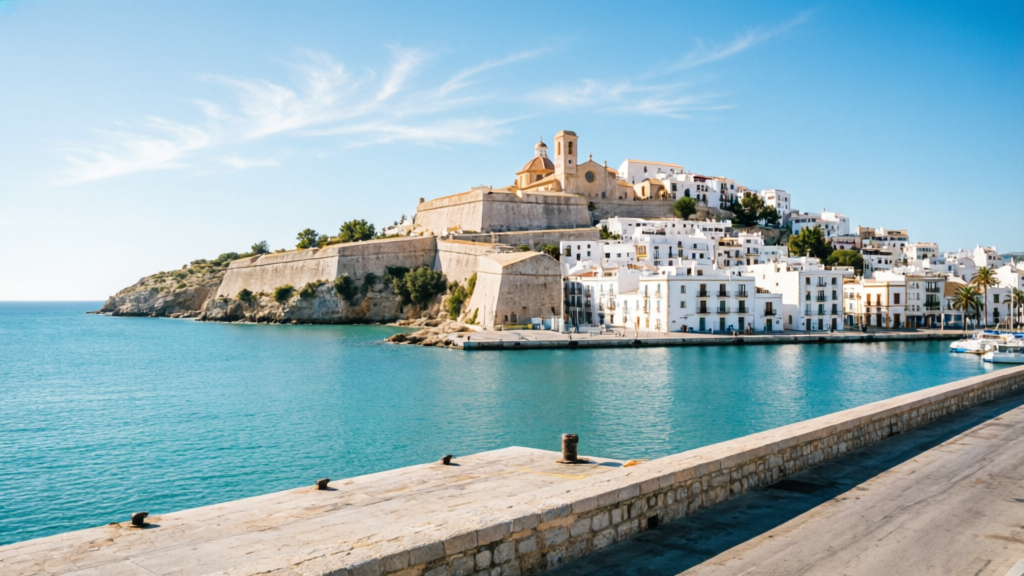
Dalt Vila is the fortified upper town on the hill above the harbour, and it is the one thing at this port that repays a whole day. You enter it the way everyone has entered it since the sixteenth century, through the Portal de ses Taules.
The approach starts at the Mercat Vell, the old market at the edge of the Marina district. A stone ramp rises across a ravelin, the detached triangular outwork built to absorb artillery fire, then crosses a drawbridge and passes under the gate arch. Two Roman statues stand in niches either side of the passage; they are copies, and the originals are held by the Museu Arqueologic d’Eivissa i Formentera inside the walls. The complete circuit of bastioned walls was built between 1554 and 1585 to an Italian and Spanish military design, and it is one of the most complete Renaissance defensive systems surviving anywhere in the Mediterranean.
Above the gate the route opens into the Placa de Vila and then climbs by cobbled lanes and flights of steps to the summit, where the Cathedral of Santa Maria d’Eivissa and the castle stand together. Gate to cathedral is roughly 700 m of walking on a continuous gradient; allow 20 to 25 minutes at a steady pace and longer in July or August heat. Surfaces are worn stone and cobble throughout and there are steps on most routes, so this is the physically demanding part of an Ibiza port day rather than an afterthought tacked onto a beach.
Walk the bastions, not only the streets. The rampart circuit runs a little over two kilometres round seven bastions, and the Baluard de Santa Llucia on the seaward side gives the clearest view down onto the harbour, the Botafoc breakwater and your own ship. The Museu Arqueologic sits beside the cathedral and holds the Punic material excavated from Puig des Molins, which is the context for almost everything else you will see on the island.
🗺️ Tours & Experiences at This Port
Skip the ship’s overpriced excursions — browse top-rated independent tours trusted by thousands of cruise passengers.
What the UNESCO Listing Actually Covers
Ibiza was inscribed on the World Heritage List in 1999 as Ibiza, Biodiversity and Culture. It is a mixed listing, cultural and natural together, entered under criteria ii, iii, iv, ix and x, and it covers 9,020 hectares, most of which is sea rather than land. Most port guides shorten this to “Dalt Vila is UNESCO”, which leaves out three quarters of what was actually listed.
There are four components. First, the Posidonia oceanica meadows in the channel between Ibiza and Formentera, dense seagrass prairies endemic to the Mediterranean and the reason the water on that crossing has the clarity it does. Second, Sa Caleta on the south coast, the remains of the first Phoenician settlement on the island, occupied in the eighth century BC and abandoned when the population moved to the hill that is now Dalt Vila in the sixth century BC. Third, Puig des Molins, the Punic necropolis on the slope behind the old town, more than five hectares of burial ground holding over 5,000 graves and declared a National Monument in 1931. Fourth, the fortifications of Dalt Vila themselves, built between 1554 and 1585 and declared a National Monument in 1942.
Puig des Molins is the component most cruise passengers walk straight past. It lies on the hillside immediately south-west of the walls, within about fifteen minutes on foot of the cathedral, and it is the largest and best preserved Punic cemetery in the western Mediterranean. Like most state museums in Spain it observes a weekly closing day, so if you are calling on a Monday, check before you build your morning around it.
The wider chronology is worth carrying with you as you climb. Phoenician foundation in the eighth century BC, the move to the hill in the sixth, Roman municipal status granted under Vespasian in AD 70, the Catalan conquest in 1235, and then the Renaissance rebuilding of the defences in the sixteenth century. Dalt Vila sits on top of all of it, which is why its street plan makes no immediate sense.
Formentera, the Salt Pans and the Beaches You Can Reach
The best day trip from Ibiza is Formentera. The crossing is 11 nautical miles, roughly 20 km, and the fast ferries cover it in about 30 minutes to La Savina, Formentera’s only ferry port. Four operators work the route, Balearia, Trasmapi, Aquabus and Formentera Lines, with frequent sailings between them in season, so the timetable is rarely the limiting factor.
The limiting factor is the geography of your own port. Formentera ferries leave from the Estacio Maritima on the town side of the bay, not from Botafoc. A Formentera day from a Botafoc berth therefore runs: transfer across the bay, 15 to 25 minutes; ferry out, 30 minutes; your actual time on Formentera; ferry back, 30 minutes; transfer back, 15 to 25 minutes. That is around two and a half hours of moving before you have stood on a beach. It works comfortably on a call of ten hours or more and it is tight on anything shorter. Ses Illetes, the beach most visitors want, is about 4 km north of La Savina, so budget for a scooter, a taxi or the pier shuttle bus on top of the crossing. Neither end of this trip involves a tender, which is the one thing working in your favour.
Closer in, the Ses Salines natural park protects the salt pans at the southern tip of the island together with the sea between Ibiza and Formentera. The saltworks have been in production since Phoenician times and still ship salt today. The beach of Ses Salines lies at the end of the park road about 10 km south of Ibiza Town, with Es Cavallet on the far side of the point. Sa Caleta, the Phoenician site named in the UNESCO listing, is roughly 15 km by road on the same southern coast, beyond the airport.
For beaches inside a port day the realistic list is short. Talamanca is about 1.2 km on foot from the Botafoc quay, flat the whole way, sandy and shallow, and it is the only beach you can genuinely walk to from the ship. Figueretes is about 1 km south-west of Dalt Vila. Platja d’en Bossa, the island’s longest beach, runs for roughly 2.7 km and begins about 3 km south of the town. The famous west and north coast coves are a different proposition: Cala Comte is about 22 km away and Benirras about 30 km, which on a short call means a booked Ibiza island day tour with a fixed return time rather than a hire car and optimism.
Ship Tour or Independent: How to Decide at Ibiza
At most ports this argument is about money. At Ibiza it is about the bay. Ship excursions board from the coach apron on the Botafoc quay, a few metres from the gangway, and they return to the same apron. Anything you book yourself has to solve the three-kilometre transfer across the bay twice, and that transfer is the part of the day most likely to go wrong when three ships are alongside and the taxi rank has emptied.
The rule of thumb is straightforward. If your plan stays in Ibiza Town, meaning Dalt Vila, the archaeological museum, Puig des Molins, the Marina streets and lunch on the quay, book independently and use the water shuttle or the ship’s bus. If your plan leaves the island or crosses it, look hard at a tour that starts on the quay, because what you are buying is the two bay transfers and a guaranteed return.
Wind matters more here than at most Mediterranean ports. Botafoc’s exposure has been studied specifically as a cruise berthing problem. The breakwater sits on the open eastern side of the bay, and a strong easterly levante can affect berthing and small-boat movements, which is precisely when the bay shuttle stops running and everybody falls back on taxis. In winter the tramuntana from the north has the same effect. If the forecast is windy, take the ship’s transfer and stop thinking about it.
Two practical points on independent booking. Check the operator’s cancellation terms against your own arrival, because a cruise itinerary can change at short notice and a berth can be swapped. And check where the tour actually starts: a large share of Ibiza tours are written for hotel guests and pick up at Platja d’en Bossa or Sant Antoni, which is no use to you at Botafoc unless you have arranged to meet them in town.
🗺️ Tours & Experiences at This Port
Skip the ship’s overpriced excursions — browse top-rated independent tours trusted by thousands of cruise passengers.
Ibiza: The Things That Actually Change Your Port Day
The club scene is largely irrelevant to you. Ibiza’s superclubs run a season that opens around late April or May and closes in the first half of October, and they operate at night. A ship calling in daylight finds shuttered doors. The big venues are also not where you are: Ushuaia and Hi face each other across the road at Platja d’en Bossa, about 3 km south of the town and beside the airport approach, while Pacha is the only one of the famous names actually in Ibiza Town. Treat the island’s reputation as background rather than as an itinerary.
The season cuts both ways. From November to April a large share of Sant Antoni and Platja d’en Bossa simply closes: hotels, beach bars and many restaurants. Ibiza Town and Dalt Vila stay open all year because people live in them, which is another reason a winter or shoulder-season call should stay in the old town rather than chase a beach that will be shut.
The names change on the signs. Catalan is the local language and official signage uses it. Eivissa is Ibiza, Sant Antoni is San Antonio, Santa Eularia is Santa Eulalia, Sant Josep is San Jose. Your map app may show one spelling and the bus destination board the other. They are the same places.
Dalt Vila is a physical morning. Cobbles, worn stone, steps and a continuous gradient of roughly 700 m from the gate to the cathedral. Wear shoes with grip. If steps are a problem, plan the wall circuit and the Placa de Vila rather than the summit.
Museums keep a weekly closing day. Spanish public museums commonly close one day a week, usually Monday. If Puig des Molins or the archaeological museum is the point of your day, verify it before you sail.
Money and signal. Spain is in the European Union and uses the euro. There is no separate Balearic currency and no cash-only rule worth worrying about; cards work normally. A local eSIM data plan is still worth arranging before you sail if your phone plan does not cover Spain, because the bay shuttle and the Formentera timetables are both things you will want to check from the quay.
Two Realistic Ibiza Port Days
Both plans assume a Botafoc berth and an alongside arrival with no tender, so your clock starts at the gangway rather than in a queue on deck.
Plan A, the old town day. First 20 minutes: walk out of the terminal and take the bay shuttle from the jetty 200 m away, or the ship’s bus if the boat is not running that day. Next 15 minutes: the crossing, landing on the town quay. From there it is about 400 m on the flat to the Mercat Vell and the ramp up to the Portal de ses Taules. Give yourself two hours inside the walls: the gate and its ravelin, the climb of roughly 700 m to the cathedral, the archaeological museum beside it, and the bastion circuit of a little over two kilometres with the Santa Llucia viewpoint for the harbour. Come down the south-west side to Puig des Molins, about fifteen minutes’ walk, for the Punic necropolis. Eat in the Marina or Sa Penya streets below the walls, allow 45 minutes to get back to the jetty, and you are aboard with margin.
Plan B, the Formentera day. Only attempt this on a call of ten hours or more. Cross the bay in the first half hour, walk to the Estacio Maritima, and take the first practical fast ferry: about 30 minutes to La Savina. On arrival, sort transport at the pier straight away, because Ses Illetes is 4 km north and walking it in summer heat is a mistake. Give yourself three hours on the island, then reverse the whole sequence and add a full hour of buffer, because 30 minutes of ferry plus up to 25 minutes of bay transfer is not a margin you can compress if a sailing is full.
The half-day variation. On a call of six hours or less, do not leave the bay at all. Walk the 1.2 km to Talamanca beach from the quay, or take the shuttle across for two concentrated hours in Dalt Vila and nothing else. A pre-booked guided walking tour of the fortifications is the efficient use of a short call, because it removes the navigation and puts the 1554 to 1585 building programme into order for you while you climb.
Whichever you choose, the two facts that shape an Ibiza day are the same. You berth alongside, and you are three kilometres of water away from the thing you came to see.
Book your Ibiza day
Tours for this port, compare before you book
Getting around in port
✈️ Before you sail: eSIM, insurance, luggage, flight delays
Ships In Ibiza
Upcoming calls from our sailings tracker, updated regularly.
Norwegian Dawn
Norwegian Cruise LineFri 9 Oct
⚓ 12:30–22:30
Norwegian Escape
Norwegian Cruise LineSat 10 Oct
⚓ 12:30–22:30
Sun Princess
Princess CruisesSun 11 Oct
⚓ 12:30–22:00
MSC Seaview
MSC CruisesWed 14 Oct
⚓ 11:30–23:00
MSC Explora 1
MSC CruisesMon 19 Oct
⚓ 12:00–23:55
MSC Seaview
MSC CruisesWed 21 Oct
⚓ 11:30–23:00