Valletta Cruise Port Guide
The ultimate guide to maximizing your Valletta cruise port day—discover secrets locals don’t want tourists to know.
In this guide
- Valletta Cruise Port: Pinto Wharf and the Grand Harbour
- From the Quay to the City: The Lift, the Climb and the Buses
- Start Here: The Bastion, the Salute and St John’s
- The Knights, the Siege and the Sights That Repay the Time
- Day Trips: Three Cities, Mdina, Marsaxlokk and the Blue Grotto
- Ship Excursion or Independent: How to Decide
- Ten Valletta Details Worth Knowing Before You Step Off
- Your Port Day: A Worked Valletta Itinerary
Try one free personalised day plan — built around your ship’s actual arrival and departure times. Then get every port on your cruise done the same way from £7.99 (about $10).
Valletta Cruise Port: Pinto Wharf and the Grand Harbour
Ships berth at Valletta Cruise Port along Pinto Wharf, the working quay behind the Valletta Waterfront promenade. The first thing most guides get wrong is the address: the terminal stands in Floriana, not in Valletta. The port has seven berths and 2,117 metres of quay – Deep Water Quay at 488 m, LAB Wharf at 443 m, Boiler Wharf at 383 m, Quays 1-2 at 307 m, Quays 4-5 at 252 m, Quay 3 at 171 m and the 73 m Wine Wharf. The longest of them take vessels up to 360 m, so on a heavy day four or five ships line the same front and your gangway can land anywhere across roughly two kilometres of waterfront. Where you dock changes every walking figure below by several minutes, so check the quay name on your daily programme before you plan anything.
The row of honey-coloured warehouses you step out into is the Pinto Stores, built in 1752 for Grand Master Manuel Pinto de Fonseca to a baroque design attributed to Andrea Belli. They are a Grade 1 national monument and now hold shops, bars and the Magazino Hall terminal, rated to clear over 1,000 passengers an hour. It is flat, shaded in parts and pleasant enough, but it is not Valletta and nothing of historic substance is on it beyond the facades themselves.
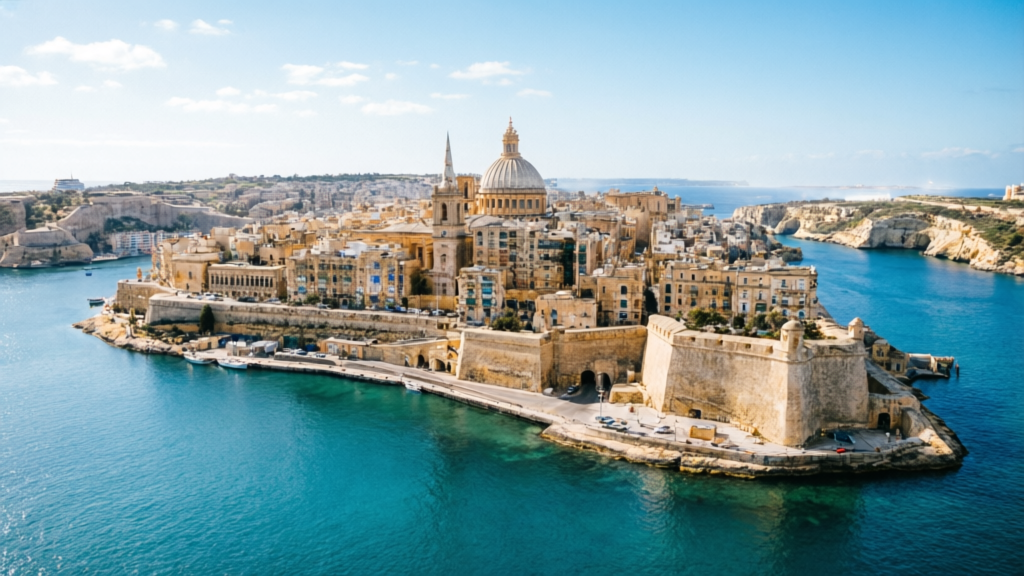
Valletta sits above you. The old city occupies a peninsula of 0.61 sq km with a population of 5,226, and its street grid was laid out from 1566 by the military engineer Francesco Laparelli on high ground behind bastion walls. That means every route from the quay into the centre involves climbing roughly 58 metres of vertical, either on foot or in the lift described in the next section.
Malta uses the euro, adopted in 2008, and English is an official language alongside Maltese, so no translation or currency hunt is needed. Traffic drives on the left. Valletta was listed by UNESCO in 1980 and holds 320 scheduled monuments inside 0.55 sq km, which is why a six or seven hour call can cover a genuinely serious amount of ground. If you want a structured half day rather than a wander, booking guided tours and tickets before you sail is worth doing, because the small-group slots on a heavy cruise day go first.
From the Quay to the City: The Lift, the Climb and the Buses
This is the single most useful thing to know in Valletta, and almost every port guide muddles it. The Barrakka Lift does not start at your ship. Its lower station is on Lascaris Wharf, a separate quay 300 to 500 metres along the waterfront from the Valletta Waterfront berths – five to eight minutes on the flat, heading towards the harbour mouth and Fort St Elmo with the water on your right. Get that wrong and you will stand at the end of Pinto Wharf looking for a lift that is around the corner.
Once you reach it, the lift is the best 58 metres of transport in Malta. It runs two cabins carrying 21 passengers each, moves up to 800 people an hour, and the ride takes about 23 seconds. It puts you out on the upper tier of St Peter and Paul Bastion, directly beside the Upper Barrakka Gardens, which is the top of the city. From that doorway you are already inside Valletta – Castille Place and Republic Street are a few hundred metres ahead on level ground.
If you would rather walk, the route from the Waterfront to City Gate is 1.2 to 1.5 km and takes 15 to 30 minutes depending on your berth and pace. It is a steady uphill gradient with no shade for most of it, which in July and August is a serious proposition rather than a stroll. Taking the lift up and walking down at the end of the day is the sensible order.
Public buses do serve the quay. A circular bus leaves the Valletta terminus, calls at the Waterfront stop between the Pinto and Kurcifiss stops, and returns. Another circular route is the useful one once you are up top: it links the ferry quays with the centre of Valletta. There is no free cruise shuttle at Valletta; a taxi booking office on the promenade sells transfers at set rates, and the drive to the city centre takes about seven minutes. If you want a car and driver held for the whole call rather than queuing twice, arranging professional drivers ahead of the day removes the gamble.
Start Here: The Bastion, the Salute and St John’s
Walk the 300 to 500 m to Lascaris Wharf, ride the lift, and start at the Upper Barrakka Gardens. The terraced arches were put up in 1661 by the Italian knight Fra Flaminio Balbiani on a bastion built in the 1560s, and the gardens have been open to the public since 1800, at the end of the two-year French occupation. Entry is free. From the parapet you look straight down onto your own ship, across to the Three Cities and over the shipyard, and fifteen minutes here gives you the harbour geography that makes the rest of the day make sense.
Directly below the terrace, on the lower tier of the same bastion, is the Saluting Battery – eight working replica SBBL 32-pounders, installed in 2011 as part of a restoration begun in 2004. A gun is fired twice a day, every day except Sunday. You can watch from the garden parapet above without paying, or go down onto the gun platform itself.
Then walk 400 m along Merchants Street or Republic Street to St John’s Co-Cathedral. Here is the critical planning fact: it is closed to visitors on Sundays and public holidays. A large share of cruise calls at Valletta fall on a Sunday, and guides that tell you to head there first never mention it. If your call is on a Sunday, restructure the day around the Grandmaster’s Palace and Fort St Elmo instead.
When it is open, the visit is exceptional. The church was built between 1572 and 1577 to a design by Girolamo Cassar for Grand Master Jean de la Cassiere, and was consecrated on 20 February 1578. The floor is a continuous carpet of inlaid marble tombstones covering around 400 knights and officers of the Order. One more rule that catches people out: stiletto and narrow heels are not allowed, to protect that floor, and shoulders must be covered. The entry fee includes a handheld audio guide with 20 stops in 11 languages.
🗺️ Tours & Experiences at This Port
Skip the ship’s overpriced excursions — browse top-rated independent tours trusted by thousands of cruise passengers.
The Knights, the Siege and the Sights That Repay the Time
Valletta was founded on 28 March 1566 by Grand Master Jean Parisot de Valette, the year after the Great Siege of 1565. Laparelli died in 1570 and his assistant Girolamo Cassar finished the job, which is why the city is a rectangular grid dropped onto a rocky spine – easier to defend, and the reason the cross streets run downhill in flights of steps.
The two Caravaggios in St John’s Co-Cathedral are the single most important thing to see in Malta, and they are not in the nave. Both hang in the Oratory, off the side of the church. The Beheading of Saint John the Baptist, painted in 1608, is the largest canvas Caravaggio ever produced and the only work he signed – his signature runs in the blood spilling from the Baptist’s throat. Beside it is Saint Jerome Writing, from 1607-08. Allow 20 minutes in that room alone; most visitors give it five and walk out having missed the signature.
The Grandmaster’s Palace on Republic Street is the sight that outdated guides handle worst. It was shut to the public for years for a restoration costing over 40 million euro, 18 million of it co-financed by the European Union, and has since reopened. The Palace Armoury has been moved back into its original 1605 home in the former parliament chamber, and the state halls, the Piano Nobile corridors and the courtyards are open again.
At the tip of the peninsula, about 1 km from City Gate, Fort St Elmo holds the National War Museum. The fort dates from 1552, built over a watchtower recorded on the site in 1488, and it is where the 1565 siege was decided. The museum runs from Bronze Age material through to the Second World War. Closer to the centre, the National Museum of Archaeology occupies the Auberge de Provence on Republic Street and covers the megalithic temple period, which predates the Knights by more than 4,000 years.
Day Trips: Three Cities, Mdina, Marsaxlokk and the Blue Grotto
The easiest escape is the Three Cities – Vittoriosa (Birgu), Senglea (Isla) and Cospicua (Bormla) – directly across the Grand Harbour. The Grand Harbour ferry runs from Lascaris Wharf to Cospicua in about 10 minutes, roughly every 30 minutes at peak times. Two details worth having: a personalised tallinja card carries you free, and a ticket on the Cospicua service includes a free ticket for the Barrakka Lift, which means the return leg back up into Valletta is covered. A free shuttle also links the Marsamxett and Lascaris wharves, timed to ferry arrivals. By land, local buses from the Valletta terminus reach the Three Cities in 15 to 20 minutes.
Mdina, the walled hill town that was Malta’s capital until the Order moved to Birgu in 1530, is the best inland trip. Take a bus to Rabat from the Valletta terminus; several routes go there and the run takes 30 to 45 minutes depending on traffic. You are set down in Rabat and walk across to the Mdina Main Gate, rebuilt under Grand Master Vilhena’s renovation programme begun in 1722. Mdina has a resident population of 242, which is why it is called the Silent City. Its St Paul’s Cathedral was rebuilt by Lorenzo Gafa between 1697 and 1703 after the 1693 Sicily earthquake brought down the 13th-century building.
The Blue Grotto sits on the south-west coast at Wied iz-Zurrieq. A bus from the Valletta terminus takes about 30 minutes; get off at the Panorama stop and walk 10 minutes downhill to the inlet. Boats into the cave system run daily, weather permitting, and each trip lasts around 20 minutes. Two honest warnings: the boats stop when the sea gets up, which happens often between November and March, and the blue light only works with the sun low and in front of the caves, so an afternoon visit can be a wasted journey.
Marsaxlokk is the fishing village of painted luzzu boats, reached by bus from Valletta in 50 to 55 minutes. The day of the week decides what you get: the large fish market on the seafront runs on Sundays, when the catch is sold straight off the quay, while every other day of the week the stalls are a tourist and souvenir market and the fish goes to Marsa instead. The village has 4,206 residents, so outside Sunday it is quiet. If you would rather have the transport and the timings handled, the day trips running from Valletta cover all four of these, and comparing them against the excursions listed here is worth five minutes before you commit.
Ship Excursion or Independent: How to Decide
Valletta is one of the easier Mediterranean ports to do alone, because the lift solves the only real obstacle in about 23 seconds. If your plan is the old city – Upper Barrakka, St John’s, the Grandmaster’s Palace, Fort St Elmo, the Three Cities ferry – you do not need an excursion at all. Every one of those is within 1 km of the lift’s upper station or a 10 minute boat ride away.
The calculation changes once you leave the peninsula. Mdina is 30 to 45 minutes each way by bus, the Blue Grotto is 30 minutes plus a 10 minute walk, and Marsaxlokk is 50 to 55 minutes on a route with more than 40 stops. For anything that combines two or more of those in one call, an organised tour or a private driver is the safer choice on timings alone.
The hop-on hop-off option is City Sightseeing Malta, which runs North and South routes; the Valletta Waterfront is one of its stops and doubles as a voucher redemption point, so you can board at the quay without going into the city first. It suits a first visit where you want to see the island’s shape rather than any one site in depth. It does not suit a short call, because a single loop eats most of a port day.
Two practical points that apply whichever route you pick. First, the Barrakka Lift is a permanent fixture and the Grand Harbour ferry is a regular service, so ignore any guide that describes the lift as a project or the ferry as seasonal. Second, build a buffer: if your ship is on Boiler Wharf or LAB Wharf rather than alongside the Waterfront, the walk back to the gangway is longer than the one you made in the morning.
🗺️ Tours & Experiences at This Port
Skip the ship’s overpriced excursions — browse top-rated independent tours trusted by thousands of cruise passengers.
Ten Valletta Details Worth Knowing Before You Step Off
One. The lift is at Lascaris Wharf, 300 to 500 m along the front from the cruise berths, not at your gangway. Two. St John’s Co-Cathedral is closed to visitors on Sundays and public holidays – check what day your call falls on before you build the itinerary around it. Three. Stiletto and narrow heels are banned inside the cathedral to protect the 400 marble tombstones in the floor, and shoulders must be covered, so carry a light scarf.
Four. The two Caravaggios are in the Oratory, a side room, not in the main nave – people do walk the church and leave without seeing them. Five. St John’s has no visitor bell tower climb. If a guide tells you to go up for harbour views, it is describing somewhere else; the views you want are free from the Upper Barrakka parapet.
Six. The Saluting Battery does not fire on Sundays. On every other day there are two salutes. Seven. A ticket on the Cospicua ferry includes a free Barrakka Lift ticket, so do the Three Cities in the morning and your ride back up is already paid for. Eight. The Grandmaster’s Palace is open again after a restoration of more than 40 million euro, with the Armoury returned to its 1605 chamber; older guides list it as closed.
Nine. Marsaxlokk’s fish market is Sunday only. Go on a Tuesday and you get a souvenir stall run, not the thing in the photographs. Ten. The Gozo Fast Ferry also leaves from Lascaris Wharf, takes about 45 minutes each way, but it carries foot passengers only – and 90 minutes of sailing plus onward transport makes Gozo a poor bet on a single port call unless you are in Malta overnight.
🗺️ Tours & Experiences at This Port
Skip the ship’s overpriced excursions — browse top-rated independent tours trusted by thousands of cruise passengers.
Your Port Day: A Worked Valletta Itinerary
This assumes a berth on the Valletta Waterfront and a call of around seven hours. Adjust the first leg if your ship is on Boiler Wharf or LAB Wharf, which adds several minutes each way.
Leave the ship and turn along the promenade towards the harbour mouth, with the water on your right. Walk the 300 to 500 m to Lascaris Wharf – five to eight minutes, flat – and take the Barrakka Lift. The ride is 23 seconds and lands you beside the Upper Barrakka Gardens. Spend 15 minutes on the parapet: your ship is below you, the Three Cities are opposite, and the whole day’s geography reads at a glance. The Saluting Battery is on the tier below, firing twice a day except on Sundays.
Walk 400 m along Republic Street to St John’s Co-Cathedral, assuming your call is not a Sunday or a public holiday. Budget 60 to 75 minutes: 20 of those belong in the Oratory with The Beheading of Saint John the Baptist and Saint Jerome Writing. The audio guide with its 20 stops is included and worth using.
Continue 250 m up Republic Street to the Grandmaster’s Palace for the state halls and the Armoury in its restored 1605 chamber – 45 to 60 minutes. From there it is about 1 km to the end of the peninsula and Fort St Elmo with the National War Museum, if the 1565 siege and the 1940-42 bombing interest you; if not, cut back down through the side streets, which is where the residential city actually is.
For the afternoon, take the ferry from Lascaris Wharf to Cospicua – 10 minutes across, roughly every half hour – and walk the waterfront of Vittoriosa and Senglea. The Three Cities predate Valletta and were the Order’s first base from 1530, and the harbour views back towards the bastions are the best in Malta. Your ferry ticket covers the Barrakka Lift on the way back.
Return to the top of the lift with at least 90 minutes in hand. Ride down, walk the 300 to 500 m back along Lascaris Wharf to the Waterfront, and you are at the ship with time to spare.
🗺️ Tours & Experiences at This Port
Skip the ship’s overpriced excursions — browse top-rated independent tours trusted by thousands of cruise passengers.
Book your Valletta day
Tours for this port, compare before you book
Getting around in port
✈️ Before you sail: eSIM, insurance, luggage, flight delays
Ships In Valletta
Upcoming calls from our sailings tracker, updated regularly.
Azura
P&O CruisesThu 8 Oct
⚓ 06:00–21:00
Celebrity Equinox
Celebrity CruisesMon 12 Oct
⚓ 09:00–19:00
MSC World Europa
MSC CruisesWed 14 Oct
⚓ 08:00–17:00
Carnival Freedom
CarnivalThu 15 Oct
⚓ 07:00–16:00
Fred Olsen Balmoral
Fred OlsenMon 19 Oct
Costa Deliziosa
Costa CruisesWed 21 Oct
⚓ 08:00–18:00