Palermo Cruise Port Guide
Insider tips for maximizing your Palermo cruise port visit—skip the tourist traps and discover what locals actually do.
In this guide
- Palermo Cruise Port: Where You Actually Dock
- Getting From the Terminal Into Palermo
- Start With the Cappella Palatina
- Arab-Norman Palermo and the Nine UNESCO Buildings
- Monreale, Mondello and the Catacombs
- Ship Excursion or Independent: How to Choose
- Palermo Practicalities Worth Knowing Before You Dock
- A Worked Palermo Port Day
Try one free personalised day plan — built around your ship’s actual arrival and departure times. Then get every port on your cruise done the same way from £7.99 (about $10).
Palermo Cruise Port: Where You Actually Dock
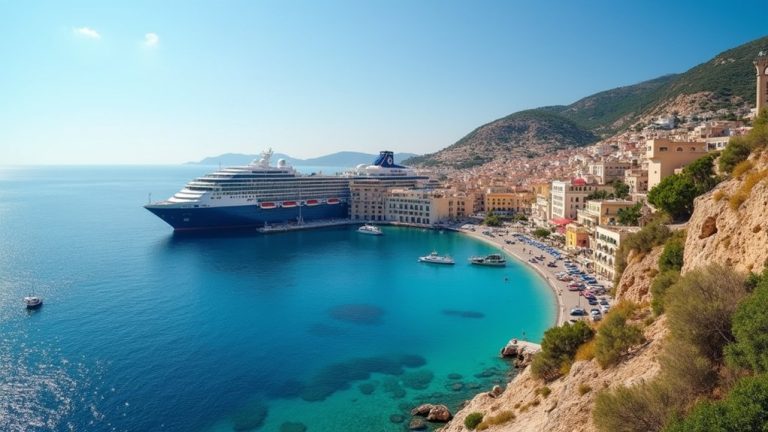
Palermo has two cruise terminals, both run by West Sicily Gate, a joint venture between Costa Cruises and MSC Cruises. The older one is Cruise Terminal Vittorio Veneto, converted from the former maritime station. Its south berth takes ships up to 300 m long in 9 m of water; the north berth handles vessels over 340 m in more than 12 m of water. The second is Cruise Terminal Sammuzzo, the newer of the two, on the Sammuzzo quay: 378 m of berth, 9 m depth, a 7,750 sq m apron and a 1,300 sq m terminal building with six security lanes, sized for up to 8,000 passengers a day.
Which one you get depends on your ship and on how many others are in. Palermo handles close to a million cruise passengers a year, and on a three-ship day you will be sharing the same 1.8 km of street with 10,000 people, so the order you do things in matters more than the list itself.
Both terminals sit on the northern side of the commercial port and discharge onto Via Francesco Crispi, the dual carriageway that runs along the waterfront. There is no hill: Palermo’s old town is flat from the quay to the Palazzo dei Normanni, 2.6 km away.
If your day is short, fix the two or three buildings you care about before you dock rather than deciding on the quay. Timed entry to the Cappella Palatina and organised runs to Monreale fill up in cruise season, and booking Palermo shore excursions and guided walks from home removes the gamble on availability once you are ashore.
Getting From the Terminal Into Palermo
The walk is genuinely simple but it is not ten minutes, whatever other guides tell you. From the terminal gate you cross Via Francesco Crispi and go straight up Via Emerico Amari, roughly 700 m of arrow-straight street, to Piazza Castelnuovo and the Teatro Politeama. Turn left into Via Ruggero Settimo and it is about 500 m more to Piazza Verdi and the Teatro Massimo. Carry on into Via Maqueda and another 500 m brings you to the Quattro Canti. That is about 1.8 km from ship to crossroads, or 22 to 25 minutes at an unhurried pace.
Keep going and the numbers stay small. Quattro Canti to Palermo Cathedral along Corso Vittorio Emanuele is about 400 m. The Cathedral to the Palazzo dei Normanni and Piazza Indipendenza is another 350 m. So the full spine of the old city, quay to royal palace, is 2.6 km and about 35 minutes on foot, all of it level and all of it on pavement.
An AMAT city bus runs from the Crispi/Scinà stop on the waterfront down to Cala Mercato Ittico at the old harbour in around 13 minutes. Tickets are sold at tobacconists and through the MyAmat app, not by the driver, and they run for 90 minutes including changes. Taxis rank at both terminals.
Do not plan around the tram. Palermo’s tram network serves the suburbs and does not touch the historic centre or the port. The suburban railway is more useful: its Palazzo Reale–Orleans station, opened in tunnel in 2001, puts you beside the Norman palace, and the same line runs out to Punta Raisi for the airport.
Start With the Cappella Palatina
If you see one thing in Palermo, make it the Cappella Palatina on the first floor of the Palazzo dei Normanni, 2.6 km and about 35 minutes from the ship. Roger II commissioned it in 1132, soon after he was crowned king of Sicily. The transept mosaics were laid by Byzantine craftsmen in the 1140s and the scheme was still being added to in the 1160s and 1170s; a Christ Pantocrator fills the dome.
The ceiling is the part people are not ready for. It is a painted muqarnas vault of Fatimid type, built from wooden components between 1 and 1.5 cm across, glued and bound into five horizontal tiers and 20 eight-pointed stars. A Christian king’s chapel, roofed by Muslim carpenters, walled by Greek mosaicists, inside an Arab emir’s palace. That single room explains Norman Sicily better than any museum label.
Two practical warnings. The Royal Apartments upstairs, including the Sala di Ruggero with its hunting mosaics, share the building with the Sicilian Regional Assembly and are shut to visitors on the days it sits, so the chapel is the only part you can count on. And entry is by timed slot in season. Book it before you sail; the queue at the Piazza Indipendenza gate can swallow a third of your port day.
🗺️ Tours & Experiences at This Port
Skip the ship’s overpriced excursions — browse top-rated independent tours trusted by thousands of cruise passengers.
Arab-Norman Palermo and the Nine UNESCO Buildings
In 2015 UNESCO inscribed Arab-Norman Palermo and the Cathedral Churches of Cefalù and Monreale as a single World Heritage site of nine components. Seven are in Palermo: the Royal Palace with the Palatine Chapel, the Zisa, Palermo Cathedral, San Giovanni degli Eremiti, Santa Maria dell’Ammiraglio (the Martorana), San Cataldo and the Admiral’s Bridge. The eighth is Monreale Cathedral, 7 km south-west; the ninth is Cefalù Cathedral, 70 km east along the coast. Every one of them dates from the Norman kingdom of 1130 to 1194.
Five of the seven Palermo components sit inside a 1 km box either side of the Quattro Canti, so a walking day covers most of the list. The Martorana and San Cataldo share Piazza Bellini, 100 m from the crossroads: the Martorana for Greek mosaics, San Cataldo for three bare red domes and an interior stripped back to stone. San Giovanni degli Eremiti and its five domes stand 200 m beyond the Palazzo dei Normanni. The Zisa, a summer palace begun under William I and finished under William II around 1175, is the outlier at about 2.3 km west of Quattro Canti.
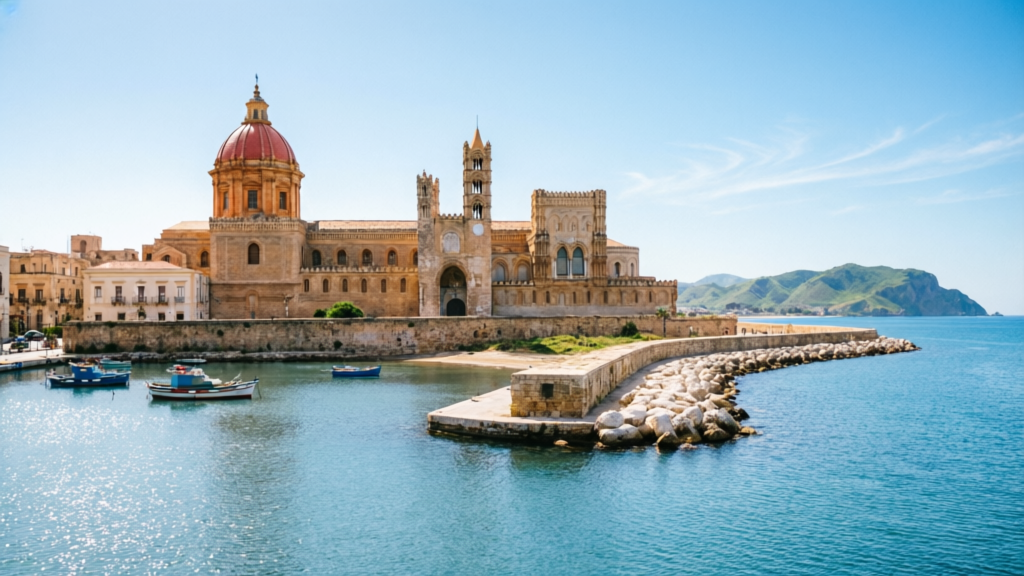
Palermo Cathedral is the one that confuses people, because it looks like four buildings arguing. Walter Ophamil founded it in 1185 on a site that had been a Byzantine basilica and then, after the ninth-century Arab conquest, a mosque; a Qur’anic inscription still survives on one of the portico columns. The dome and much of the interior are a remodelling of 1781 to 1801, to Ferdinando Fuga’s designs, carried out by Giuseppe Venanzio Marvuglia. Inside are the porphyry tombs of Roger II, Constance, Henry VI and Frederick II. The nave is free; the royal tombs, the crypt, the treasury and the roof walk are ticketed separately. On the floor runs a meridian line laid in 1801 by Giuseppe Piazzi, the astronomer who discovered Ceres, fed by a pinhole in one of the minor domes.
The Teatro Massimo is worth the 500 m detour from Quattro Canti even if you never go inside. Construction began on 12 January 1875 to Giovan Battista Filippo Basile’s design and was finished by his son Ernesto; it opened on 16 May 1897 with Verdi’s Falstaff. At 7,730 sq m it was the third largest opera house in Europe when it opened and is still the largest theatre in Italy, with 1,381 seats over seven tiers of boxes. It then shut in 1974 for safety works and stayed shut for 23 years, reopening on 12 May 1997. Guided tours run between rehearsals.
Monreale, Mondello and the Catacombs
Monreale is the day trip that repays the effort. William II founded the cathedral between 1174 and 1176, and its interior carries 6,340 sq m of gold-ground mosaic across roughly 130 panels, most of it executed between 1183 and 1189. The apse Pantocrator is 7 m tall and 13.3 m wide, with a head over 3 m high and a right arm spanning 7 m. Next door, the Benedictine cloister is a 47 by 47 m square ringed by 228 paired columns, no two capitals alike.
Getting there independently is easier than most guides suggest. An AMAT city bus to Monreale leaves from Piazza Indipendenza, beside the Palazzo dei Normanni, and runs up Corso Calatafimi through the day. The ride is 30 to 40 minutes depending on traffic. The Monreale terminus is the roundabout where Via Palermo meets Via Benedetto d’Acquisto; from there it is 300 m and about five minutes uphill on Via Palermo to the cathedral square. Monreale sits at 310 m on Monte Caputo, which is why the bus is slow and why walking up from Palermo is not a plan. Budget three hours door to door from the ship, including the 2.6 km walk to Piazza Indipendenza.
Mondello is 14 km from the port by road, round the far side of Monte Pellegrino. A seasonal AMAT bus runs from Piazza Crispi, on Via della Libertà about 2.3 km from the terminal, to Valdesi and the Mondello seafront in around 30 to 35 minutes, running frequently through the summer. Read that carefully: it is a summer service, and outside its season the direct link to Mondello has been withdrawn in the past, leaving a two-bus combination through the suburbs. Check it is running before you build a day around it. The beach is about 2 km of pale sand, most of it under lido concession with only one or two small free stretches; the pavilion on stilts, the Antico Stabilimento Balneare, dates from 1913.
The so-called free summer shuttles at Mondello and Sferracavallo are free only for Palermo residents, under-12s, over-65s and disabled passengers. Everyone else pays. Plenty of guides list them as a free ride for visitors; they are not. The third option out of the centre is the Catacombe dei Cappuccini at Piazza Cappuccini 1, entrance on Via Pindemonte, 1.8 km and about 25 minutes west of Quattro Canti, or 1 km from the Palazzo Reale–Orleans railway station. The first friar was laid there in 1599; a 2011 EURAC census counted about 8,000 bodies, 1,252 of them mummified, sorted into corridors for monks, men, women, professionals and children. The site officially closed in 1880 but exceptions continued into the twentieth century, the last in 1939. Rosalia Lombardo, embalmed by Alfredo Salafia after her death in December 1920 just short of her second birthday, is at the end. If the walk is too much in July heat, book the Monreale run or a catacombs slot before you sail.
Ship Excursion or Independent: How to Choose
Palermo is one of the easier Mediterranean ports to do alone, because the whole UNESCO core is within 2.6 km of the gangway on flat ground with no tender. If your plan is the Cathedral, Quattro Canti, the Martorana, Ballarò and the Cappella Palatina, you do not need a coach and you do not need a guide to find any of it. Walk out, follow Via Emerico Amari, and you are at the Politeama in 700 m.
The calculation changes the moment you leave the centre. Monreale by bus costs you a 2.6 km walk to Piazza Indipendenza, a wait at the stop, a 30 to 40 minute ride, the 300 m climb at the far end and the same again coming back; miss one bus and the wait for the next eats into your day. Cefalù, 70 km east, is a train from Palermo Centrale and realistically a full day. If Monreale and the catacombs are both on your list, or if you are back on board early, a booked transfer is the sensible answer rather than a point of principle.
Independent operators sell the same Monreale and catacombs itineraries as the ship, usually in smaller groups, but they carry no obligation to hold the ship if you are late. Ship excursions do. If your all-aboard is tight, that difference is worth more than anything else on the comparison. You can weigh up guided tours and shore excursions before you sail and see what the timings look like against your own call.
One more variable: on a heavy call day the Cappella Palatina, the Cathedral roof walk and the catacombs all run on timed entry, and ship excursions hold blocks of those slots. Booking direct, well ahead, is the only reliable way to get a morning slot as an independent.
Palermo Practicalities Worth Knowing Before You Dock
Go to Ballarò, not the Vucciria. The Vucciria, around Piazza Caracciolo between Via Roma and Corso Vittorio Emanuele, is still named as Palermo’s great market in most cruise guides. By day it is now a handful of stalls and shuttered fronts; its life is at night, as a drinking quarter. The working markets are Ballarò, in the Albergheria quarter behind the Palazzo dei Normanni, the oldest of the three and the closest to an Arab souk, and Il Capo, entered through the Porta Carini about 700 m from Quattro Canti. Both trade Monday to Saturday and both wind down through the afternoon, so a ship sailing in the late afternoon should hit them first, not last.
Dress code is enforced. The Cathedral, the Cappella Palatina, the Martorana and Monreale all require covered shoulders and knees, and stewards turn people away. On a 35°C August day that means carrying a scarf or a light layer, not buying one at the door.
Cards are widely accepted. Italian law obliges retailers to accept card payment, and the market stalls, bars and ticket desks generally do. Carry some cash for a granita or a fruit stall, but the old advice that Palermo is cash-only is a decade out of date. Tickets for AMAT buses, however, really are sold off the bus, at tobacconists or through the app.
The heat is the real constraint. Palermo sits at 38° north on a south-facing coast, and July and August afternoons regularly sit in the mid-30s with the sirocco pushing them higher. The historic centre has almost no shade between Quattro Canti and Piazza Indipendenza. Do the outdoor walking early, save the Cappella Palatina, the Cathedral crypt or the catacombs for the hottest part of the day, and refill at the public fountains rather than buying water on Via Maqueda.
Watch the surface, not the traffic. Much of the old town is laid with basalt slabs polished by four centuries of use, and they are slick after rain. Scooters use the pedestrian streets. Neither is a reason to stay on the ship, but trainers beat sandals here.
🗺️ Tours & Experiences at This Port
Skip the ship’s overpriced excursions — browse top-rated independent tours trusted by thousands of cruise passengers.
A Worked Palermo Port Day
Step one, off the ship and straight up Via Emerico Amari. Cross Via Francesco Crispi, walk the 700 m to Piazza Castelnuovo, turn left down Via Ruggero Settimo for 500 m and you are at the Teatro Massimo in Piazza Verdi. Twenty minutes from the gangway, and you have already passed the two grandest nineteenth-century buildings in the city.
Step two, Via Maqueda to the Quattro Canti. Another 500 m south. Piazza Vigliena, to give it its proper name, was cut between 1608 and 1620 for the Spanish viceroys by Giulio Lasso and Mariano Smiriglio, and it splits the walled city into its four historic quarters. Each of the four concave faces is stacked in tiers: a fountain of one of the four seasons at the bottom, finished by 1630; a Spanish king above, added between 1661 and 1663; and one of Palermo’s four female patron saints, Christina, Ninfa, Oliva and Agata, at the top. Piazza Pretoria and Piazza Bellini, with the Martorana and San Cataldo, are both within 100 m.
Step three, Corso Vittorio Emanuele to the Cathedral. Four hundred metres west along the street Palermitans call the Cassaro. Walk the nave and the meridian line, then decide whether the tombs and the roof are worth the ticket on your timetable.
Step four, the Palazzo dei Normanni. Three hundred and fifty metres further, with your timed slot for the Cappella Palatina already booked. Allow 45 minutes inside. Piazza Indipendenza, where the Monreale bus leaves, is directly outside if you are going on.
Step five, Ballarò and back. The market starts about 300 m behind the palace, in the Albergheria. Eat there: panelle, crocchè, sfincione and arancine are all made in front of you. From Ballarò it is roughly 2.2 km back to the terminal, around 30 minutes, or pick up the city bus at the old harbour. Work backwards from all-aboard and give yourself a 45-minute cushion. That is a full Palermo day, on foot, with four of the nine UNESCO components seen properly rather than photographed from a coach window.
🗺️ Tours & Experiences at This Port
Skip the ship’s overpriced excursions — browse top-rated independent tours trusted by thousands of cruise passengers.
Book your Palermo day
Tours for this port, compare before you book
Getting around in port
✈️ Before you sail: eSIM, insurance, luggage, flight delays
Ships In Palermo
Upcoming calls from our sailings tracker, updated regularly.
Costa Smeralda
Costa CruisesThu 8 Oct
⚓ 08:00–16:00
Marella Discovery 2
Marella CruisesThu 8 Oct
⚓ 09:00–16:00
Costa Pacifica
Costa CruisesFri 9 Oct
⚓ 08:00–16:00
Arcadia
P&O CruisesFri 9 Oct
MSC Meraviglia
MSC CruisesFri 9 Oct
⚓ 09:00–18:00
MSC Seaview
MSC CruisesMon 12 Oct
⚓ 11:00–20:00