Valencia Cruise Port Guide
How can cruise passengers escape tourist traps and experience authentic Valencia while maximizing their limited port time?
In this guide
Try one free personalised day plan — built around your ship’s actual arrival and departure times. Then get every port on your cruise done the same way from £7.99 (about $10).
Cruise Port Overview: What to Expect
Valencia’s cruise port sits several kilometres from the city centre, so you’ll need to arrange transport the moment you disembark. The shuttle bus or a taxi will get you there, but either option eats into your budget for what’s essentially a short journey.
The port terminal itself is modern and functional, with clear signage and staff who speak enough English to help you navigate. Once you leave the building, the real work begins because Valencia sprawls across a considerable area rather than clustering around a compact centre. The city breaks into distinct neighbourhoods separated by genuine distance, which means aimless wandering will consume most of your port day.
The benefit of this sprawl is that you won’t be fighting shoulder-to-shoulder with other cruise passengers the moment you step ashore. The drawback is that you need a concrete plan before you leave the terminal, or you’ll spend hours figuring out which way to go. The city bus network offers your best solution—it’s cheap, runs frequently, and requires far less negotiation than taxis or relying on ship transport. Consider booking guided tours and shore excursions in advance to maximize your limited time at port and ensure you experience Valencia’s highlights without wasting hours on logistics.
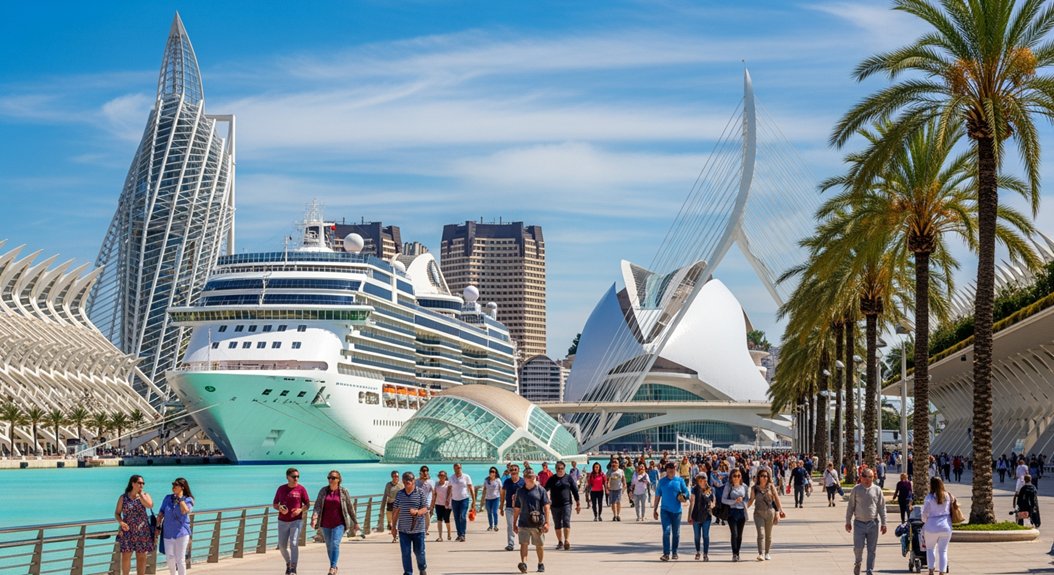
Most people gravitate towards the City of Arts and Sciences complex because it dominates the skyline and actually justifies the trip. From there, everything else—the old town, the beach, the paella restaurants—spreads outward like spokes on a wheel. If you know this layout before you arrive, you can make realistic decisions about what to see rather than wandering in circles.
Getting From the Port to Town
Public transport from the port is cheaper than a taxi and spares you from haggling or standing around. The nearest bus stop is roughly a ten-minute walk from the terminal—staff will point the way—and the ride into the city centre takes around half an hour, depending on traffic. Buy a single ticket or day pass, get on, and watch the suburbs pass while you sit down.
Taxis charge moderate, metered fares, but you’ll spend considerably more than the tram to go essentially the same route. The cruise line runs its own shuttle service to the city centre, which eliminates decision-making but costs significantly more and bundles you with dozens of other passengers. Unless handling public transport alone genuinely worries you, the shuttle makes no sense financially.
The bus network works better than the alternatives because it’s affordable, runs reliably, and gets you close to where you actually want to go. Buses from the port area head towards the old town and the City of Arts and Sciences, and the two are linked by bus as well. Most cruise passengers complicate this unnecessarily and pay extra for convenience they simply don’t require.
The Must-Do Experience: Start Here
Most cruise passengers spend their morning queuing for the City of Arts and Sciences when the old town is where actual Valencia exists. The futuristic complex is impressive enough, but it swarms with tour groups by mid-morning and charges more than warranted for what amounts to walking around outside buildings. Your time ashore is limited, so the medieval streets, working tapas bars, and everyday life of Valencia are elsewhere.
Start at the Cathedral in the old town, reachable by bus or taxi from the port. Inside you’ll find what the Valencia clergy insist is the Cup of the Holy Grail, and the building itself merits an hour of proper looking around. The plazas and narrow streets surrounding it show you the Valencia where residents actually spend their time, not the version designed for postcards.
The Turia Gardens come next—an unusual linear park built on the old riverbed after the city diverted the Turia following the catastrophic flood of 1957. This green corridor runs through the entire city and costs nothing to walk, and you’ll encounter actual residents rather than the concentrated cruise passenger crowds elsewhere. Spend an hour here, grab lunch from a café in a residential neighbourhood rather than the tourist area, and you’ll understand why people choose to live in Valencia.
If you have time left, book an independent walking tour of the old town in advance since the good ones fill up quickly with cruise passengers and typically undercut what the ship charges while delivering better local knowledge and smaller groups.
🗺️ Tours & Experiences at This Port
Skip the ship’s overpriced excursions — browse top-rated independent tours trusted by thousands of cruise passengers.
History Culture and the Top Sights
Valencia’s history is a sequence of Mediterranean power struggles layered into its streets. You walk through Moorish, Christian and modern Spanish identities simultaneously, with each era leaving architectural marks on the stone that you can read if you know what to look for.
The Cathedral functions as a physical record of conquest rather than simply a religious building. Each expansion and alteration tells you something about who controlled the city at that moment and what they valued enough to build.
The Torres de Serrano and Torres de Quart sit at opposite ends of the old town, functioning as reminders of how seriously Valencia defended itself during the medieval period. Climbing the Serrano tower orients you to the entire city layout without the queues at the City of Arts and Sciences, and the effort involved is minimal.
The Barrio del Carmen shows you medieval Valencia as locals actually use it rather than as a performed spectacle for visitors. Narrow lanes open onto small plazas where people gather for ordinary reasons, and the church of Santa Catarina demonstrates simple, proportionate design with mixed Gothic and Renaissance elements that reveal exactly when different sections were constructed.
Book an independent walking tour before you arrive because guide quality varies significantly and the competent ones fill weeks ahead. A worthwhile guide explains why Valencia’s history matters—the silk trade connections, paella origins, the complicated political relationship with Madrid—rather than simply directing your attention at buildings and moving forward.
Beyond the Centre: Day Trips and Alternatives
Paying for a ship excursion to the Turia Gardens or City of Arts and Sciences means spending significantly more money and losing half your time to waiting for other passengers. The genuine benefit of arranging things yourself is control—you set the pace and leave when you’re finished rather than being corralled back to the coach at someone else’s convenience. Valencia’s public transport runs reliably enough that you don’t need a guided tour unless you actually want historical explanation.
If you only care about seeing the white futuristic buildings and the parkland where the river once ran, local buses or a taxi will get you there for far less than a cruise line charges. You’ll have real time to walk around without pressure to keep moving. Where this approach fails is context—if you want to understand what makes Valencia matter beyond photographs, book an independent walking tour beforehand focusing on either the Turia Gardens transformation or the old town.
Independent guides cost substantially less than cruise lines charge and their slots fill weeks in advance with cruise passengers. Someone who can explain how Valencia converted nine kilometres of urban space from a concrete riverbed into parkland gives you information that wandering alone simply cannot provide. Your choice ultimately depends on whether convenience and crowds matter to you more than spending less and controlling your own schedule—either way you’ll see what you came to see.
🗺️ Tours & Experiences at This Port
Skip the ship’s overpriced excursions — browse top-rated independent tours trusted by thousands of cruise passengers.
Shore Excursion or Going It Alone
The ship’s excursion desk will pitch their organised tour to the City of Arts and Sciences, emphasising travel time as a reason to book with them. What they won’t tell you is that arriving early on your own means fewer people around, and you can spend two hours there or stay all day without worrying about when the coach leaves.
Going solo offers more than just savings, though skipping the cruise line markup does mean real money in your pocket. The genuine advantage is controlling your own schedule—you arrive when crowds are thinner and leave when you’ve seen what matters to you, rather than moving through on a tour operator’s timeline with thirty other passengers.
The trade-off is that you need to sort your transport and any guided experience in advance. Popular independent walking tours fill up quickly, especially slots reserved for cruise passengers with limited shore time. Booking an online guide weeks before departure costs substantially less than the ship’s price and locks in your place, which beats discovering on the dock that everything’s booked out.
Your comfort level with independent travel is the real deciding factor. If you’re confident navigating unfamiliar streets and reading transport maps, you’ll manage well on your own. If having someone explain what you’re looking at while you walk makes the experience easier, booking an independent guide beforehand solves both the cost issue and gives you the structure you want.
🗺️ Tours & Experiences at This Port
Skip the ship’s overpriced excursions — browse top-rated independent tours trusted by thousands of cruise passengers.
Small Things That Make a Difference in Valencia
The cruise terminal sits too far from anything worth visiting, which means the ship’s transport markup for getting into the city centre feels less like a rip-off and more like a genuine logistical problem you actually need to solve.
Book a shared shuttle or arrange a private driver through an online platform weeks before you sail. This costs a fraction of what the ship charges, leaves whenever you’re ready, and you avoid being herded onto a vehicle with fifty other passengers. Consider booking professional airport transfers to ensure reliable transportation at competitive rates. The local metro works too if you’ve got time, though buying a travel card at the station and walking from the terminal to the stop eats into hours most cruise passengers don’t have.
Ignore the official port map. Download offline maps on your phone instead, because the printed version leaves out half the useful routes and cafés, and your phone signal will be patchy in older neighbourhoods. Wear genuinely comfortable shoes because the old town’s cobbled streets are deceptive, and the climb to the cathedral will punish anything with a heel.
Arrive before mid-morning. The City of Arts and Sciences is far less crowded at nine than at half-past ten, and the museums have shorter queues. Eat your main meal at lunch rather than dinner—restaurant prices in evening tourist areas cost considerably more than they should, whereas lunchtime menus in neighbourhood spots offer genuine value.
Leave your valuables on the ship and carry only what fits in one pocket or a small crossbody bag. Petty theft targets distracted tourists with expensive cameras and dangling bags, and you won’t enjoy anything if you’re constantly checking your belongings.
Your Port Day: A Sample Itinerary
Valencia changes completely depending on when you arrive at the City of Arts and Sciences. Getting there early means you’ll move through the spaces without constantly sidestepping other people, while arriving mid-morning puts you in a crowd that makes photography and simple observation harder.
Take a bus or taxi from the terminal to the complex and spend enough time there to actually see what you’re looking at. Two hours lets you move through without that compressed feeling of rushing between exhibits, and you’ll notice architectural details that vanish when you’re moving at crowd pace.
Walk back through the old town after mid-morning and stop in a neighbourhood café away from the cathedral area for coffee. The pastries cost almost nothing, and you’re sitting where locals sit rather than in a space designed specifically for tourists. The old streets themselves reveal how the city actually functions once you step off the main commercial routes.
Lunch should be in Ruzafa, which costs substantially less than eating near the centre and where the food reflects what people actually want to eat. Ask anyone working in your café where they go—these recommendations lead you to places where your money translates into genuine quality rather than convenience markup.
Your afternoon can split between the Cathedral if you want the climb or the Central Market if you prefer to watch how a city actually sources its food and supplies. The market costs nothing to walk through and shows you infrastructure rather than scenery. If you have energy left and decent light, the Turia Gardens run back towards the terminal, and there’s no need to rush the metro journey—you’ve built in enough time that missing your ship isn’t a reasonable concern.
🗺️ Tours & Experiences at This Port
Skip the ship’s overpriced excursions — browse top-rated independent tours trusted by thousands of cruise passengers.
Book your Valencia day
Tours for this port, compare before you book
Getting around in port
✈️ Before you sail: eSIM, insurance, luggage, flight delays
Ships In Valencia
Upcoming calls from our sailings tracker, updated regularly.
MSC Orchestra
MSC CruisesSat 10 Oct
⚓ 07:00–18:00
MSC Explora 1
MSC CruisesSun 11 Oct
⚓ 09:00–19:00
Norwegian Dawn
Norwegian Cruise LineTue 13 Oct
⚓ 07:00–16:00
Marella Explorer
Marella CruisesFri 16 Oct
⚓ 08:00–17:00
MSC Orchestra
MSC CruisesSat 17 Oct
⚓ 07:00–18:00
MSC Orchestra
MSC CruisesSat 24 Oct
⚓ 07:00–18:00