Trieste Cruise Port Guide
Uncover hidden gems and authentic experiences in Trieste that cruise guides won’t tell you about—discover what locals know.
In this guide
Try one free personalised day plan — built around your ship’s actual arrival and departure times. Then get every port on your cruise done the same way from £7.99 (about $10).
Cruise Port Overview: What to Expect
Trieste’s main cruise terminal stands within walking distance of the city centre, which creates an immediate problem: the old town becomes impassable whenever a ship docks. Thousands of cruise passengers flood the narrow streets simultaneously, transforming what could be a quiet exploration into a crowded scramble for pavement space.
What saves Trieste is that it functions as a real city rather than a tourist construct. The Austro-Hungarian architecture carries a genuine weight—grey facades and grand boulevards that feel lived-in rather than preserved. The working harbour around your berth, complete with operating cranes and stacked containers, reinforces that this is a place with purposes beyond accommodating visitors.
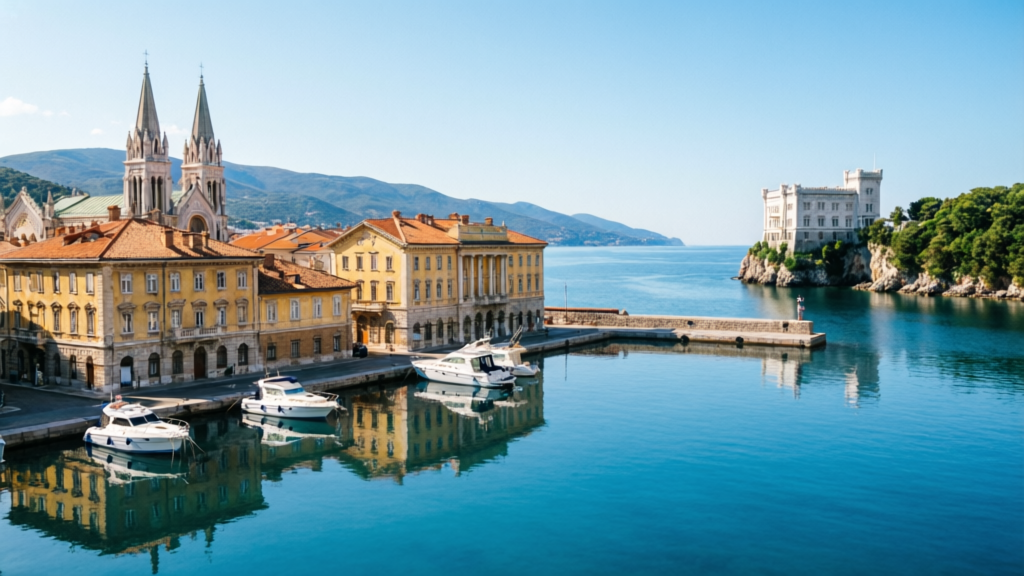
Navigation is straightforward because the city layout follows a logical grid. Most attractions cluster within reasonable walking distance, with the seafront stretching north-west towards Miramare Castle and the historic centre rising on steep terraces inland from the water. The hills demand proper footwear; casual shoes will leave you regretting the gradient by mid-morning. Consider booking guided excursions at ports in advance to maximize your limited time ashore and avoid the peak crowds.
Your actual constraint is a combination of time and sheer volume of other people. The window for shore exploration is narrow, which means you need to plan what matters to you and move without hesitation toward it. Independent walking tours that operate outside the main cruise passenger channels fill quickly, so arranging these in advance matters more than it should.
Getting From the Port to Town
The terminal sits right on the waterfront, a few steps from Piazza Unità d’Italia, so the walk to town takes almost no time. You’ll reach the Molo Audace and the seafront promenade straight away, and the old town entrance lies just behind the square. Most people find walking more practical than waiting for a taxi, even though cabs queue by the terminal.
The waterfront promenade offers a straightforward route into the centre—flat, wide, and less congested than the narrow streets above where cruise passengers tend to congregate. You orient yourself to the city’s layout as you walk, which matters if you have limited hours ashore and want to move with purpose rather than circling back on yourself. The harbour edge gives you a genuine sense of how the city sits rather than the disorienting effect of plunging straight into the old town’s maze.
Local buses run from near the terminal if you prefer not to walk, though you need change or the ability to navigate the ticket machines beforehand. The system functions reliably and costs little, but for a first visit with restricted time ashore, walking simply gets you where you need to be without the friction. You won’t waste effort deciphering routes or waiting for departures.
Booking a guided walking tour with a local operator before you sail costs considerably less than the ship’s excursion desk and moves at a proper pace rather than herding large groups through streets. These independent guides direct you to cafés where coffee costs normal money instead of the inflated rates on the main tourist strips. Popular tours fill during peak season, so arrange this in advance rather than hoping for availability once you’re aboard.
The Must-Do Experience: Start Here
Most cruise passengers squander their first hour in Trieste working out directions when they could be standing on the Molo Audace watching the city materialise across the water. The waterfront is where Trieste’s geography actually makes sense—the old town‘s cramped streets will only confuse you with collisions and lost perspective. Walk the promenade at a proper pace before heading inland, and you’ll grasp how the city nestles between the harbour and limestone hills.
The actual character emerges once you slip into the neighbourhood behind the seafront, where residents genuinely live and eat rather than perform for visitors. A coffee at a local bar costs half what you’ll pay on the tourist strips, and it tastes like something rather than generic espresso. The architecture here mixes Habsburg palaces with Austro-Hungarian shop signs—a Central European quality that most ports lack entirely.
If you prefer structure to wandering, book an independent walking tour with a local operator before your cruise arrives. These tours move at realistic speeds, undercut the ship’s pricing substantially, and guides steer you toward actual restaurants instead of tourist traps. Popular tours fill weeks in advance during busy seasons, so securing your spot online means arriving in port with a confirmed time rather than gambling on last-minute slots.
🗺️ Tours & Experiences at This Port
Skip the ship’s overpriced excursions — browse top-rated independent tours trusted by thousands of cruise passengers.
History Culture and the Top Sights
Trieste’s greatest historical irony is that this Habsburg port‘s most important sight sits in a museum across the border, yet what remains in the city itself tells a far more honest story about Central European identity than any postcard could.
The Cathedral of San Giusto dominates the old town’s highest point and dates from the fourteenth century, though its real power lies in the view across the Adriatic rather than the frescoes inside. Climb up through the warren of medieval streets—they’re genuinely cramped, so go early before tour groups solidify into human traffic jams. Standing outside costs nothing and delivers the same geographical revelation as paying to enter the basilica itself.
The Castello di Miramare sits on the coast just beyond the centre and represents what happens when an Austrian archduke decides he wants a seaside residence. The interior furnishings and gardens offer genuine insight into nineteenth-century aristocratic taste, though the castle attracts considerably more organised groups than the cathedral. Book an independent guided tour that includes transport beforehand—ship excursions charge considerably more for identical experiences, and local operators know which rooms the crowds skip.
Back in town, the Museo Revoltella houses Italian art and Habsburg-era portraiture in a neoclassical palace, and it’s mercifully quiet compared to the waterfront. You’ll spend perhaps an hour here without feeling rushed, and admission costs considerably less than what the cruise lines suggest for their cultural tours. This is where you actually understand Trieste’s historical position as a bridge between worlds rather than simply observing its architecture from outside.
Beyond the Centre: Day Trips and Alternatives
The ship excursion to the Karst Plateau charges roughly double what independent booking costs, yet delivers you to the same viewpoints with the same crowds. This represents where cruise line markups waste your money most efficiently—you’re paying for convenience you don’t actually need.
The limestone terrain inland is genuinely different from coastal architecture, but reaching it requires transport and local knowledge about which caves, villages and wine regions warrant your time. Independent operators running small-group tours provide reliable transport and spend time in actual working villages rather than tourist-filtered stops. These tours cost considerably less than cruise line pricing, fill up quickly for single port days, and you can reserve online rather than hoping for terminal availability.
The coastal towns northward toward Slovenia go largely unvisited by cruise passengers simply because they demand slightly more effort to reach independently. Monfalcone and Aquileia contain Roman archaeology and medieval quietness that Trieste’s waterfront lost years ago. Local taxis and regional trains connect these towns affordably, though you must plan your return carefully to avoid missing the ship—there’s no structured timeline here, so your schedule depends entirely on your own organisation.
The practical reality: Trieste’s hinterland offers more than the city itself, but only if you arrange transport beforehand. Ship excursions provide convenience at premium cost. Independent tours deliver better value and actual local insight. Either way, book in advance—popular Karst tours regularly sell out for cruise passengers with limited shore time.
Shore Excursion or Going It Alone
The cruise terminal sits a few steps from Piazza Unità, so there is no need to join a shuttle queue. Walking to the waterfront takes barely any effort and avoids the wait entirely, though you need to know where you’re heading before you leave the terminal—wandering around wastes the limited time you have on shore.
The tourist information office near Molo Audace handles straightforward questions adequately, but the staff operate on ship schedules rather than your interests. Plan anything beyond a basic waterfront stroll before you arrive, because last-minute research won’t happen there. Independent tour operators pick passengers up directly from the terminal, which skips the shuttle entirely and gets you moving while most people are still deciding where to get coffee.
The Euro works here like everywhere else in Europe now, but restaurants close to the terminal charge roughly double what you’d pay in the rest of Trieste. Walk inland a few minutes and prices return to normal. The seafood is genuinely worth eating when you find somewhere that hasn’t redesigned its menu specifically for cruise passengers, which is rare enough that local knowledge matters far more than any guidebook.
Your phone will work fine with data roaming active, though the terminal’s public WiFi moves slowly enough that asking someone in person is faster. Save offline maps to your phone before you dock. The single most useful thing you can do is arrange your transport or book a tour the night before you arrive, because how smoothly your day goes depends almost entirely on whether you’ve sorted logistics in advance.
🗺️ Tours & Experiences at This Port
Skip the ship’s overpriced excursions — browse top-rated independent tours trusted by thousands of cruise passengers.
Trieste: Practical Details Worth Reading Twice
The cruise terminal’s location right by the main square is its greatest advantage. Most passengers never get past the overpriced cafés on the waterfront, which lets you slip into the real city. Locals know this, which is why the neighbourhoods beyond the terminal’s immediate radius feel genuinely untouched by cruise tourism.
Your biggest tactical mistake would be lingering near the waterfront unless you have a specific reason to be there. The Austro-Hungarian architecture along the harbour is handsome enough, but you’ll spend half your time dodging other cruise passengers taking the same photograph. The actual Trieste—the one where people actually live and eat—begins the moment you head inland past Piazza Unità d’Italia.
Book any walking tour or food experience through independent local operators rather than your ship, not because the ship’s offering is poor, but because you’ll pay considerably less and skip the group-shepherd aspect entirely. Many operators fill their tours within hours of a ship’s arrival, so securing your spot the evening before saves both money and disappointment. The same logic applies to visiting Miramare Castle—independent transport gives you genuine flexibility rather than the rigid timing of a ship excursion.
One detail worth knowing: Trieste closes down more thoroughly than you might expect on certain days, and some restaurants literally will not serve you lunch. Check what’s actually open before you set your heart on eating somewhere specific. Asking locals near the terminal takes seconds and prevents an hour of wandering looking for somewhere that isn’t shuttered.
🗺️ Tours & Experiences at This Port
Skip the ship’s overpriced excursions — browse top-rated independent tours trusted by thousands of cruise passengers.
Your Port Day: A Sample Itinerary
Trieste works best if you ignore the waterfront entirely and move inland, where you’ll actually have space to walk around. Start your morning at Caffè degli Specchi on Piazza Unità d’Italia, a working café where locals sit and coffee costs properly. Grab a seat inside and watch the people moving through the square.
From there, walk straight into the old town by heading up the narrow streets towards Via Torino and beyond. By mid-morning you should be deep enough in the backstreets where the city actually functions for residents rather than visitors. Browse the independent bookshops and antique dealers along these streets at your own pace.
If you’ve arranged a walking tour or food experience with a local operator beforehand, meet your guide now—the decent ones fill up early. If you haven’t booked anything, use this time to find lunch at a proper trattoria, somewhere without English menus or laminated photos in the window. The difference between this and the terminal restaurants is substantial.
Your afternoon should go to either Miramare Castle or the Cathedral of San Giusto depending on how much energy you have left. Miramare requires you to sort out your own transport but gives you actual control over your schedule instead of being shepherded back on a group timeline. The cathedral sits high in the old town and gives better views of the harbour when you eventually need to head back to the terminal.
Leave yourself enough time to return comfortably before your ship departs. Don’t cut this close—getting stuck on the wrong side of the city is how people miss their ships.
For trips that need transport and a guide, see what is on offer in Trieste.
🗺️ Tours & Experiences at This Port
Skip the ship’s overpriced excursions — browse top-rated independent tours trusted by thousands of cruise passengers.
Book your Trieste day
Tours for this port, compare before you book
Getting around in port
✈️ Before you sail: eSIM, insurance, luggage, flight delays
Ships In Trieste
Upcoming calls from our sailings tracker, updated regularly.
Costa Deliziosa
Costa CruisesSat 10 Oct
⚓ arrives 09:00
Norwegian Gem
Norwegian Cruise LineSat 10 Oct
⚓ 08:00–19:00
MSC Fantasia
MSC CruisesMon 12 Oct
⚓ 09:00–19:00
Costa Deliziosa
Costa CruisesSat 17 Oct
⚓ departs 17:00
MSC Fantasia
MSC CruisesWed 21 Oct
⚓ 09:00–19:00
Costa Deliziosa
Costa CruisesSat 24 Oct
⚓ 09:00–17:00