Venice Cruise Port Guide
Avoid expensive cruise excursions—discover Venice’s hidden gems, lagoon islands, and local secrets that cruise lines don’t want you to know.
In this guide
Try one free personalised day plan — built around your ship’s actual arrival and departure times. Then get every port on your cruise done the same way from £7.99 (about $10).
Cruise Port Overview: What to Expect
Where your cruise terminal is depends on the size of your ship. Large cruise ships are no longer allowed past San Marco and along the Giudecca Canal, so they berth at terminals on the mainland side of the lagoon, such as Marghera or Fusina, or at ports further away such as Trieste or Ravenna, with a transfer into Venice. Smaller ships can still use Marittima, at the western edge of the historic centre, which is essentially a functional cargo and passenger facility with no canals in sight, so you’ll need to factor in extra time to actually reach Venice proper.
If you berth at Marittima, the People Mover monorail links the terminal with Tronchetto, Venice’s car park island, and Piazzale Roma. From there signs point you toward the vaporetto stops, where you’ll queue alongside other cruise passengers to buy tickets. A day ticket makes more financial sense than paying for individual journeys, and it saves you from repeatedly standing in line throughout the day.
The vaporetto ride crosses the lagoon toward San Marco, and this approach does matter. You’re seeing the landscape that made Venice famous, and it’s worth your attention rather than scrolling on your phone. The water state and light quality vary depending on conditions and season, so what you see is genuinely specific to your day.
Crowds are the reality here, especially when multiple cruise ships are in port simultaneously. Venice gets packed with tourists, and this doesn’t change based on your intentions or plans. Moving with purpose and getting into the city early gives you reasonable photo opportunities and space before the mid-morning surge begins.
Getting From the Port to Town
The vaporetto is your only realistic option, and you’ll queue with several hundred other cruise passengers—it’s simply how this works. Water taxis exist but cost far more than justified for a basic lagoon crossing.
Buy a day ticket at Tronchetto rather than individual journey tickets. This approach costs less overall and crucially, it eliminates the need to queue for tickets every time you move around the city. The vaporetto system functions efficiently once you clear the initial bottleneck—boats arrive frequently and routes become obvious once you learn the stop names.
Line 1 takes the slow scenic route, stopping at every pontoon and showing you the Grand Canal properly. Line 2 is the express option if you’re short on time. Both routes reach San Marco, where most attractions are clustered, and the journey is longer than you might expect, but you’re using it productively to understand the city’s layout and why the lagoon geography forced Venice to develop as it did.
You’ll pass under the Rialto Bridge a few hundred metres before reaching San Marco—actually look at it rather than your phone. From there the vaporetto continues to San Marco Basilica stop, where you should disembark for the main attractions. The walk from the vaporetto stop into central San Marco takes only a few minutes, and you’ll immediately see why crowds concentrate where they do.
The Must-Do Experience: Start Here
Accepting that you’ll see about thirty percent of what you planned is actually the right approach, because that thirty percent will be the part worth your time. Head straight from San Marco vaporetto stop to the Basilica and arrive early enough to move through before the crowd peaks around mid-morning. Forty minutes inside covers the floor mosaics that demonstrate Venice’s medieval wealth and the window light that explains why people queue for this building, then walk directly into the Doge’s Palace next door.
Tour the palace independently rather than taking an organised group excursion, which moves you through at someone else’s pace and prevents you from lingering where you actually want to. After this, ignore the obvious tourist funnels toward the Rialto Bridge and instead wander the streets behind San Marco where you’ll find smaller churches, local people doing ordinary shopping, and restaurants that charge reasonable prices. The Rialto Bridge itself deserves a single crossing to see the engineering, but twenty minutes standing on it wastes time you could spend elsewhere.
Take a vaporetto to the Accademia Gallery if you have energy and daylight remaining, since its painting collection actually explains why Venice held historical significance rather than just showing you famous buildings. Book your entry before arriving because cruise-ship day queues move slowly, and buying directly costs substantially less than what the ship’s tour desk charges for a guided group.
🗺️ Tours & Experiences at This Port
Skip the ship’s overpriced excursions — browse top-rated independent tours trusted by thousands of cruise passengers.
History Culture and the Top Sights
Venice’s history arrives as layers, not a linear story — medieval merchants built on Byzantine foundations, then Renaissance princes added their own ambitions on top, and now what you’re actually seeing is mostly later reconstructions of those earlier ideas. Understanding this prevents the disappointment that comes from expecting authentic medieval stonework when you’re often looking at 18th-century replacements.
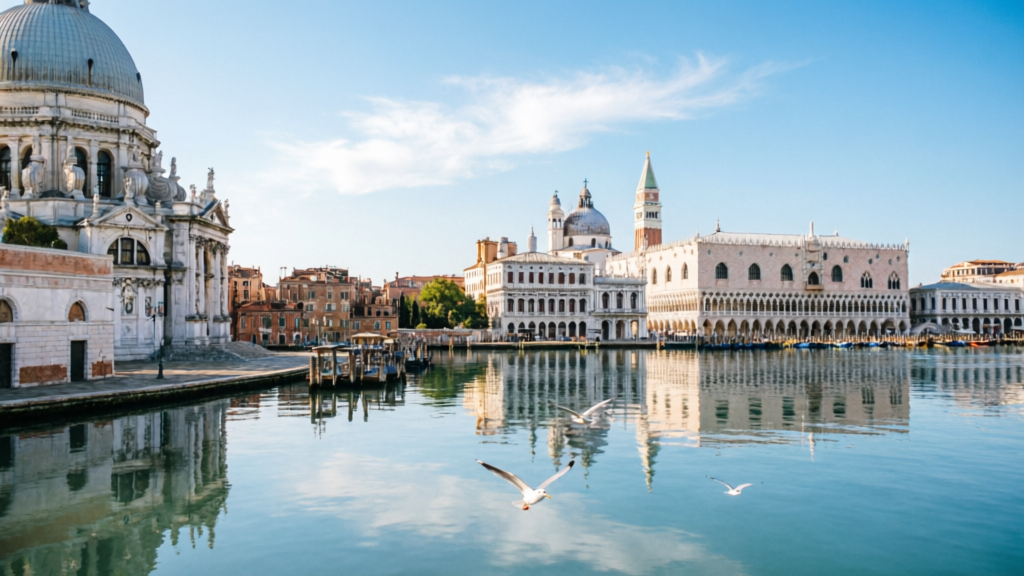
The Basilica di San Marco is the logical place to start because its architecture tells you why Venice mattered. The building synthesises Eastern and Western design because Venice was fundamentally a trading post between them, with merchant connections embedded into every arch and column. The floor mosaics function as medieval maps and religious instruction — this was how people without printed books learned their world.
The Doge’s Palace shows you how power actually worked here. You’ll see the chambers where Venice’s elected leaders governed, the prisons where they locked up ambitious rivals, and the bureaucratic systems that made their trading empire possible. From the waterside galleries you recognise that this small republic ran half the Mediterranean’s commerce from these rooms.
For genuine understanding without the cruise-ship crowds, book an independent walking tour that focuses on lesser-known churches and the neighbourhood history of individual districts. Popular guides fill quickly through the season, so securing your spot online before you arrive saves considerable money compared to the ship’s tour desk and gives you actual flexibility about where you linger.
Beyond the Centre: Day Trips and Alternatives
The cruise line’s Venice package charges substantially more than organising your own day, and you’ll spend considerable time waiting in queues with other passengers while your guide recites information you’ve already read. Booking an independent walking tour before arrival makes practical sense, particularly during peak season when popular guides fill up weeks in advance. Securing your spot online now gives you actual flexibility to explore rather than following a schedule dictated by ship departure times.
You’ll pay significantly less than the tour desk charges, and your money goes directly to a local guide instead of a corporate operator taking a cut. Independent guides work at a pace that suits exploration rather than maximising numbers, which means you can linger or ask questions without feeling rushed. This difference alone justifies the small effort of booking ahead.
The vaporetto—Venice’s public water buses—run regularly from near the cruise terminal to Murano and Burano, offering a straightforward alternative to organised tours. Murano is where glassmaking actually happens rather than being performed for tourists in central shops, though expect demonstrations aimed at encouraging purchases. Burano has colourful houses worth photographing and can be quieter if you go early, before other cruise ships arrive, though the waterfront restaurants charge accordingly for their view.
Staying within Venice itself but hiring a guide who knows Cannaregio, Dorsoduro, or San Polo gives you access to how the city functions beyond the main tourist routes. These neighbourhoods contain ordinary Venetian life—small grocers, local bars where residents drink standing up, people going about daily routines unrelated to tourism. A knowledgeable independent guide shows you how these areas actually work rather than treating them as backdrop, leaving you with genuine understanding of Venice as a functioning city rather than an open-air museum.
Shore Excursion or Going It Alone
The cruise terminal sits closer to actual Venice than most people expect, which means you can walk into quieter streets while other passengers wait for official shuttles. Most cruise passengers queue for organized excursions, giving you a genuine head start if you’re willing to navigate independently. Your first real choice is between paying substantially more for a fixed schedule or keeping that money and moving at your own pace.
Organized ship excursions lock you into a guide’s timetable, which rarely tolerates sitting quietly in a café or stopping to look at something that interests you. Going solo means you spend according to your rhythm, not according to someone else’s watch. The trade-off is simple: convenience costs significantly more, and the convenience itself often means rushing through places worth lingering in.
The vaporetto network functions exactly like any city bus system once you understand it works on tap cards and fixed routes. A day pass provides better value than paying for individual journeys if you’re making several stops across the city. Water buses arrive frequently enough that you don’t need to consult schedules; you simply show up and another one comes within minutes.
Walking from the terminal to Basilica di San Marco takes roughly half an hour on foot and teaches you how the neighbourhoods actually connect rather than following a predetermined route. The bridges, the small squares tucked between buildings, the ordinary shops—these are what Venice genuinely is. The postcard version means almost nothing once you’re here.
🗺️ Tours & Experiences at This Port
Skip the ship’s overpriced excursions — browse top-rated independent tours trusted by thousands of cruise passengers.
Venice: Practical Details Worth Reading Twice
The cruise terminal staff will suggest their official gondola service at roughly double the rate of independent gondoliers working five minutes’ walk away. The gondola experience itself justifies the expense, but their commission markup is substantial and entirely avoidable once you know where to look.
Venice operates on rhythms that ignore cruise ship schedules entirely. Shops close for extended midday breaks, museums restrict afternoon entry, and the city empties and refills according to local patterns rather than tourist convenience. Working with these rhythms instead of against them means you’ll experience the place as it actually functions rather than as a rushed backdrop.
The language barrier people worry about rarely materialises in practice. Most Venetians engaged in tourism speak English competently, and those who don’t respond well to pointing and gestures. Download an offline map before arrival because your phone’s data connection will falter in narrow streets bordered by old buildings, and repeatedly asking for directions wastes time you won’t get back. Consider purchasing a local eSIM data plan to maintain connectivity as a backup when offline maps aren’t sufficient.
Booking an independent guided tour in advance—particularly for the Doge’s Palace or lesser-known churches—grants you skip-the-line access and genuine insight without the cruise ship markup. These tours fill quickly during peak season, especially for passengers working within tight schedules, so arrange this before you board rather than hoping for availability on your port day.
Wear shoes with proper grip and genuine comfort. The marble bridges and worn stone pavements are slippery when wet, and Venice stays damp almost constantly. You’ll walk considerable distances, and sore feet will undermine what could otherwise be an excellent day ashore.
Your Port Day: A Sample Itinerary
Most cruise passengers queue inside the Basilica di San Marco during their first hours ashore, missing the actual advantage: seeing the square when it’s still functioning as a place rather than a photograph location. Head directly from the terminal to the Rialto Bridge instead, where you’ll see locals conducting business at market stalls and water traffic moving as it has for centuries. Walk across and spend time in the neighbourhood rather than fighting for positioning on the stone itself.
By late morning, circle back toward San Marco but approach from the quieter side streets that bypass the crowded square entirely. Book an independent guided tour before your cruise departs—this eliminates the morning queues and replaces generic commentary with actual history. These tours book quickly during peak seasons, so arrange this in advance rather than attempting to find availability once you’ve arrived.
Eat lunch away from the main square where you’ll pay less and receive better food prepared for people who actually live there. Spend your midday hours in the smaller churches or the Accademia if paintings interest you, then simply walk without direction through neighbourhoods you haven’t yet explored. Sit in a quiet campo and watch how the city operates when it’s not performing for tourists—you’ll only understand Venice’s rhythm once you stop working against it.
Return to your ship with buffer time intact. Vaporetto queues grow longer as departure approaches, and rushing through your final hours cancels out whatever advantage you gained by arriving early.
For trips that need transport and a guide, see what is on offer in Venice.
🗺️ Tours & Experiences at This Port
Skip the ship’s overpriced excursions — browse top-rated independent tours trusted by thousands of cruise passengers.
Book your Venice day
Tours for this port, compare before you book
Getting around in port
✈️ Before you sail: eSIM, insurance, luggage, flight delays
Ships In Venice
Upcoming calls from our sailings tracker, updated regularly.
MSC Lirica
MSC CruisesSat 10 Oct
⚓ 08:00–16:00
MSC Armonia
MSC CruisesSun 11 Oct
⚓ 08:00–19:00
MSC Lirica
MSC CruisesSat 17 Oct
⚓ 08:00–16:00
MSC Armonia
MSC CruisesSun 18 Oct
⚓ 08:00–19:00
MSC Lirica
MSC CruisesSat 24 Oct
⚓ 08:00–19:00
MSC Armonia
MSC CruisesSun 25 Oct
⚓ 08:00–19:00