Nice Cruise Port Guide
Optimize your Nice port day with insider tips on beating crowds, finding authentic meals, and booking independent guides—but there’s one critical mistake most cruisers make.
In this guide
Try one free personalised day plan — built around your ship’s actual arrival and departure times. Then get every port on your cruise done the same way from £7.99 (about $10).
Cruise Port Overview: What to Expect
Nice sits on the Côte d’Azur in the south of France, and it is one of the few Mediterranean calls where the city itself is the reason to come, rather than a jumping-off point for somewhere else. It is a proper working city of around 358,000 people — the fifth largest in France — with a daily market, a dense old quarter and a seafront that has been drawing visitors for two centuries.
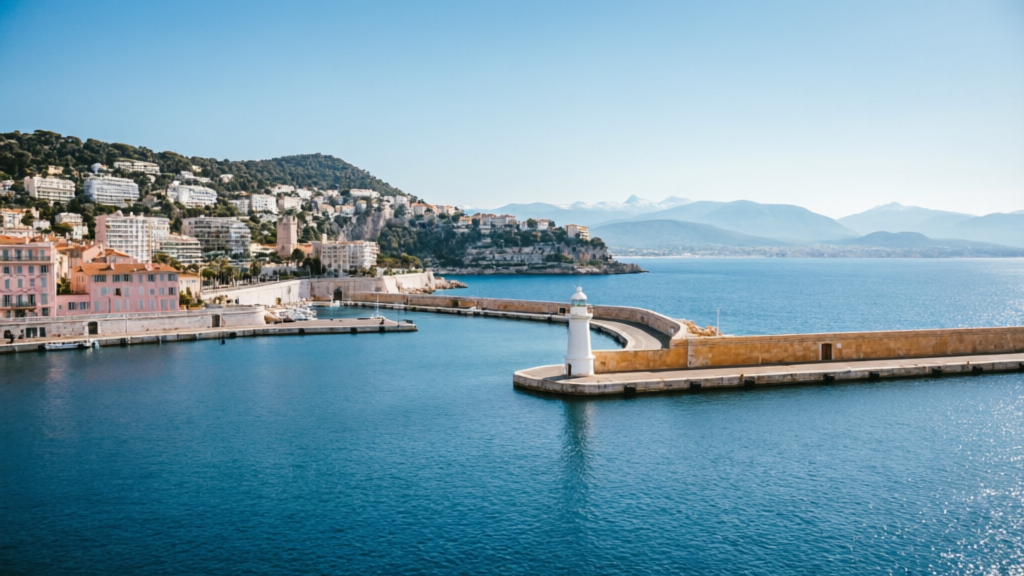
Where you actually tie up matters here more than at most ports, and it varies. Most ships use Port Lympia, Nice’s own harbour just east of the old town, tucked under the far side of Castle Hill. Larger ships sometimes anchor in the Baie des Anges and tender ashore. And some itineraries do not come to Nice at all but dock at Villefranche-sur-Mer, a deep natural bay about ten kilometres along the coast, running passengers in by tender. Check your daily programme the night before, because the day looks genuinely different depending on which of the three you get.
From Port Lympia the centre is close — roughly a kilometre and a half, or a flat 25 to 35 minute walk into Vieux Nice, the old town. There is often a seasonal shuttle, local buses cost a couple of euros on the Lignes d’Azur network, and a taxi into the centre is usually in the region of fifteen to twenty euros. None of it is difficult. Nice is one of the easier Mediterranean ports to do independently.
Getting From the Port Into Town
The walk is the best option for most people. From Port Lympia you come out onto the quayside, turn right along the water, and follow the shore round the base of Castle Hill. It is flat the whole way, it is pleasant, and it delivers you into the old town at the Quai des États-Unis rather than dropping you on a ring road behind it. Allow half an hour at a gentle pace.
If your ship anchors in the bay instead, the tenders normally run in to the same area and the walk is shorter still.
If you are docked at Villefranche, the day changes shape. You will tender ashore into a small, steep and very pretty harbour town that is worth an hour in its own right. Nice is then a short train ride away — the station is a walk up from the waterfront, uphill, and trains run frequently along the coast. Budget the extra time in both directions and do not leave your return to the last minute, because the tender queue at the end of the day is the thing that catches people out.
That coastal railway is the single most useful thing to know about this port. The line runs the length of the Riviera, hugging the sea for much of it. From Nice you can be in Monaco in around twenty to forty minutes depending on the service, or in Cannes or Antibes in a similar time heading the other way, for a few euros each way. On a long call it opens up the whole coast without booking a coach tour, and the views from the train are part of the point.
Nice Ville is the main station and is about a twenty-five minute walk up from the seafront, or a short bus ride. There are smaller halts closer to the water at Nice Riquier, which is handier for the port.
The Must-Do Experience: Start Here
Start at Cours Saleya. It is the wide market street running parallel to the sea at the edge of the old town, and it is the heart of the place. Most days it is the flower market — cut flowers, potted plants, fruit and vegetables, olives, herbs, spices, soap and cheese, with socca vendors working the edges. On Mondays the flower market is replaced by an antiques and second-hand market, which is a completely different morning and worth timing for if that is your thing. On summer evenings there is an arts and crafts market instead.
It is busiest and best early. Come at nine and it is a working market; come at one and it is mostly restaurant tables. If you want the photograph and the atmosphere, go straight there off the ship.
From there walk into Vieux Nice proper. The old town is a tight grid of narrow lanes between tall ochre and terracotta buildings, with washing strung between shutters and shops selling things people actually buy — olive oil, socca flour, candied fruit, knives, sandals. It is not a preserved museum quarter. People live and work in it.
Work your way to Place Rossetti, the small square at the heart of it, where the baroque Cathédrale Sainte-Réparate stands with its tiled dome. The square is the natural place to stop for an ice cream and watch the lanes empty into it. Nearby, the Palais Lascaris is a seventeenth-century aristocratic townhouse with a painted ceiling and a collection of historic musical instruments — small, cool, and a good twenty minutes out of the sun.
Castle Hill and the Promenade
Then climb Castle Hill (Colline du Château). It rises 93 metres above the Baie des Anges between the old town and the port, and it gives you the view that sells Nice: the terracotta roofs of the old town below, the sweep of the bay, and the whole curve of the Promenade des Anglais running west into the haze. On a clear day you can see Corsica from the seaward side, and west as far as Antibes and the Estérel hills.
There is no castle. A fortress stood here from the eleventh century until 1706, when it was razed on the orders of Louis XIV, and what is left is a park on the site — shaded paths, pines, two cemeteries, a Holocaust memorial, and a large artificial waterfall that cools the air noticeably in summer.
Getting up is the bit worth knowing. There is a free lift from the Quai des États-Unis at the eastern end of the seafront, near the Bellanda tower, which takes most of the climb out of it and leaves only a short walk at the top. Or you can walk up on foot in twenty to thirty minutes on stepped paths. If anyone in your party is unsteady on their feet, take the lift both ways.
The Promenade des Anglais itself runs about seven kilometres along the shore, palm-lined, wide, with the pebble beach below it and the traffic held back on the far side. Its name is literal. It was begun in 1820 and paid for by the Reverend Lewis Way and the congregation of the Anglican church in Nice, at a time when English aristocrats were wintering here in numbers. The Niçois called it the Camin deis Anglés, the English Way, and the name stuck when Nice became French. Walk a stretch of it even if you do nothing else.
History, Culture and the Top Sights
Nice was not French for most of its history, and that explains a great deal about it. The city put itself under the protection of the Counts of Savoy in 1388 and stayed in the Savoyard orbit for the best part of five hundred years. It only became French in 1860, under the Treaty of Turin. The change was not universally welcome — a substantial number of Niçois emigrated to Italy in protest.
You can taste all of it. The food here is closer to Liguria than to Paris. Socca is the one to try: a thin chickpea-flour pancake baked in a wide copper pan, scraped off, peppered and served hot in a paper cone. Pissaladière is an onion tart with anchovies and olives on a bread base. Salade niçoise as it is actually made here has no potato and no green beans, which surprises people. There is also petits farcis, small vegetables stuffed and baked, and pan bagnat, essentially a salade niçoise packed into a round loaf and pressed — the best portable lunch in the city.
For art, the city punches well above its weight, largely because the light drew painters here for a century. The Musée Matisse and the Musée Marc Chagall are the two to know. Both sit in the Cimiez district on the hill above the centre, reachable by bus in fifteen minutes or so. Cimiez was the Roman town, and there are excavated Roman baths and an amphitheatre beside the Matisse museum, along with a monastery with formal gardens and a view. If you only do one, the Chagall is the more concentrated visit; the Matisse sits in more attractive surroundings.
Back down in the centre, Place Masséna is the main square, floored in black and white chequerboard paving and lined with red-ochre arcaded buildings in the Italian manner. The Russian Orthodox Cathedral, built for the Russian aristocracy who also wintered here, is the most unexpected building in the city and worth the detour if you have a full day.
Beyond the Centre: Day Trips
Monaco is the obvious one, and the train makes it genuinely easy — twenty to forty minutes, and you come out in Monte Carlo within walking distance of the casino, the harbour and the climb up to the palace and the old town on the rock. Time the changing of the guard at the palace if you want the set piece.
Èze is a medieval hill village on a crag above the coast, with a cactus garden at the summit and a view along the whole Riviera. It is genuinely beautiful and genuinely steep, with cobbles and steps throughout, so it is not for everyone. The village is a bus ride up from Èze-sur-Mer station rather than a walk.
Villefranche-sur-Mer, if you are not already docked there, is a fifteen-minute train ride and one of the prettiest harbours on this coast — a curve of coloured houses round a deep blue bay, with a fortress at one end.
Cannes and Antibes are both west along the same line. Antibes in particular repays a visit: a walled old town, a very good covered market, and a Picasso museum in the seafront fort where he actually worked in 1946.
Local Knowledge Worth Having Before You Dock
Check where you are docked before you plan anything. Port Lympia and Villefranche are different days. One is a flat walk into town; the other is a tender, a hill and a train. Getting this wrong is the most common way to waste a Nice call.
The beach is pebbles, not sand. Large, smooth, grey pebbles, the whole length of the bay. Beach shoes make it far more pleasant, and there is no sand anywhere along the Nice seafront whatever the photographs suggest. Much of the beach is free public shoreline; the sections with mattresses and parasols are private beach clubs and you pay for the day.
Buy a train ticket, not a coach seat, for Monaco. It is a fraction of the price and roughly the same journey time, and you are not tied to a group.
Eat socca standing up. It comes off the tray, you eat it with your fingers, and it is better from a market stall than from a restaurant table. It is also cheap, which almost nothing else on this coast is.
The old town is shaded and the seafront is not. On a hot day, do Vieux Nice and the museums in the middle of the day and save the Promenade for late afternoon.
Mondays are different. Antiques instead of flowers on Cours Saleya, and some museums close. Worth a check if your call falls on one.
Your Port Day: A Sample Itinerary
Early: walk from the port along the waterfront into Cours Saleya while the market is at its best and the light is good.
Mid-morning: wander Vieux Nice, Place Rossetti and the cathedral, then take the free lift up Castle Hill for the view.
Lunch: socca from a stall, or a pan bagnat, eaten in the old town.
Afternoon, option one: a stretch of the Promenade des Anglais, then the bus up to Cimiez for the Chagall or the Matisse.
Afternoon, option two: the train to Monaco, or to Villefranche, if you have eight hours or more ashore.
Last hour: back along the seafront to the ship. It is a flat walk and a pleasant way to end the day — and if you are on a tender, leave yourself considerably longer than you think you need.
Book your Nice day
Tours for this port, compare before you book
Getting around in port