Marseille Cruise Port Guide
Beyond crowded tourist traps and overpriced taxis, discover how to navigate Marseille like a local—but where exactly should you start?
In this guide
Try one free personalised day plan — built around your ship’s actual arrival and departure times. Then get every port on your cruise done the same way from £7.99 (about $10).
Cruise Port Overview: What to Expect
Marseille is the oldest city in France, founded around 600 BC by Greek sailors from Phocaea who called it Massalia, and it has been a working port ever since. It is not a pretty museum town and it does not pretend to be. It is loud, steep, Mediterranean and completely its own thing, and it rewards passengers who come ashore with a plan.
The single most important fact is geography. The cruise terminals are not on the Vieux-Port. They sit several kilometres north of the centre inside the Grand Port Maritime, a commercial harbour that also handles freight and the ferries to Corsica and North Africa. You cannot step off the ship and find yourself in the old town, and any guide that tells you to walk out of the gate and follow the harbour round is sending you into a container terminal. Getting into the city is straightforward, but it is a procedure rather than a stroll, and it is worth knowing before the gangway goes down.
What you get in return is a hilltop basilica visible from every street in the city, the oldest quarter in France, an island fortress with a novel attached to it, and the Calanques on the doorstep. Guided tours and shore excursions can be booked direct if you would rather not work out the logistics yourself.
Getting From the Port to Town
There is a green line painted on the ground from the ship to the port exit. Follow it. Depending on which berth you are on it is a 5 to 12 minute walk to Gate 4, signposted La Calade – L’Estaque. This is the only pedestrian route out and it is the part most people get wrong.
At the gate there is a free shuttle on every cruise day, and a local bus that also runs only when ships are in. Both take you to Place de la Joliette. That is where the city proper starts.
From Place de la Joliette you have two options. Métro line 2 runs from Joliette station and will take you across town in minutes. Or walk: it is about 25 minutes on foot from Place de la Joliette to the Vieux-Port, along the waterfront past the striped stone of the Cathédrale de la Major and the MuCEM, and it is a good walk rather than a chore.
Marseille has only two métro lines, M1 and M2, which cross at Saint-Charles and Castellane, so it is difficult to get badly lost. Vieux-Port station is on line 1, with the entrance on Quai de la Fraternité.
One warning, because it is the opposite of what some guides say: buy a ticket and validate it. The métro has barriers and RTM inspectors do check, particularly on cruise days. Riding without a ticket gets you a fine, not a shrug.
Taxis wait at the terminal and are metered. They are the sensible choice if you are carrying luggage on a turnaround day or if the weather has turned.
The Must-Do Experience: Start Here
Notre-Dame de la Garde stands on a limestone hill 154 metres above the city, topped by a gilded Madonna the locals call la Bonne Mère. You can see it from almost everywhere in Marseille, and from the terrace you can see almost everywhere in Marseille back.
It is not medieval, whatever you may have read. A chapel has stood on the hill since the thirteenth century, but the basilica you visit is Victorian: the foundation stone was laid on 11 September 1853, the architect was Henry Espérandieu, and it was consecrated on 5 June 1864. Inside, the Byzantine-style mosaics are worth the climb on their own, and hanging from the ceiling are the ex-votos — model ships, paintings and plaques left by sailors’ families in thanks for a safe return. In a port city, that is the room that explains the place.
Three ways up from the Vieux-Port. A city bus runs from the Vieux-Port to the foot of the basilica steps and is the easy answer. The Petit Train de Marseille leaves from the Vieux-Port and takes the scenic way. Or walk it in about 45 minutes — but it is a genuine climb, not a stroll, and in July it is hard work.
🗺️ Tours & Experiences at This Port
Skip the ship’s overpriced excursions — browse top-rated independent tours trusted by thousands of cruise passengers.
History Culture and the Top Sights
Twenty-six centuries of trading leaves a mark. Marseille has been Greek, Roman, a medieval republic, a plague port, a Revolutionary hotbed that gave France its national anthem, and the door through which most of the empire came and went. None of it is tidy, which is the appeal.
Le Panier is the oldest quarter in France, climbing the slope behind the north side of the Vieux-Port. Its street plan is medieval, not Renaissance: narrow, stepped lanes, washing lines, shuttered fronts and a great deal of street art. At its centre is the Vieille Charité, a seventeenth-century almshouse built round an arcaded courtyard and a domed chapel, now museums and exhibition space.
The MuCEM — properly the Musée des Civilisations de l’Europe et de la Méditerranée — sits on the J4 quay where the old port meets the sea, wrapped in a concrete lattice that throws shadows all day. A high footbridge links it to Fort Saint-Jean, and the walk across the bridge and round the fort’s ramparts is free and arguably better than the galleries.
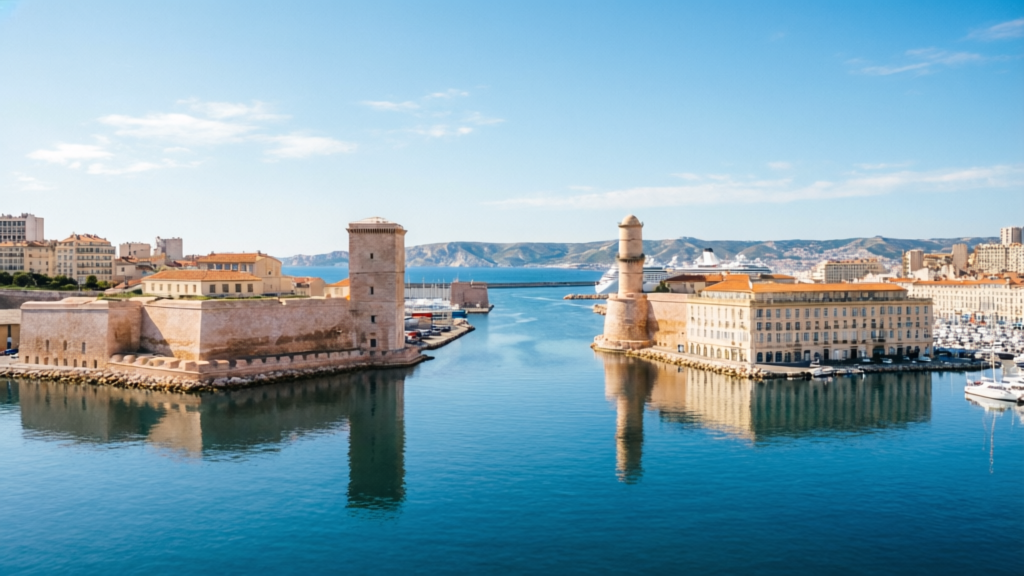
The harbour mouth is guarded by two forts, one on each side: Fort Saint-Jean on the north, Fort Saint-Nicolas on the south. Louis XIV built Saint-Nicolas with its guns pointing inland at the city rather than out to sea, which tells you exactly how Marseille and Paris were getting on at the time.
The Cathédrale de la Major, banded in green and white stone, stands between the Joliette and Le Panier. You walk past it on the way in from the shuttle, so it costs you nothing to look.
And at the top of the Vieux-Port is the ferry boat, a tiny electric launch that has crossed the 280-odd metres between Quai de la Fraternité and Place aux Huiles since 1880. It is free, it takes a couple of minutes, and it is the shortest ferry crossing you will ever make.
Beyond the Centre: Day Trips and Alternatives
The Château d’If is the obvious one and it is a 20-minute crossing from the Vieux-Port. François I built it in the 1520s to guard the harbour, it never fired a shot in anger, and it spent three centuries as a prison instead — Protestants, political prisoners, and in fiction the Count of Monte Cristo, whose cell the guides will cheerfully show you. The boats also run on to the Frioul islands, about 30 minutes out, which are bare, white and good for a swim.
The Calanques are the reason people come back to this coast: narrow limestone inlets with turquoise water at the bottom, running east from Marseille towards Cassis, protected as a national park. Boat trips leave from the Vieux-Port and are the only sensible way to see several of them in a port day. Going on foot means a hot walk in from Luminy or Callelongue and, in high summer, access restrictions when the fire risk is up — worth checking before you commit a whole day to it.
Cassis itself, a small fishing town at the eastern end of the Calanques, is the classic half-day if your call is a long one.
Aix-en-Provence, inland, is the other standard trip: fountains, plane trees, Cézanne, and a completely different Provence from the one at the dockside. It is far enough out that the ship’s coach is a reasonable way to do it.
🗺️ Tours & Experiences at This Port
Skip the ship’s overpriced excursions — browse top-rated independent tours trusted by thousands of cruise passengers.
Shore Excursion or Going It Alone
Marseille is perfectly manageable on your own, but only once you know the chain: green line, Gate 4, shuttle, Joliette, then métro or a 25-minute walk. Passengers who go it alone without knowing that are the ones who end up in a taxi they did not budget for, or back aboard having seen a car park.
Once you are in the centre, doing it yourself is easy. Two métro lines, a compact old town, a bus straight up to the basilica and boats leaving the Vieux-Port all day. Nothing needs a guide to be enjoyable.
The ship’s excursion earns its place where distance is the problem rather than navigation: the Calanques by boat, Cassis and Aix-en-Provence all eat travel time, and on those the guaranteed return matters. It is also the easier option on a turnaround day, or for anyone who would find the hills and steps hard going.
What is not worth paying for is a guided walk of the Vieux-Port and Le Panier. That is a flat twenty minutes from the métro and you will do it better at your own pace.
Practical Tips: Money, Weather and Timing
France uses the euro and cards work almost everywhere, including on the boats and in the métro machines. Cash is worth having for a market or a small bar.
The mistral is the thing nobody warns cruise passengers about. It is a cold, dry north-westerly that funnels down the Rhône valley and can blow hard for days at a stretch, most often in winter and spring. It scours the sky clean, which is why Marseille photographs so well, but it is genuinely strong — it can cancel the Château d’If and Calanques boats at no notice, and it makes the basilica terrace an exercise in holding onto your hat. If your trip is on the water, have a plan B.
Summers are hot and the city is built on hills that look gentler on a map than they are underfoot. Flat shoes, water, and the shady side of the street.
Marseille’s reputation for being rough is overstated but not imaginary, and it is geographic: the areas passengers visit are ordinary working city. Normal sense applies. Pickpocketing concentrates around Gare Saint-Charles, on crowded métro cars and along the Vieux-Port when ships are in. Bag across the body, nothing in a back pocket.
Eat what the city eats. Bouillabaisse is the local dish and the real version is a ritual — the broth first, the fish brought separately and filleted at the table — not a bowl of fish soup with a crouton on it. Navettes, the hard little boat-shaped orange-flower biscuits, have been baked in Le Panier for over two hundred years. And pastis is Marseille’s own drink, served with a jug of water to cloud it yourself.
A few words of French go a long way here, more so than in Paris. Bonjour on entering, l’addition s’il vous plaît, and a real merci will change how you are treated.
🗺️ Tours & Experiences at This Port
Skip the ship’s overpriced excursions — browse top-rated independent tours trusted by thousands of cruise passengers.
Your Port Day: A Sample Itinerary
Ship alongside early in the morning, all aboard in the early evening. Follow the green line to Gate 4 and take the first shuttle rather than the third — the queue builds fast once a big ship empties. From Place de la Joliette, walk the twenty-five minutes along the water past the Major and the MuCEM to the Vieux-Port, which gets you the sea view and the cathedral for free.
Do the basilica first, while the light is good and the terrace is quiet: the bus from the Vieux-Port to the steps, an hour up there with the mosaics and the ex-votos, then back down. Cross into Le Panier from the north side of the harbour and let yourself get lost in it for an hour — the Vieille Charité is the one thing to aim at. Lunch somewhere in the lanes rather than on the quay.
Afternoon is a straight choice. Either the Château d’If, twenty minutes each way plus an hour on the island, or the MuCEM and Fort Saint-Jean, where the ramparts and the footbridge are the point. Both finish within easy reach of the water.
Back to the ship: métro line 2 to Joliette, then the shuttle from Place de la Joliette to Gate 4. Allow more time than the map suggests, because the shuttle runs to its own rhythm rather than yours.
On a short call, drop the island and the museum. The basilica, Le Panier and lunch is a proper day in Marseille and needs about five hours ashore.
🗺️ Tours & Experiences at This Port
Skip the ship’s overpriced excursions — browse top-rated independent tours trusted by thousands of cruise passengers.
How do I get from the ship into Marseille?
Do I need to book the Château d’If or Calanques boat trip ahead?
Is Marseille easy to do independently?
Book your Marseille day
Tours for this port, compare before you book
Getting around in port
✈️ Before you sail: eSIM, insurance, luggage, flight delays
Ships In Marseille
Upcoming calls from our sailings tracker, updated regularly.
MSC Orchestra
MSC CruisesThu 8 Oct
⚓ 09:00–18:00
MSC Seaview
MSC CruisesFri 9 Oct
⚓ 09:00–18:00
Costa Toscana
Costa CruisesSat 10 Oct
⚓ 09:00–18:00
Carnival Freedom
CarnivalSat 10 Oct
⚓ 07:00–16:00
MSC World Europa
MSC CruisesSat 10 Oct
⚓ 08:00–18:00
Costa Fascinosa
Costa CruisesSun 11 Oct
⚓ 08:00–17:30