Genoa Cruise Port Guide
Must-see medieval streets, affordable shore excursions, and insider safety tips await cruise passengers—but where exactly should you start?
In this guide
- Genoa Cruise Port: Berths, Terminals and First Steps Ashore
- Getting From the Terminal Into Genoa
- Start Here: Porto Antico and the Aquarium
- History, the Rolli Palaces and the Top Sights
- Beyond Genoa: Cinque Terre, Portofino and Other Day Trips
- Shore Excursion or Independent: How to Decide
- Genoa Details Most Port Guides Get Wrong
- Your Port Day in Genoa: A Worked Plan
Try one free personalised day plan — built around your ship’s actual arrival and departure times. Then get every port on your cruise done the same way from £7.99 (about $10).
Genoa Cruise Port: Berths, Terminals and First Steps Ashore
Genoa is Italy’s largest port by cargo volume and cruise ships use one small corner of it. Passenger calls are handled at the Stazione Marittima on the western edge of the old city, where there are two cruise berthing points. Ponte dei Mille has a 340-metre quay plus a second berth of 290 metres, and its terminal building covers more than 16,000 square metres over three levels, rated for up to 10,000 passengers a day. Ponte Andrea Doria, about 420 metres further west, has two berths of 300 metres each and an 11,000-square-metre terminal on two floors, rated for up to 8,000 passengers a day. Which one you get depends on the size of your ship and who else is in that day; the largest MSC ships normally take Andrea Doria.
The difference matters for your legs. From the Ponte dei Mille gate it is roughly 1.2 km to Porto Antico and the Aquarium, about 15 minutes on flat ground. From Ponte Andrea Doria add around 400 metres and five minutes each way. Neither route involves a hill. The climbing in Genoa starts only when you turn inland away from the water.
One thing that trips up a lot of pre-cruise reading: Calata Bettolo is not a cruise berth. It is a container terminal roughly 4 km west of the passenger piers, and no passenger walks out of it. If a forum post or a PDF tells you your ship is at Bettolo, it is either wrong or describing a cargo movement. Cruise calls go to Ponte dei Mille or Ponte Andrea Doria, full stop.
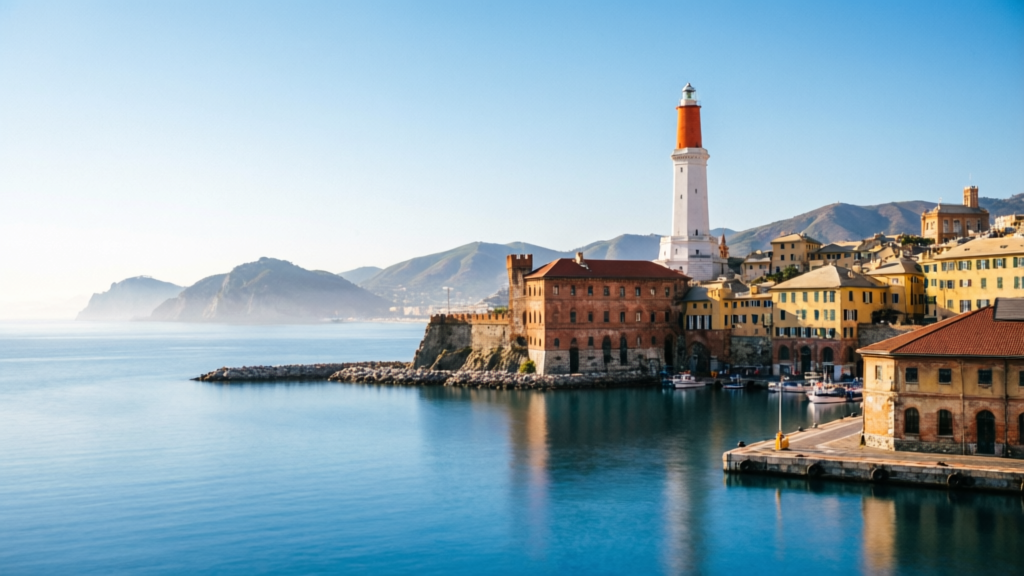
Both terminals sit inside a working port, so the landside exit drops you onto Via Milano rather than into a square. Turn left for the city. The Lanterna, the 76-metre lighthouse rebuilt in 1543 with its light 117 metres above sea level and visible 25 nautical miles out, stands behind you to the west.
Getting From the Terminal Into Genoa
Walking is the default and the route is flat from the gate to Porto Antico. From the Ponte dei Mille gate the nearest station is Piazza Principe, 10 to 15 minutes on foot, which is both a metro stop and the mainline station at the port end of the city. From Ponte Andrea Doria, Dinegro metro station is the nearer one, about 10 minutes away and one stop west of Principe on the same line.
The metro is a single line, eight stations over 7.1 km, opened in 1990, running Brin to Brignole in about 15 minutes end to end. Trains come every 6 to 8 minutes at peak and every 10 to 12 minutes off-peak. From Dinegro, Principe is one stop, Darsena two and San Giorgio three. San Giorgio is the stop for the Aquarium and Porto Antico, Darsena is the stop for the Galata maritime museum, and De Ferrari, five stops along, puts you in the main city square.
The ordinary AMT ticket is valid for 110 minutes from first validation, not the 100 minutes still printed in a good many guides, and it covers the whole city network: buses, the metro, the funiculars and the public lifts. Three exclusions matter to cruise passengers. Volabus, the airport coach, is outside it. So is the narrow-gauge Genova-Casella railway. So is the local bus between Santa Margherita Ligure and Portofino, which catches people out on the one day trip where it costs them time.
The two mainline stations cause more confusion than anything else in Genoa. Genova Piazza Principe is the one by the port. Genova Brignole is 2.5 km further east, at the far end of the metro line, five stops and under ten minutes from Principe. Both are served by trains down the Riviera di Levante, and a good many Cinque Terre and Santa Margherita departures leave from Brignole rather than Principe, so read the departure station on your ticket before you start walking.
Taxis rank outside both terminals and run on the meter, which removes 20 minutes of walking at each end of the day. There is no permanent municipal shuttle at Genoa of the kind Livorno or Civitavecchia operate; where a shuttle bus exists it is your own cruise line’s, arranged call by call, so check the daily programme rather than assuming one will be waiting.
Start Here: Porto Antico and the Aquarium
Porto Antico is the obvious first move and the 1.2 km waterfront walk from Ponte dei Mille delivers you straight into it. Renzo Piano rebuilt this stretch of quay for Expo ’92, the 500th anniversary of Columbus’s first crossing, and three of the structures he put up are still what people photograph.
The Aquarium of Genoa stands on Ponte Spinola with roughly 10,000 square metres of exhibition space and 70 tanks, 43 of them on the standard visitor route. It is the largest aquarium in Italy. In 1998 it gained a 100-metre vessel moored alongside and linked to the main building by a walkway, which now holds the biodiversity section. The sharks are in the main building and the dolphins have their own cetacean pavilion alongside. Allow two hours if you intend to read the panels, 90 minutes if you are moving at pace. It is the busiest ticketed attraction in the city, so book a timed entry online before you sail rather than queueing on the quay with everyone else off your ship.
The Bigo, the white crane-shaped structure alongside, is Piano’s too and also dates from 1992. Its cabin rises to 40 metres and rotates through a full 360 degrees on the way up, which gives you the only effortless overhead view of the medieval roofline and of your own ship at the Stazione Marittima. Budget ten minutes for it, not an afternoon. The Biosfera, the glass sphere sitting out on the water, went up in 2001 and holds a small tropical planting under glass.
About 200 metres west along the same quay is the Galata Museo del Mare, opened in 2004 when Genoa was European Capital of Culture, and the largest maritime museum in the Mediterranean. It holds a full-scale reconstruction of a 17th-century Genoese galley on the original slipways and a permanent section on Italian emigration running since 2011. The submarine Nazario Sauro S 518 has been moored outside since 26 September 2009 and opened as a floating annexe in May 2010, so you climb down through a real boat. Darsena metro station is at the door, two stops back to Dinegro.
🗺️ Tours & Experiences at This Port
Skip the ship’s overpriced excursions — browse top-rated independent tours trusted by thousands of cruise passengers.
History, the Rolli Palaces and the Top Sights
Genoa’s UNESCO listing is the thing most day visitors walk straight past. In 2006 UNESCO inscribed “Genoa: Le Strade Nuove and the system of the Palazzi dei Rolli”: 42 palaces along three streets laid out between the 16th and 18th centuries, namely Via Garibaldi (built 1558 to 1583 and originally called Strada Nuova), Via Balbi (1602 to 1620) and Via Cairoli (1778 to 1786). The rolli were official registers drawn up by the Genoese Senate from 1576, listing private palaces obliged to lodge visiting heads of state and ambassadors, allocated by public draw. The 1588 register carried 111 palaces and the 1599 one carried 150. This was a republic with no royal palace, so it billeted kings in its bankers’ houses.
Via Garibaldi is only 250 metres long and 7.5 metres wide, which is exactly why people miss it. It lies about 1.5 km from the Ponte dei Mille gate, 18 to 20 minutes on foot, and the final 300 metres climb. Three of its palaces form the Musei di Strada Nuova: Palazzo Rosso, Palazzo Bianco and Palazzo Doria-Tursi, which still works as the city hall. Tursi holds Paganini’s violin, the 1743 Guarneri del Gesù known as Il Cannone, taken out and played by its curator once a month. As with most Italian civic museums, the three normally close one day a week, usually Monday, so check the day of the week your ship calls before building an itinerary around them.
The Cathedral of San Lorenzo is about 1.8 km from the terminal, roughly 22 minutes with the climb from the waterfront. Ground was broken in 1110 and Pope Gelasius II consecrated it in 1118; the Gothic front in alternating courses of black and white stone was completed between 1307 and 1312. That striping is deliberate medieval design, not soot and not scaffolding, whatever you have read. Inside, lodged in the south-eastern corner of the nave, is a 381 mm armour-piercing shell fired by the battleship HMS Malaya during the naval bombardment of 9 February 1941. It punched through and failed to detonate, and it is still sitting there with a label on it. The Treasury museum beneath the cathedral holds the Sacro Catino and the Zaccaria Cross.
Piazza De Ferrari is two minutes further on, with the Palazzo Ducale on one side, seat of the Genoese doges from 1339, and the Teatro Carlo Felice opposite. For a view without a climb, the Castelletto lift runs from Piazza Portello at the top end of Via Garibaldi: an Art Nouveau installation of 1909 that lifts you 57 metres to the Spianata terrace in 45 seconds and is covered by your ordinary AMT ticket. The Zecca-Righi funicular from Largo Zecca goes considerably higher, opened in 1897, seven stops and 11 minutes to the Righi belvedere at 302 metres.
Beyond Genoa: Cinque Terre, Portofino and Other Day Trips
The Cinque Terre is the day trip everyone asks about and the one most guides describe badly. The villages lie roughly 100 km down the coast. Direct regional and Intercity trains run from both Genova Piazza Principe and Genova Brignole to Levanto, Monterosso and La Spezia at about hourly intervals, and Monterosso takes around an hour and a half, from about 1 hour 20 minutes on a fast service to nearly two hours on a slow one. Monterosso has the most direct trains from Genoa. A few regional services also stop at the other villages, but for Vernazza, Corniglia, Manarola and Riomaggiore you will usually change at Levanto onto the Cinque Terre Express, the local shuttle running Levanto to La Spezia and calling at all five villages, with hops between adjacent villages of four to eight minutes.
Do the arithmetic before you commit to it. Terminal to Principe on foot is 10 to 12 minutes, the train is about 1 hour 30 minutes each way, and you need slack for a missed connection at Levanto. On a standard port call that is three to four hours of travelling and leaves you two or three hours in one or two villages. It is perfectly possible. It is not a restful day, and with an early all-aboard it is not a sensible one.
The boat version needs correcting as well. There is no scheduled ferry between Genoa and the Cinque Terre. A seasonal day excursion sails from Porto Antico on a small number of dates, typically a handful of Saturdays in July and August plus one or two in June and September, and it gives you around three hours ashore in Monterosso with the other four villages seen from the water. It is cancelled outright when the captain does not like the sea state. Treat it as a bonus if your call happens to fall on one of those dates, never as the plan.
Portofino is the easier trip. Trains from Genova Piazza Principe reach Santa Margherita Ligure-Portofino in about 40 minutes, and the final 5 km is the local bus or the boat around the headland; remember that bus sits outside the AMT ordinary ticket. Camogli, and the abbey at San Fruttuoso reached by boat from it, are the quieter version of the same coastline, and Recco is roughly 25 minutes by train. You can compare guided excursions at ports along this coast, and checking a small-group operator against your ship’s coach tour takes ten minutes before you sail. Genoa-based shore excursions and day trips are also worth scanning for the same coastline.
Shore Excursion or Independent: How to Decide
Genoa is one of the more straightforward Mediterranean ports to handle by yourself, because the ship berths 1.2 km from the historic centre and the ground stays flat until you choose to climb. For Porto Antico, the Aquarium, Via Garibaldi and the cathedral you need no coach and no shuttle: that circuit is about 5 km of walking including the return, and the metro will cut any leg of it.
The calculation changes the moment you leave the city. For the Cinque Terre, an organised trip buys the one thing you cannot buy back: the operator’s obligation to get you to the ship. Miss a connection at Levanto and the next train can be an hour away, on a line where one delayed regional service cascades down the whole coast, and Sunday frequencies are thinner still. Going 100 km from the ship on a port call, either travel with an operator or leave a full hour of margin at the far end.
Mobility is the other deciding factor. The caruggi, the medieval quarter, is a grid of lanes often under three metres wide, frequently stepped and cobbled throughout, and a wheelchair or pushchair will not get far into it. The waterfront from the terminal to Porto Antico is level and paved the whole way, and the metro has lifts, so a Porto Antico day works where an old-town day does not.
If you want a guide, book before you sail. English-speaking walking-tour slots for Via Garibaldi and the Rolli interiors are limited, because several palaces are private and open only on scheduled visits. Comparing independent Genoa tours against the ship’s programme is worth doing while you still have both options open.
🗺️ Tours & Experiences at This Port
Skip the ship’s overpriced excursions — browse top-rated independent tours trusted by thousands of cruise passengers.
Genoa Details Most Port Guides Get Wrong
Start with the station. Genova Piazza Principe is the port station and Genova Brignole is 2.5 km east of it, five metro stops apart. Trains down the Riviera call at both, but not every train calls at both in the same pattern, and a ticket issued from Brignole is no use to you standing at Principe with 12 minutes to go. Check the departure station, not just the departure time.
From Ponte dei Mille the nearest metro stop is Piazza Principe, 10 to 15 minutes on foot. From Ponte Andrea Doria it is Dinegro, one stop further west on the same line and about 10 minutes away.
The AMT ticket runs 110 minutes, not 100, and it covers the funiculars and the public lifts as well as buses and the metro, which makes the Castelletto lift and the Zecca-Righi funicular free at the point of use if you have already validated. The exceptions that catch cruise passengers are Volabus, the Genova-Casella railway and the Portofino bus from Santa Margherita.
The cathedral’s black-and-white front is original design, not dirt. The 1941 shell inside it is real and is one of the more remarkable things in any Italian cathedral, yet half the guides describing San Lorenzo never mention it.
On food, the geography is more precise than most articles admit. Pesto belongs to Genoa and Basilico Genovese carries DOP status; focaccia col formaggio belongs to Recco, 25 minutes east by train, and carries its own IGP; farinata, the chickpea flour pancake, is Ligurian rather than specifically Genoese.
Finally, the Card Musei di Genova exists in 24-hour and 48-hour forms covering around 20 civic museums, with variants that also cover AMT city transport. Check it is on sale for your dates before you count on it, and remember that most of the museums it covers observe a weekly closing day.
🗺️ Tours & Experiences at This Port
Skip the ship’s overpriced excursions — browse top-rated independent tours trusted by thousands of cruise passengers.
Your Port Day in Genoa: A Worked Plan
This plan assumes a standard call with eight hours ashore and no pre-booked tour. Everything in it sits inside the city, so nothing depends on a train connection you cannot control.
Walk out of Ponte dei Mille and turn left onto Via Milano, then follow the waterfront for 1.2 km to Porto Antico, about 15 minutes. Go straight to the Aquarium first with a pre-booked timed entry, because the queue builds through the morning as the ships empty. Two hours covers the 43 tanks on the main route and the 1998 annexe vessel. Come out, ride the Bigo for the 40-metre view over the roofline, and give it ten minutes.
From Porto Antico, turn inland into the caruggi. Piazza Caricamento to the Cathedral of San Lorenzo is about 600 metres through lanes often under three metres wide, and it climbs. Give the cathedral 30 minutes, including the shell in the nave and the Treasury below. Another 250 metres brings you to Piazza De Ferrari and the Palazzo Ducale.
Head north-west from De Ferrari to Via Garibaldi, about 500 metres. The street is 250 metres end to end; walking it takes five minutes, and Palazzo Rosso plus Palazzo Doria-Tursi take 90. Short of time, pick Tursi for the Paganini violin. At the Piazza Portello end, the 1909 Castelletto lift carries you 57 metres up in 45 seconds for the best free view in the city.
Eat inland rather than on the quay, then head back to the waterfront. Piazza Portello to the Ponte dei Mille gate is about 2 km, 25 minutes downhill, or take the metro from De Ferrari to Principe, four stops, then walk down to the terminal. Leave an hour of slack against your all-aboard; the security queue at Ponte dei Mille runs long when two ships sail the same evening.
To swap the museums for coast, take a train from Principe to Santa Margherita Ligure, 40 minutes each way, then the local bus or the boat for Portofino. That leaves three hours on the water and gets you back with margin, which the Cinque Terre does not reliably do.
🗺️ Tours & Experiences at This Port
Skip the ship’s overpriced excursions — browse top-rated independent tours trusted by thousands of cruise passengers.
Is my ship really docking at Calata Bettolo?
Can I do the Cinque Terre on a normal port call?
Do I need to book the Aquarium in advance?
Book your Genoa day
Tours for this port, compare before you book
Getting around in port
✈️ Before you sail: eSIM, insurance, luggage, flight delays
Ships In Genoa
Upcoming calls from our sailings tracker, updated regularly.
Costa Toscana
Costa CruisesFri 9 Oct
⚓ 08:30–17:30
MSC Opera
MSC CruisesSat 10 Oct
⚓ arrives 09:00
MSC Seaview
MSC CruisesSat 10 Oct
⚓ 09:00–18:00
MSC World Europa
MSC CruisesSun 11 Oct
⚓ 08:00–16:00
MSC Grandiosa
MSC CruisesMon 12 Oct
⚓ 08:00–18:00
MSC Orchestra
MSC CruisesWed 14 Oct
⚓ 09:00–18:00