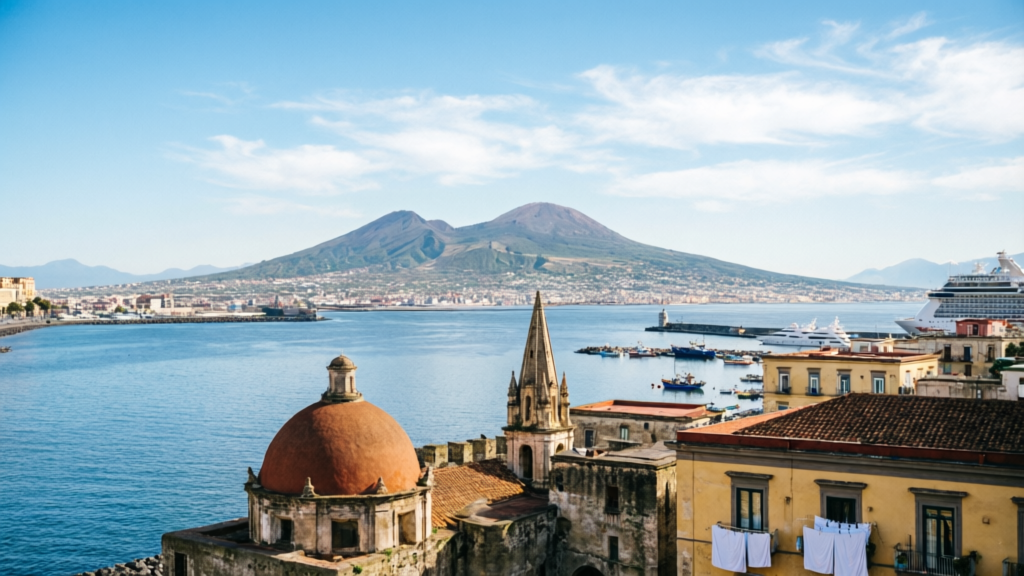
Naples Cruise Port Guide
Travel to Naples like a local: discover hidden gems, insider tips, and why most cruise passengers miss the best experiences—but you won’t.
In this guide
- Naples Cruise Port: Where Your Ship Actually Ties Up
- Walking Distances and the Metro From the Terminal
- Start Here: The Walk Along Spaccanapoli
- The Sights That Justify Your Hours Ashore
- Pompeii, Herculaneum, Vesuvius and the Coast
- Ship Excursion or Independent: The Honest Trade-Off
- Local Detail That Changes How Your Day Goes
- Three Port Days That Actually Fit
Try one free personalised day plan — built around your ship’s actual arrival and departure times. Then get every port on your cruise done the same way from £7.99 (about $10).
Naples Cruise Port: Where Your Ship Actually Ties Up
Naples has one of the most central cruise berths in the Mediterranean. Ships come alongside the Molo Angioino, the pier that runs beside the Stazione Marittima terminal building, a travertine block designed by Cesare Bazzani and opened in 1936. Step out of the landward doors and Castel Nuovo is about 300 metres away across Piazza Municipio, four to five minutes on foot. There is no transfer coach, no security perimeter to cross and no long quay walk.
Two other quays matter on your port day. Molo Beverello, the hydrofoil and fast-ferry pier for Capri, Sorrento, Ischia and Procida, sits roughly 350 metres west of the terminal doors, directly in front of Castel Nuovo. Calata Porta di Massa, written on some schedules as Calata di Massa, lies about 1 km east and handles the car ferries; when the Molo Angioino is full, cruise ships are berthed there at berths 21 and 22 and a shuttle bus runs along the quay to the Stazione Marittima. Read your ship’s daily programme for the berth name before you assume you can walk straight into Piazza Municipio, because that 1 km along an industrial quay is the one genuinely awkward walk in this port.
The Stazione Marittima has arrival and departure halls, an information desk, left luggage, shops and a taxi rank. Taxis to city destinations run on fixed predetermined fares rather than the meter; ask for the tariffa predeterminata and agree the route before you get in. The nearest metro entrance, Municipio on Line 1, is about 400 metres from the terminal on the far side of the square. If you would rather have a driver waiting rather than queue, professional drivers can be booked to meet the ship. Half-day guided options that meet at the terminal gate are listed on the Naples excursions page if you want the day fixed before you sail.
Walking Distances and the Metro From the Terminal
Naples rewards walking from the ship more than almost any other Mediterranean port. Measured from the Stazione Marittima doors: Castel Nuovo 300 metres, five minutes. Galleria Umberto I about 600 metres, seven minutes. Teatro San Carlo about 700 metres, eight minutes. Piazza del Plebiscito about 900 metres, ten to twelve minutes, reached by crossing Piazza Municipio and following Via San Carlo past the opera house. Spaccanapoli about 1.5 km, twenty to twenty-two minutes, via Via Medina and Via Monteoliveto to Piazza del Gesu Nuovo. The Museo Archeologico Nazionale about 2.3 km, thirty minutes, and that last stretch climbs.
Metro Line 1 is the workhorse. From Municipio it is three stops west to Museo for the archaeological museum, calling at Toledo and Dante, about six minutes. It is three stops east to Garibaldi, calling at Universita and Duomo, again about six minutes, and that is the station you want for the Pompeii and Herculaneum trains. Line 6 interchanges with Line 1 at Municipio, running 5.5 km and eight stations west to Mostra in Fuorigrotta.
Tickets are issued under the Consorzio Unico Campania scheme. Paper tickets must be validated before you board, at the gate line or in the small machine on a bus; an unvalidated ticket is treated as no ticket and inspectors do work the Line 1 gates. Contactless Tap and Go lets you tap a bank card in and out on Metro Line 1, on the ANM Centrale and Chiaia funiculars and on EAV’s Naples to Sorrento line, which removes the ticket queue entirely. Three funiculars climb from the centre to the Vomero hill; the Centrale, boarded off Via Toledo, makes the climb in under five minutes.
Start Here: The Walk Along Spaccanapoli
If you do one thing in Naples, walk the decumanus inferiore of the Greek city. Naples was founded as Neapolis by settlers from Cumae in roughly 470 BC on a strict grid, and the lower of its three east-west streets survives dead straight for about 2 km through the historic centre. Neapolitans call it Spaccanapoli, the street that splits Naples. On maps it carries the names Via Benedetto Croce and Via San Biagio dei Librai.
From the ship the quickest way in is Via Medina then Via Monteoliveto, about 1.5 km and twenty minutes, arriving at Piazza del Gesu Nuovo at the western end. The Gesu Nuovo church faces you, its pyramid-studded stone front built in 1470 as the front of the Palazzo Sanseverino and kept when the palace was converted into a church between 1584 and 1601. Fifty metres on is Santa Chiara, built between 1310 and 1340 for Robert of Anjou, with the majolica-tiled cloister laid out by Domenico Antonio Vaccaro between 1739 and 1742.
Keep going east. The Cappella Sansevero is one street north at Via Francesco de Sanctis 19 and holds Giuseppe Sanmartino’s Veiled Christ of 1753, a single block of marble carved to look like a shroud over a body. Entry is by timed slot booked online and the chapel is small, so slots go early in cruise season. A further 300 metres brings you to Via San Gregorio Armeno, the nativity-figure street, workshops trading in the same craft all year rather than only at Christmas. The whole walk from Piazza del Gesu Nuovo to the Duomo end is about 1.3 km and can absorb two hours without effort.
🗺️ Tours & Experiences at This Port
Skip the ship’s overpriced excursions — browse top-rated independent tours trusted by thousands of cruise passengers.
The Sights That Justify Your Hours Ashore
The Museo Archeologico Nazionale at Piazza Museo 19 is the single most important building in the region for anyone going to Pompeii, because almost everything portable found at Pompeii and Herculaneum is here rather than at the sites. Founded in 1777 in a building put up in 1585 as cavalry barracks and used by the university from 1616 to 1777, it holds the Alexander Mosaic of around 100 BC from the House of the Faun, the bronzes and carbonised papyrus scrolls from the Villa of the Papyri at Herculaneum, the Farnese Hercules and Farnese Bull, more than 2,500 Egyptian objects, and the Gabinetto Segreto of erotic material, which only opened to the general public in April 2000. It is closed on Tuesdays. Metro Line 1 to Museo or Line 2 to Piazza Cavour puts you at the door.
Castel Nuovo, 300 metres from your gangway, was begun in 1279 for Charles I of Anjou to a design by Pierre de Chaulnes, then rebuilt from 1453 for Alfonso V of Aragon by the Majorcan architect Guillem Sagrera and finished in 1479. The white marble triumphal arch wedged between the two seaward towers dates from 1470 and stands about 35 metres high. Inside are the Museo Civico and the fourteenth-century Palatine Chapel.
The Duomo, 1.8 km from the terminal on Via Duomo, was begun in 1294 under Charles II of Anjou and finished in 1313. Its Chapel of the Treasure holds the reliquary of San Gennaro, brought out three times a year: the Saturday before the first Sunday in May, on 19 September and on 16 December.
Naples holds three Caravaggios and it is worth knowing exactly where. The Seven Works of Mercy, painted in 1606 and 1607, still hangs above the altar it was made for at Pio Monte della Misericordia, Via dei Tribunali 253, about 1.7 km from the ship. The Martyrdom of Saint Ursula of 1610, his last known painting, is at Gallerie d’Italia, Via Toledo 177, about 1 km from the ship. The Flagellation of Christ of 1607 is at Capodimonte, 4 km north of the port and a separate trip.
Pompeii, Herculaneum, Vesuvius and the Coast
Everything east of Naples runs on the Circumvesuviana, operated by EAV on 950 mm narrow gauge and completely separate from the standard-gauge national railway. This is the fact most guides get wrong. The trains do not leave from the Trenitalia concourse at Napoli Centrale. You want Napoli Garibaldi, on the lower level beneath Centrale, or the terminus at Napoli Porta Nolana, about 400 metres further east. From the ship, take Line 1 from Municipio to Garibaldi, three stops, about six minutes, then follow the EAV signs down.
The Naples to Sorrento line is 47 km with around seventeen stations and takes about an hour end to end, with departures roughly every twenty to thirty minutes. Ercolano Scavi for Herculaneum is fifteen to twenty minutes from Garibaldi, then 700 metres downhill along Via IV Novembre, about eight minutes, to the entrance on Corso Resina. Pompei Scavi – Villa dei Misteri is thirty-five to forty minutes from Garibaldi and the Porta Marina entrance is five minutes from the platform. Do not get off at the station simply called Pompei, which is the national-railway town station, and do not take the Poggiomarino branch to Pompei Santuario; both leave you at the sanctuary end of the modern town rather than at the ruins. In the main season, roughly mid-March to the end of October, EAV also runs the limited-stop Campania Express with a reserved seat and a supplement.
At Pompeii, admissions are capped each day and every ticket is personalised with the holder’s name, with separate morning and afternoon entry bands between 1 April and 31 October. Book online before you sail rather than joining the gate queue. Herculaneum is the quieter site and in some ways the better one: it was sealed under about 20 metres of pyroclastic material, which carbonised roof beams, doors, beds, food and papyri instead of burning them, and upper floors survive. Only about four hectares were uncovered by Amedeo Maiuri between 1927 and 1942 and more than three-quarters of the town is still under modern Ercolano. Around 340 skeletons were found in the shoreline boatsheds from 1980 onwards. Vesuvius summits at 1,281 metres; the road climbs to within 200 vertical metres of the top and the rest is a gravel path, with buses running up from outside Ercolano Scavi in about thirty minutes. Timed admission to the Gran Cono must be booked online in advance. The last eruption was in March 1944.
The Amalfi Coast is the trip to think hard about. Amalfi is only about 60 km from Naples by road, but that is ninety minutes in clear conditions and realistically two to two and a half hours each way in season, so four to five hours of a port day inside a vehicle. The SS163 is the only coast road, and on set high-season dates an alternating odd and even number-plate ban operates between Vietri sul Mare and Positano; two-wheelers, residents, taxis and licensed chauffeur cars are exempt, hire cars are not. The public alternative is the Circumvesuviana to Sorrento, about seventy minutes, then a SITA bus west along the cliff. Comparing structured coastal and archaeological day tours on day trip listings is the quickest way to see which itineraries genuinely fit a port call.
Ship Excursion or Independent: The Honest Trade-Off
In Naples the independent case is unusually strong, because the hard part of most ports, getting from the berth to transport, does not exist here. The metro is 400 metres from the terminal and the train to Herculaneum is under forty minutes beyond that. Anything inside that radius is comfortable on your own.
The argument for the ship’s tour is not logistics, it is the return guarantee. Two things can genuinely strand you. Italian transport strikes are called with notice and usually keep guaranteed service bands, but they thin the Circumvesuviana badly on the day. And the SS163 can add an hour each way without warning. Those risks fall on the Amalfi Coast run and, to a lesser extent, on Capri, where the last useful sailing back to Molo Beverello is the constraint rather than the road.
A workable rule: Herculaneum and Pompeii independently, Amalfi and Capri with a fixed return. Herculaneum is the strongest independent choice of all, because the round trip from gangway to gangway runs at about five hours with two to three hours actually on site. Pompeii needs five and a half to six hours by the same method, which still fits most calls but leaves less slack.
If you want a guide rather than a coach, small-group operators meet at the site entrances rather than at the terminal, which saves the transfer both ways. Independent guided tours booked ahead of the call generally run smaller groups than the ship’s coaches, and in cruise season the good archaeological guides are committed weeks out.
🗺️ Tours & Experiences at This Port
Skip the ship’s overpriced excursions — browse top-rated independent tours trusted by thousands of cruise passengers.
Local Detail That Changes How Your Day Goes
Napoli Centrale and Napoli Garibaldi are the same building and different railways. Buying a Trenitalia ticket upstairs will not get you to Pompeii; the EAV Circumvesuviana platforms are on the lower level with their own ticket hall and their own turnstiles. This single confusion costs more cruise passengers their morning than anything else in Naples.
The fish market is at Porta Nolana, not Vomero. The working fish stalls sit in the lanes beside the Circumvesuviana terminus at the eastern edge of the centre, roughly 2.5 km from the ship. Vomero is a hilltop residential district 170 metres above the sea, reached by funicular, with Castel Sant’Elmo and the Certosa di San Martino and a covered neighbourhood market, but no fish quay.
Check the Tuesday closure. The Museo Archeologico Nazionale shuts on Tuesdays, and a Tuesday call planned around the Pompeii collection is a wasted plan. Build the day around Spaccanapoli and the Duomo instead.
Validate or tap. Paper tickets are only valid once stamped; on Line 1 and the Centrale and Chiaia funiculars you can skip that entirely by tapping a contactless card in and out under Tap and Go.
Other things worth knowing. The Quartieri Spagnoli, the steep grid of lanes climbing west off Via Toledo, was laid out in the 1530s to barrack Spanish garrison troops under the viceroy Don Pedro de Toledo, which is why the streets run so tightly and so straight uphill. Napoli Sotterranea, entered from Piazza San Gaetano about 1.8 km from the ship, drops around 40 metres into Greek tuff quarries later used as Roman aqueduct cisterns and as air-raid shelters in the Second World War. And the craft of the Neapolitan pizzaiuolo was added to UNESCO’s Intangible Cultural Heritage list in 2017, which is the one piece of food tourism here that is genuinely documented rather than marketed.
Three Port Days That Actually Fit
The city day, about 5 km on foot. Off the ship and straight across Piazza Municipio to Castel Nuovo at 300 metres. Galleria Umberto I at 600 metres, Teatro San Carlo at 700, Piazza del Plebiscito at 900 with San Francesco di Paola, built between 1816 and 1846 to Pietro Bianchi’s design, facing the Palazzo Reale. Back north up Via Toledo, stopping at Gallerie d’Italia at number 177 for the Caravaggio. Into Spaccanapoli at the 1.5 km mark, east past Santa Chiara and the Cappella Sansevero, up to Pio Monte della Misericordia on Via dei Tribunali. Finish at the archaeological museum, then three stops back to Municipio on Line 1 rather than walking the last 2.3 km downhill.
The Herculaneum day, about five hours. Line 1 from Municipio to Garibaldi, three stops, six minutes. Circumvesuviana to Ercolano Scavi, fifteen to twenty minutes. The 700-metre walk down Via IV Novembre. Two to three hours on the site, which is compact enough to see properly rather than sample. Reverse the journey with an hour of margin. If you have energy left, the museum at Piazza Museo is one stop from Garibaldi on Line 2 to Piazza Cavour and ties the finds to the rooms you have just stood in.
The Pompeii day, five and a half to six hours. Same route to Garibaldi, then thirty-five to forty minutes to Pompei Scavi – Villa dei Misteri with a named timed ticket already booked. Three hours on site covers the Forum, the Stabian Baths, the House of the Faun and the amphitheatre at a reasonable pace; the site is far too large to finish. Leave on a train that gets you to Garibaldi with at least ninety minutes in hand.
Whichever you choose, work backwards from the berth. If your ship is on the Molo Angioino you are five minutes from the gangway once you reach Piazza Municipio. If it is at Calata Porta di Massa, add the 1 km along the quay or wait for the shuttle, and build in the difference.
🗺️ Tours & Experiences at This Port
Skip the ship’s overpriced excursions — browse top-rated independent tours trusted by thousands of cruise passengers.
Which pier will my ship use, and does it matter?
Do I need to book Pompeii or Herculaneum tickets in advance?
Should I do the Amalfi Coast or Capri independently, or book a ship’s excursion?
Book your Naples day
Tours for this port, compare before you book
Getting around in port
✈️ Before you sail: eSIM, insurance, luggage, flight delays
Ships In Naples
Upcoming calls from our sailings tracker, updated regularly.
Celebrity Ascent
Celebrity CruisesThu 8 Oct
⚓ 07:00–18:00
MSC Divina
MSC CruisesThu 8 Oct
⚓ 11:00–20:00
Sun Princess
Princess CruisesThu 8 Oct
⚓ 07:00–18:30
Legend Of The Seas
Royal CaribbeanFri 9 Oct
⚓ 07:00–19:00
Marella Discovery 2
Marella CruisesFri 9 Oct
⚓ 07:00–17:00
Carnival Legend
CarnivalSat 10 Oct
⚓ 07:00–19:00