Southampton Cruise Port Guide
Skip the cruise desk markups and discover how savvy travelers save money—but there’s one insider secret you won’t find in the brochure.
In this guide
Try one free personalised day plan — built around your ship’s actual arrival and departure times. Then get every port on your cruise done the same way from £7.99 (about $10).
Staying in Southampton before or after your cruise? Answer a few quick questions and we’ll point you to the best part of town for you, including flat, step-free options, then show hotels that fit.
Cruise Port Overview: What To Expect
Southampton is Europe’s busiest turnaround port, handling more than 500 cruise calls and around three million passengers a year. For almost everyone reading this it is not a port of call at all — it is the day you board or the day you get off, worked around luggage, a check-in time or a train.
The first thing to establish is which terminal you are using, because Southampton has five and they are not in the same place. Two sit in the Eastern Docks, entered through Dock Gate 4: the QEII Terminal (berth 38/39, opened 1966) and the Ocean Terminal (berth 46, opened 2009). Three sit in the Western Docks on Herbert Walker Avenue: the Mayflower Terminal (berth 106, opened 1960), the Horizon Terminal (berth 102, opened 2021) and the City Terminal (berth 101, opened 2003).
Mayflower and Ocean are on opposite sides of the port. Telling a taxi driver "the cruise terminal" is not enough information on a morning when four ships are turning round. Check your berth number before you travel; it is on your boarding documents.
None of the terminals is in the city centre, whatever you may read elsewhere. They sit between 0.8 and 1.5 miles out, and getting from one to the centre means walking out through a live dock estate with lorry traffic on the same roads.
Getting From the Port To Town
Distances from each terminal, which is the thing every other guide leaves out:
The City Terminal is the closest — 0.8 miles from Southampton Central, about 15 minutes on foot. Horizon is about 1 mile from Southampton Central, around 20 minutes. The QEII Terminal is about 1.1 miles from the city centre, roughly 20 minutes, or a 10-minute taxi from Southampton Central. Ocean Terminal is 1.2 miles from Southampton Central, about 25 minutes on foot, with Oxford Street about half a mile away. Mayflower is the furthest at 1.5 miles from Southampton Central, around 30 minutes walking or a 5-minute taxi, with the city centre itself 0.9 miles off.
Ocean, City and Horizon are generally treated as within walking distance of the centre; from Mayflower and QEII most passengers take the five-minute taxi. Walking out is possible from all of them, but you are crossing a working port through a manned dock gate, and it is not a walk to attempt dragging a suitcase.
Southampton Central is the station for everything. Southampton Airport Parkway is 7 minutes up the line, and the airport terminal is 99 steps from the platform across a lift-served footbridge — under a minute’s walk, and the easiest airport-to-ship transfer of any major cruise port in Britain.
For London, South Western Railway runs frequent trains to Waterloo, 70 miles, the fastest in 1 hour 14 minutes. Coaches from Heathrow take a little under two hours; driving from Heathrow is about an hour and a half, from Gatwick about two. Gatwick has direct trains taking around two hours. Guided excursions and transfers can be booked ahead if you would rather not work the trains out with cases in hand.
If you are flying in or out around this call, or you simply want the transport settled rather than taking your chances at the rank, a pre-booked private transfer puts a named driver at an agreed place and time. It is worth more here than at a port where you are only ashore for the day.
The Must-Do Experience: Start Here
Go to the SeaCity Museum. Southampton’s claim on the Titanic is not a marketing angle, it is a bereavement: the ship sailed from here on 10 April 1912, and of roughly 2,224 people aboard, around 900 were crew from Southampton. Whole streets lost their men. The museum is built around that rather than around the ship, and it is the difference between a Titanic exhibition and this one.
It is 0.8 miles from the City Terminal, 1.2 miles from Ocean and Horizon and 1.4 miles from the QEII Terminal, in the old civic centre.
If your day is short or the weather has turned, the alternative is Mayflower Park, which is 0.4 miles from the Mayflower Terminal, 0.6 miles from Horizon and City and 0.8 miles from Ocean and QEII. It is the classic ship-watching spot, looking straight down Southampton Water at whatever is coming in.
One local peculiarity worth knowing while you are looking at it: Southampton has double tides, giving roughly 17 hours of rising water a day against an average range of about 4 metres. That quirk of the Solent is the reason the port outgrew its rivals and the reason the biggest ships in the world still come here.
History Culture and the Top Sights
The medieval town walls are the best free thing in Southampton and among the most complete in England. They ran 2 km with 29 towers and 8 gates; about half survives, including 13 of the towers and 6 of the gates. You can walk long stretches of them. They are 0.6 miles from the QEII Terminal, 0.7 miles from Ocean and 0.9 miles from Mayflower and City.
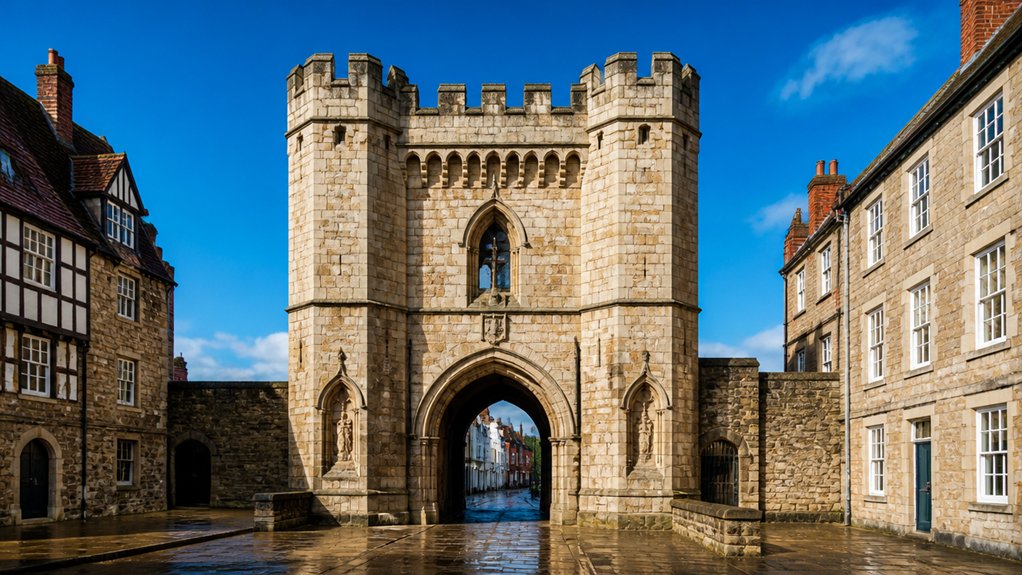
The Bargate, the main medieval gate, still stands in the middle of the shopping street with the city built round it. The Medieval Merchant’s House on French Street is a genuine merchant’s home of about 1290, furnished as it would have been.
The other ship Southampton launched is the one nobody associates with it. The Mayflower left from here in 1620, sailing in company with the Speedwell, and only put into Plymouth after the second ship proved unseaworthy. The Mayflower Memorial stands on Western Esplanade near Town Quay, and the terminal on berth 106 is named for the voyage.
Tudor House and Garden, in St Michael’s Square inside the walls, covers eight hundred years on one site — medieval hall, Tudor merchant’s house, Georgian alterations, all visible in the same building. God’s House Tower, at the south-east corner of the walls, began as a thirteenth-century gate, later fortified as a gun tower and gunpowder store and is now an arts venue, which is a better fate than most medieval fortifications manage.
Holy Rood Church, 0.6 miles from Ocean Terminal, was bombed out in 1940 and deliberately left as a ruin. It is now the memorial to the merchant navy, and it is the quietest and most affecting corner of the city centre.
Solent Sky, 0.4 miles from the QEII Terminal, holds a Spitfire and a Sandringham flying boat. The Spitfire was designed and first flown here, which most visitors never realise.
WestQuay, the main shopping centre, is 0.8 miles from Mayflower, 0.9 miles from City and Horizon and 1 mile from Ocean, and is where you go for anything you forgot to pack.
Beyond the Centre: Day Trips and Alternatives
Southampton Central makes this one of the easiest ports in Europe for a day out, and on a turnaround day with a late check-in there is time for a proper one.
Winchester is 12 miles, fastest 15 minutes, with frequent trains. It has the longest medieval cathedral nave in Europe, Jane Austen’s grave in it, and a working market town around it. For the time it takes, nothing else comes close.
Brockenhurst, in the middle of the New Forest, is 9 miles, fastest 13 minutes, with frequent trains. Ponies and cattle wander the village and the open heath starts at the edge of it. It is the shortest journey on this list and the biggest change of scene.
Salisbury is 20 miles, fastest 29 minutes, regular trains, with a cathedral holding one of the four surviving originals of Magna Carta. The Stonehenge Tour bus leaves from outside Salisbury station and takes about 35 minutes to the stones, running through the day, so check times before you go. Stonehenge and back from Southampton is a full day; do not attempt it on a tight embarkation morning.
Portsmouth Harbour is 15 miles, fastest 43 minutes, regular trains, and the station is beside the Historic Dockyard, HMS Victory and the Mary Rose.
All of those leave from Southampton Central.
Two boats leave from Town Quay, a short walk from the Western Docks terminals, and both are worth knowing about. Red Funnel runs to the Isle of Wight, with a fast passenger service to West Cowes and a vehicle ferry to East Cowes. The Hythe Ferry crosses Southampton Water to Hythe, where it lands at a pier served by the oldest operating public pier railway in the world, running since 1922. The crossing gives you the best view of the docks there is — your own ship included — and it is a working commuter route rather than an excursion.
Ocean Village and Town Quay are the two marinas, both with waterfront restaurants and both within reach of the Eastern Docks terminals on foot.
Shore Excursion or Going It Alone
Southampton is a port where going it alone is straightforward, because it is your own country’s rail network and everything speaks English. Southampton Central is a short taxi from every terminal, the trains are frequent, and Winchester, Brockenhurst and Salisbury are all reachable and back inside a morning.
What you are managing is not navigation but luggage and a deadline. On embarkation day, most terminals will take your cases before your boarding time and most hotels will hold bags after checkout; that is what frees the morning. On disembarkation day you are out of the cabin early with a train or a flight later, and a tour that carries your luggage and ends at the airport is one of the few ship excursions that is plainly worth the money.
The organised trip earns its place on the Stonehenge run, where the coach goes directly and the train-plus-bus chain does not, and for anyone who would struggle with the walk out through the dock gates.
What is not worth buying is a transfer into the city centre. It is 0.8 to 1.5 miles depending on your berth, and a taxi covers it in five or ten minutes.
Practical Tips: Money, Weather and Timing
Sterling, and contactless works on everything including the buses and the trains — you can tap in and out at Southampton Central without buying a ticket at all. There is no reason to carry much cash.
The weather is the genuine variable. Southampton sits on the south coast and changes its mind quickly: a July average maximum of around 22°C, a January average minimum of around 3°C, and November the wettest month. Take a waterproof whatever the forecast said when you packed, and shoes with grip — the dock roads and the walls both get slippery.
Give yourself more time than the map suggests on embarkation day. Five terminals sharing two dock gates means the traffic into the port backs up badly at peak check-in, and the queue is on the road rather than in the building.
Most British passengers drive to Southampton rather than fly, and the port is set up for it — secure parking at every terminal, but pre-book it. Turning up on a four-ship morning hoping to sort parking at the gate is how people start a holiday badly. The M27 and M3 both feed straight in, and the dock gates are signposted from the motorway by gate number rather than terminal name, so know which gate you need as well as which berth.
If someone is dropping you off, the drop-off points are inside the dock estate at each terminal and there is no charge for a short stop, but the approach roads queue badly between mid-morning and early afternoon on turnaround days.
If you are flying in, come in the day before. A same-day flight with a ship sailing that afternoon is how people miss cruises, and Southampton’s weather is exactly the sort that delays a regional flight.
Eat on Oxford Street, about half a mile from Ocean Terminal, or on Bedford Place. Both are where the city eats rather than where passengers are funnelled.
Ship wi-fi is slow and charged by the day, and roaming outside your own network can cost more again. A local eSIM data plan arranged before you sail is the cheapest way to have maps, timetables and messaging working the moment you walk down the gangway in Southampton — and it matters most if you are travelling independently rather than following a guide.
Your Port Day: A Sample Itinerary
Embarkation day, boarding from early afternoon. Drop the cases at the terminal or the hotel first thing. Taxi or walk to SeaCity and give it an hour and a half — the Titanic gallery and the crew stories are the point. Walk down through the Bargate and onto the medieval walls, then along to Holy Rood for ten quiet minutes. Coffee on Oxford Street and back to your terminal in good time.
Disembarkation day with a late train or flight. Off the ship early, bags into left luggage at Southampton Central, and take the 13-minute train to Brockenhurst. Walk out into the New Forest for a couple of hours, lunch in the village, and back with the whole afternoon still in hand. It is the best-value few hours available at any British cruise port.
If you have a full day, make it Winchester — 15 minutes each way, the cathedral, the Great Hall and a market town that has nothing to do with ships. Build a plan for your day around your ship’s times.
If you have two hours, walk to Mayflower Park and watch whatever is coming up Southampton Water. On a turnaround morning that is four of the largest ships afloat, and it is free.
Book your Southampton day
Tours for this port, compare before you book
Getting around in port
✈️ Before you sail: eSIM, insurance, luggage, flight delays
Ships In Southampton
Upcoming calls from our sailings tracker, updated regularly.
Aurora
P&O CruisesThu 8 Oct
⚓ departs 16:00
Queen Anne
CunardFri 9 Oct
⚓ departs 16:00
Arvia
P&O CruisesSat 10 Oct
⚓ 06:00–17:00
Sky Princess
Princess CruisesSat 10 Oct
⚓ 07:00–16:00
Liberty Of The Seas
Royal CaribbeanSat 10 Oct
⚓ 05:30–17:00
Britannia
P&O CruisesSun 11 Oct
⚓ departs 16:00