Siem Reap Cruise Port Guide
Optimize your Siem Reap cruise port day with insider tips that reveal why organized tours might be costing you more than necessary.
In this guide
Try one free personalised day plan — built around your ship’s actual arrival and departure times. Then get every port on your cruise done the same way from £7.99 (about $10).
Cruise Port Overview: What to Expect
Siem Reap is an inland city in north-western Cambodia, located on the banks of the Siem Reap River. For Mekong river-cruise passengers, this is typically the endpoint of a river journey, often reached after several days sailing upstream from Ho Chi Minh City through the Cambodian countryside. Unlike ocean cruise passengers, you will not be tendering ashore—your ship simply moors in the heart of the city, making access straightforward. Ocean-going cruise ships, however, do not call at Siem Reap; they use the coastal port of Sihanoukville, several hours away by road.
Siem Reap itself is modest and atmospheric, with a riverfront, a busy market area, and temple-lined streets. The main reason cruise passengers visit is to explore Angkor, the vast archaeological complex of ancient Khmer temples about 5 km from the city centre. Most river cruises build in time for Angkor visits, whether as an organised excursion or independently arranged.
Getting Ashore
River-cruise passengers simply walk off their ship into Siem Reap’s town centre. The city is compact and navigable, though walking in high heat and humidity can be demanding. For Angkor, you’ll need transport—either through your cruise line’s organised tours or by hiring a car, motorbike taxi, or arranging transport through your hotel or a local operator. Most Mekong cruises include Angkor as part of the itinerary, with guides and transport provided.
The road to Angkor is paved and well-maintained. Travel time from central Siem Reap to the Angkor entrance is roughly 15 minutes by car.
What You’ll See: Angkor
Angkor is one of the world’s most significant archaeological sites, containing the remains of several capitals of the Khmer Empire spanning roughly the 9th to 15th centuries. The complex is vast—over 400 square kilometres—but most visitors focus on the major temples within the central park area.
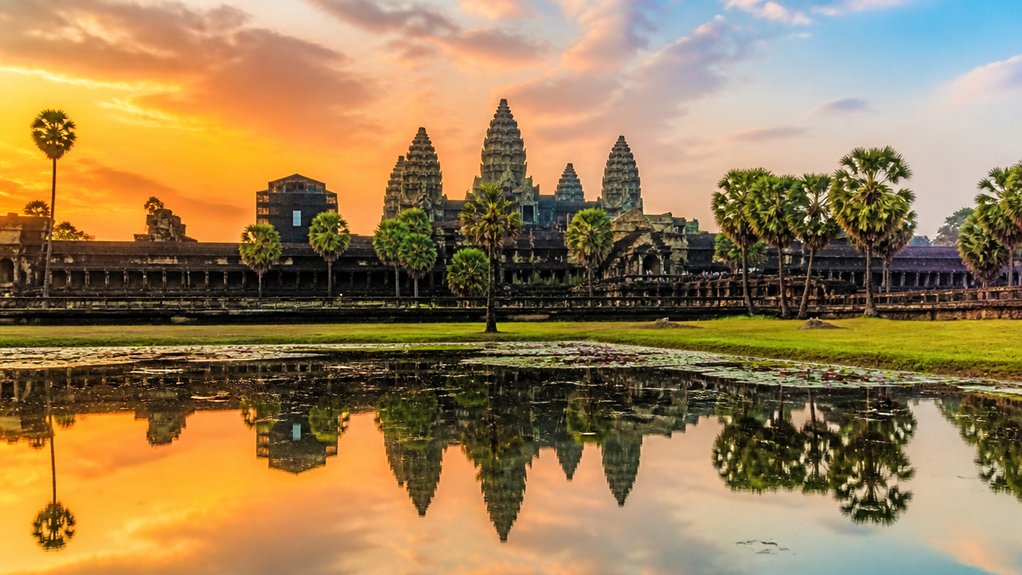
Angkor Wat is the centrepiece and the most recognizable temple. Built in the 12th century, it is the largest religious monument on Earth. The structure features five towers representing the peaks of Mount Meru (a sacred mountain in Hindu cosmology), with the central tower rising high above the others. A wide moat surrounds the entire complex, symbolizing the cosmic ocean. Inside, you’ll find extensive galleries decorated with bas-reliefs depicting Hindu epics, historical battles, and daily life. The most famous relief is the Churning of the Ocean of Milk, showing hundreds of figures in intricate detail. Sunrise at Angkor Wat is legendary for its reflection in the water and is crowded but memorable. The main temple requires about 3 to 4 hours to explore properly, though you could cover the highlights in less time if rushed.
Ta Prohm is famous worldwide as the “Tomb Raider temple” after the Tomb Raider film, though the site is much older. What makes it distinctive is the way nature has reclaimed it: enormous trees with serpent-like roots have grown over and through the stone structures, creating a haunting fusion of jungle and architecture. Over 150 species of trees grow in the temple complex. Unlike Angkor Wat, Ta Prohm retains much of its original artistic detail, including ornate carvings of celestial dancers and intricate pediments. Most visitors spend 1 to 2 hours here.
Bayon, at the centre of Angkor Thom (a walled city), is instantly recognisable by its 54 towers, each decorated with enormous carved stone faces—216 in total—believed to represent the king. The faces are calm and smiling, and their expression follows you as you move around the temple, creating an eerie effect. The bas-reliefs here show scenes of daily life and military campaigns. The distinctive architecture and scale make Bayon unlike any other temple.
Tours and Excursions
The Angkor Archaeological Park offers several visiting circuits. The Small Circuit covers the main temples—Angkor Wat, Angkor Thom, Bayon, and Ta Prohm—and is achievable in one day, though it means a full day of walking and climbing. The Grand Circuit extends the route to include more remote temples and takes considerably longer. Most river cruises arrange Small Circuit tours, typically departing early to catch sunrise at Angkor Wat and returning to the ship by afternoon.
If you arrange independent exploration, you will need to purchase an Angkor pass at the entrance. Pass options exist for different durations—a one-day pass is the standard choice for cruise passengers, allowing multiple entries within a single day. Other lengths are available for those staying longer in Siem Reap.
No prices are displayed here as they vary, and current rates should be confirmed when you arrive. Children under 12 typically enter free (passport required).
Beyond Angkor, Siem Reap itself has smaller temples and a few museums worth visiting if you have extra time, though most cruise schedules don’t leave room for this. The night market and riverfront offer relaxing evening options after a full day at the temples.
Practical Tips
Wear comfortable walking shoes with good grip—the temple steps are steep, often uneven, and sometimes slippery. Sun protection is essential: the temples offer some shade, but you will spend hours in direct sunlight. Bring far more water than you think you’ll need. The humidity is intense year-round, and dehydration sneaks up quickly.
The temples are open from early morning to late afternoon. Sunrise visits mean starting before dawn, which is why guided tours are popular. If exploring independently, an early start avoids the worst heat and crowds. Photography is allowed throughout Angkor, and the light changes dramatically through the day—early and late hours offer the most dramatic shadows and colours.
Dress modestly (shoulders and knees covered) out of respect for the temples’ religious significance, though enforcement is relaxed for tourists. Sturdy walking poles are useful on steep sections and can be hired at the entrance or brought with you.
If you suffer from knee or joint problems, Angkor will be physically demanding. The terrain is rough, stairs are steep, and the distances are considerable. Be realistic about what you can manage in the heat.
History and Context
Angkor was the capital of the Khmer Empire for roughly 600 years. At its height, it was one of the largest cities in the medieval world. The temples reflect the empire’s artistic ambition and engineering skill. Angkor Wat itself may have held 750,000 inhabitants in its heyday—a sprawling, sophisticated city of which the temples are the surviving monuments.
The empire gradually declined, and by the 15th century the capital had moved to Phnom Penh. The Angkor temples were not “lost” (locals always knew of them), but they were abandoned and reclaimed by the jungle. Western rediscovery in the 19th century sparked archaeological interest. Restoration and conservation work continues, as does ongoing archaeological investigation. The site remains deeply sacred to Cambodians and is their most important cultural symbol.
Book your Siem Reap day
Tours for this port, compare before you book
Getting around in port