Brindisi Cruise Port Guide
Wondering why Brindisi’s cruise port holds secrets most passengers never discover?
In this guide
Try one free personalised day plan — built around your ship’s actual arrival and departure times. Then get every port on your cruise done the same way from £7.99 (about $10).
Cruise Port Overview: What To Expect
Brindisi lacks the marketing appeal of better-known ports, which works in your favour if you’re willing to look beyond the surface. Your ship arrives at a container terminal on the city’s northern fringe, deliberately distant from the old town centre. This separation means the medieval streets stay relatively clear of the cruise ship congestion that clogs Venice or Dubrovnik, though it also means you’ll need to walk into town or use a taxi or bus to get anywhere interesting.
The terminal itself operates as functional infrastructure with a few cafés and an intermittently staffed information desk. Nothing here justifies spending your morning, and you shouldn’t expect it to. The real geography that matters lies beyond the gates.
Brindisi’s actual value comes from its position as a base for exploring regions that reward a day’s travel. South lies the Salento peninsula with its whitewashed towns, Baroque squares, and beaches that haven’t been over-developed. North sits the Valle d’Itria, where trulli houses dot the landscape and local wine country spreads across rolling hills worth a full day if you have the time. Most cruise lines sell excursions to these areas, but booking independent operators in advance costs less and gives you greater control over your schedule.
Getting From the Port To Town
The walk from the terminal into the city centre takes long enough that you’ll lose valuable time on your port day, and the route bypasses anything worth looking at—just industrial roads and warehouses instead of any waterfront interest. Taxis, buses, or a combination of both will get you there faster and leave you with more hours to spend actually exploring.
Taxis queue outside the terminal, and the drivers track the cruise schedule so queues move predictably. The fare to the old town won’t break your budget, though some drivers will test whether you know the going rate—asking another passenger what they paid is a practical way to verify you’re not being overcharged. The journey itself is straightforward and direct.
The local bus network costs less than a taxi and functions adequately outside peak arrival times, though you should expect crowded carriages and the possibility of delayed departures when multiple ships dock simultaneously. Neither option truly works in your favour, which explains why most cruise passengers either use the ship’s transfer service or book tours that include transport. The time you save rarely justifies what you’ll pay for it.
If you’re going independently, book a private driver or guide through a local operator before you arrive. This arrangement costs considerably less than the cruise line charges, puts you exactly where you want to begin exploring, and removes the uncertainty of waiting for buses that may run late or not appear. Consider booking guided tours through established shore excursion providers to enhance your experience with expert local knowledge. The old town genuinely rewards a visit, provided you arrive with enough daylight remaining to wander its streets properly.
The Must-Do Experience: Start Here
Most cruise passengers never make it into Brindisi’s old town because the port layout works against casual exploration. Your advantage is arriving with basic structure—the awkward logistics that keep others away mean less crowd competition if you know where to go first.
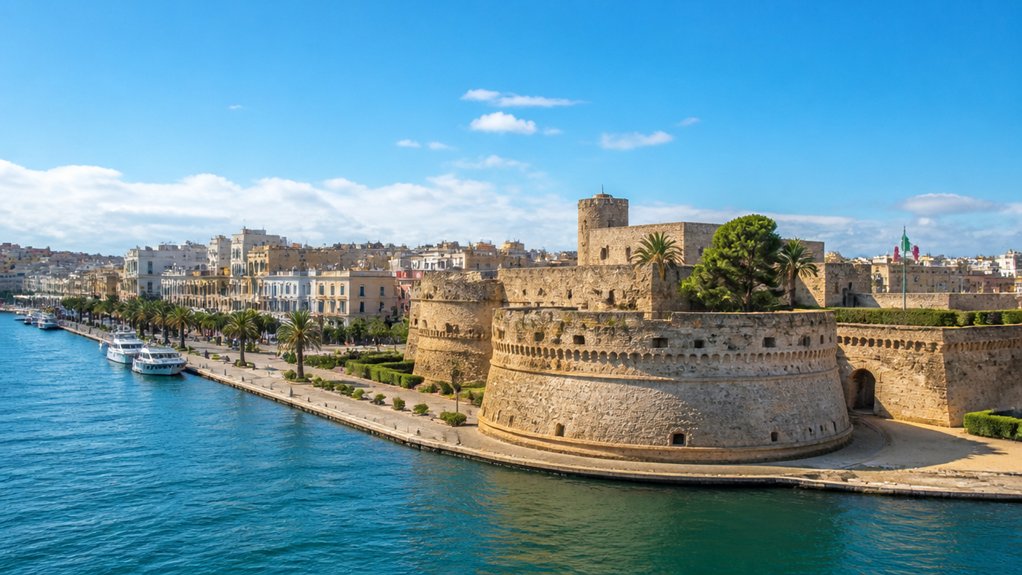
The harbour front is your entry point. The Aragonese Castle dominates the waterfront and gives you immediate spatial orientation. Walking its perimeter costs nothing and teaches you why this place mattered as a crusader embarkation point; even skipping the interior, the external views are worth the walk.
Move inland toward the Cathedral and Piazza della Vittoria where actual daily life happens rather than performed tourism. Eat lunch several blocks back from the seafront on a side street—restaurant prices rise predictably the closer you get to water, and local spots cook better food for less money. This is what residents do automatically.
If time and daylight allow, the Roman Column at the harbour edge communicates Brindisi’s ancient port function more clearly than written explanations ever will. Arrange a walking tour with a local independent guide before you leave your ship; they book out quickly, cost substantially less than ship-organised tours, and provide the historical framework that turns idle sightseeing into actual understanding. Without someone who knows the context, you’ll spend your afternoon observing without comprehending.
History Culture and the Top Sights
Brindisi’s cultural identity exists in the gap between its historical significance and its present function as a working port city—that tension is what actually rewards your attention. The Cathedral in the centro storico was founded as a Norman-Romanesque church but was largely rebuilt after an earthquake in 1743. Inside, fragments of its twelfth-century mosaic floor survive, and they convey more about medieval Brindisi than any written account.
Piazza della Vittoria nearby sits at the heart of the city centre, and locals use it for their own purposes rather than as a stage for visitors. This distinction matters when you want to understand how a place actually functions. The Archaeological Museum justifies an hour if Roman ceramics and maritime trade routes interest you; otherwise allocate that time to walking instead.
The Roman Column at the harbour’s edge marks what survives of the Appian Way‘s terminus, and standing beside it connects you across two thousand years of people arriving by sea. That historical continuity registers differently when you experience the actual scale of the stone. A local walking guide will explain why the Aragonese Castle‘s fortifications follow that particular geometry and trace the crusader routes that made medieval Brindisi crucial to European movement and commerce.
Independent guides cost less than ship-organised alternatives and book quickly during cruise season, so arrange yours before you leave the vessel if possible.
Beyond the Centre: Day Trips and Alternatives
Most cruise passengers stay within the port area, which leaves the surrounding countryside and smaller towns relatively quiet. The Salento Peninsula spreads south from the harbour with limestone villages, Baroque churches, and beaches that operate on a different rhythm entirely from the terminal.
Lecce sits inland and functions as the place locals actually visit rather than Brindisi itself. The city’s architecture is predominantly Baroque, and the sandstone has weathered to a warm gold over centuries—the streets have genuine character because nothing here is polished for tourism. You can cover the centro storico on foot and eat at restaurants where cruise passengers represent a genuine rarity.
Gallipoli operates as a working town with a functioning fishing harbour and local seafood restaurants that charge substantially less than port-marketed alternatives. Otranto further south contains Byzantine mosaics in its cathedral and older defensive structures, though it attracts more organised tourism than Gallipoli does.
Independent local guides who cover the Salento Peninsula book early during cruise season and charge considerably less than ship excursions for equivalent coverage. Contact operators before you board if possible, as the reliable ones fill their available slots well before ships arrive, and you’ll get better value and actual flexibility rather than standardised package alternatives.
Shore Excursion or Going It Alone
The ship’s excursion desk charges significantly more than independent booking, and you’ll spend roughly half your time moving with forty other people between predetermined stops. If you’re comfortable navigating on your own, a minibus or local taxi to Lecce costs far less and lets you set your own rhythm. The cathedral and Basilica di Santa Croce genuinely repay a visit—the Baroque stonework is excessive because that’s how the city was actually constructed, not because it was designed for effect.
Eating lunch at a centro storico restaurant means you’re the unusual visitor rather than one of many cruise passengers, which costs substantially less than restaurants near the port. If you want proper understanding of the Salento Peninsula’s history and architecture, independent local guides who focus on the region offer better value than cruise line tours and book quickly during peak season. Consider purchasing a local eSIM data plan before your excursion to stay connected without incurring roaming charges while navigating independently. These operators provide genuine flexibility—you can spend time where you’re genuinely interested and skip sections that don’t appeal, rather than standing at a scheduled viewpoint with a group.
Going independently works if you’re confident using public transport and willing to handle the occasional wrong turn. Hiring a guide works better if you want someone who understands why the architecture matters and can explain it clearly in English without rushing through prepared commentary.
Before You Leave the Ship: Brindisi Practicalities
Brindisi works as a functioning port rather than a polished tourist destination, which means the waterfront remains genuinely busy with local activity instead of theatrics. Most cruise passengers cluster near the terminal or hop on ship excursions without realising Lecce sits close by and offers far more substance for your time. The trade-off is that locals aren’t primed to absorb five hundred visitors at once, so arriving early matters if you’re heading into the centro storico to avoid the crush of other ships’ passengers in narrow streets.
Restaurants clustered immediately around the port charge significantly more than those a couple of blocks inland. The typical mistake cruise passengers make is treating waterfront establishments as your best option when they’re simply your most convenient—walking away from the water leads you to proper trattorias where locals eat lunch for half what you’d pay at the terminal-facing places. The prices reflect this fundamental difference in clientele and expectation.
Booking shore excursions independently online before your port day costs considerably less than arranging them through the ship’s desk. Popular guides fill quickly during busy seasons, and independent operators often include skip-the-line basilica access plus transport from the terminal without the forty-person group format that defines ship-organised tours. This approach gives you more flexibility and better value.
Cobblestones throughout the centro storico demand proper footwear because they’re punishing on feet and you’ll cover real distance if you’re exploring properly. Comfortable shoes aren’t optional if you plan to walk beyond the immediate port area. Everything else is secondary to getting this right.
Your Port Day: A Sample Itinerary
Most cruise passengers waste their first hour in Brindisi by staying near the terminal when what matters is inland—and your time ashore disappears quickly.
Head straight into the centro storico toward the Cathedral, which anchors the old town and gives you a framework for understanding everything else. The walk from the port takes you through actual Brindisi where locals live, not through a tourist-scrubbed route, and you’ll pass real shops and bars where people are simply working or having coffee. Grab a coffee at a neighbourhood café rather than at the waterfront, then get your bearings before the midday crowds arrive.
If your ship timing allows, move toward Lecce in mid-morning—it’s close enough to visit properly without booking a full excursion. Independent guides who work directly with cruise passengers offer better value than the ship’s tours and typically include skip-the-line access to the Basilica di Santa Croce without forcing you into a massive group. Book one online in advance because the good operators book up quickly, and you’ll save money that would otherwise go to waterfront restaurant markups within the first hour.
Spend your remaining time back in the centro storico on foot, letting the narrow streets and piazzas reveal themselves gradually rather than checking them off as boxes. The Palazzo Granafei and surrounding squares work better when you’re moving at your own pace without pressure. Return to the port with actual time to spare instead of rushing back stressed, which wastes the point of going somewhere worth your attention.
Book your Brindisi day
Tours for this port, compare before you book
Getting around in port
✈️ Before you sail: eSIM, insurance, luggage, flight delays
Nearby cruise ports
All Mediterranean cruise ports · Every port guide, by region
Ships In Brindisi
Upcoming calls from our sailings tracker, updated regularly.
MSC Armonia
MSC CruisesFri 9 Oct
⚓ 07:00–18:00
MSC Armonia
MSC CruisesFri 16 Oct
⚓ 07:00–18:00
Celebrity Constellation
Celebrity CruisesTue 20 Oct
⚓ 07:00–17:00
Fred Olsen Balmoral
Fred OlsenWed 21 Oct
MSC Armonia
MSC CruisesFri 23 Oct
⚓ 07:00–18:00
MSC Armonia
MSC CruisesFri 30 Oct
⚓ 07:00–18:00