Amber Cove Cruise Port Guide
Just discovered why most cruise passengers miss the real Dominican Republic—and how you can avoid their mistakes.
In this guide
Try one free personalised day plan — built around your ship’s actual arrival and departure times. Then get every port on your cruise done the same way from £7.99 (about $10).
Puerto Plata Has Two Cruise Ports, Not One
This is the single fact that most guides to this destination get wrong. Puerto Plata is served by two entirely separate cruise facilities, roughly 16 km and a 20 to 25 minute drive apart, on opposite sides of the city. Which one your ship uses changes almost everything about your day, so check your itinerary before you read another word.
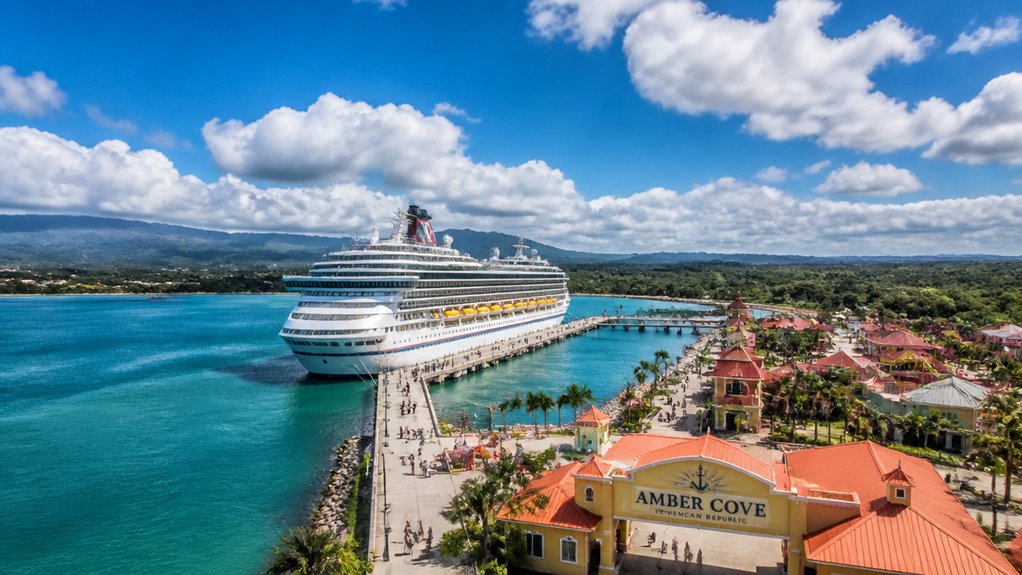
Amber Cove sits on the Bay of Maimón, about 11 km west of Puerto Plata. Carnival Corporation built it for around 85 million US dollars on a 30-acre site and opened it on 6 October 2015, with Carnival Victory as the first ship alongside. It has two berths and can land up to 8,000 passengers at once. It is a purpose-built compound rather than a town: a 300,000-gallon pool with a swim-up bar, twin 650-foot zip lines, shops, bars and a taxi and tour staging area. Carnival, Princess, Holland America, Costa, Cunard, AIDA and P&O ships call here. There is no beach at the pier itself, whatever the brochure photography implies.
Taino Bay opened on 15 December 2021, built on the old commercial harbour on the edge of the historic city, with MSC Seashore as the inaugural call. It handles up to three ships and as many as 14,000 passengers, and it is the one that matters for anyone who wants to walk into a real Dominican town. MSC, Royal Caribbean, Norwegian, Virgin Voyages and Cunard use it. From the Taino Bay gate, Parque Central Independencia is a walk of 10 to 15 minutes.
The short version: if you dock at Taino Bay you can walk into Puerto Plata’s Victorian centre. If you dock at Amber Cove you cannot walk anywhere useful, and you will need wheels. Shore excursions booked before you sail cover both piers, and the north coast fills up fast in the December to April high season, so the useful trips are gone within days of a ship’s manifest being published.
Getting From Your Pier Into Puerto Plata
From Taino Bay: free tuk-tuks shuttle passengers the short distance from the ship along the pier to the terminal entrance; they do not go into town, and tipping the driver is normal. Once through the gate you are on the edge of the historic grid. Parque Central Independencia and the Catedral San Felipe Apóstol are 10 to 15 minutes on foot. The Amber Museum on Calle Duarte is about 1.6 km, roughly 20 minutes walking. The painted Umbrella Street is about 1.1 km. Fortaleza San Felipe sits on the Puntilla headland at the western end of the Malecón, 1.5 to 2 km from the gate, about 20 to 25 minutes on foot with the sea on your right the whole way. The streets are flat, the grid is simple, and you do not need a guide to manage it.
From Amber Cove: there is no free shuttle into Puerto Plata and there never has been. Do not plan around one. The exit leads to a taxi and tour rank, and the drive into the historic centre takes 15 to 20 minutes. Cofresí and Costambar are about 6 minutes away, Maimón village is the nearest settlement, and Taino Bay itself is 20 to 25 minutes if you want the old town.
Taxis at both piers are official and rank-based. Agree the destination and the fare with the driver before the car moves, and agree whether the fare is per vehicle or per person, because a Puerto Plata taxi fare is normally quoted per car for up to four or five people. Drivers take US dollars and Dominican pesos alike; change is often handed back in pesos.
Public guaguas — shared minibuses — run along the coast road through Puerto Plata towards Sosúa and Cabarete and inland towards Imbert. They are cheap, frequent and used by everyone locally, but they stop wherever a hand goes up, take pesos in cash only, and will roughly double your journey time against a taxi. That is a reasonable trade if you have eight hours ashore and a poor one if you have five. If you would rather have a vehicle waiting rather than negotiate at a rank, pre-booked private transfers can be timed to your ship’s arrival at either pier.
The One Thing To Do First
The Teleférico, the cable car up Pico Isabel de Torres, is the one sight that justifies rearranging a day around it. The peak rises to 793 metres directly behind the city, and the cable car is the easy way up. The base station is on Avenida Manolo Tavárez Justo, about 2 km from the Taino Bay gate — a 25 to 30 minute walk uphill, or five minutes in a taxi. From Amber Cove it is a drive of roughly 25 minutes, across the city.
At the top there is a Christ the Redeemer statue, a direct copy of the Rio de Janeiro original at exactly half its size, standing on a summit plateau with a botanical garden laid out around it. On a clear morning you can see the whole north coast from Punta Rucia in the west to Cabarete in the east, plus both cruise piers, which makes the two-port geography obvious in one glance.
Go early. The cabins fill as soon as the first gangways clear, and the queue at the base station is the longest single wait most passengers face all day. Cloud also builds on the summit through the afternoon, so an early car buys you the view as well as the shorter line. The summit is 793 m up and noticeably cooler and windier than the seafront; take a layer.
History, Culture and the Top Sights
Puerto Plata was founded in 1502 by Nicolás de Ovando, and it holds the best-preserved concentration of Victorian timber architecture in the Spanish-speaking Caribbean — the legacy of a 19th-century tobacco boom rather than of the colonial period.
Fortaleza San Felipe is the oldest thing standing. Commissioned in 1564 and completed in 1577, named for King Felipe II, it is the only 16th-century building left in the city. It was abandoned between 1605 and 1736 after the Devastations of Osorio emptied the north coast, briefly taken by buccaneers in 1659, fought over in the Battle of Puerto Plata Harbour in 1800, occupied by US forces between 1916 and 1924, and used as a prison under Trujillo. It became a museum in 1965, was restored in 1972 and opened properly to the public in 1983. It now holds 18th and 19th-century military pieces. It stands at the harbour entrance at the end of the Malecón, so the walk out to it is the walk along the seafront.
Parque Central Independencia is the hinge of the old grid, with the Catedral San Felipe Apóstol on one side and restored Victorian houses around the other three. In the middle is La Glorieta, the Victorian bandstand that appears on every postcard of the city.
The Amber Museum is at Calle Duarte 61, about 100 metres from the San Felipe church, in Villa Bentz — a mansion built in 1919 by two German brothers who made their money in sugar. The museum opened in March 1982. This province is where Dominican amber is mined, which is why the cove is called Amber Cove in the first place, and the collection includes rare blue amber and a fossil lizard close to 17 inches long preserved in a single piece. Columbus recorded Taíno people on this coast wearing amber; the material has been worked here for five centuries.
The Malecón runs the length of the city’s seafront from the fort eastwards, and walking it is free, flat and the most reliable hour in Puerto Plata. One correction worth making: Columbus did not first land here. His first Hispaniola landfall was on the coast of what is now Haiti in 1492. What is nearby is La Isabela, founded between December 1493 and January 1494 on his second voyage — the first stable Spanish town in the Americas, abandoned by 1500 and now a national historic park, 42 km west of Puerto Plata near El Castillo.
Day Trips Beyond Puerto Plata
The 27 Charcos de Damajagua is the standout trip on this coast, and it is one of the few cases where your pier genuinely decides the plan. The falls are at Imbert, inland on Highway 5, and they are 12 km and 15 to 20 minutes from Amber Cove but 28 km and 35 to 45 minutes from Taino Bay. Amber Cove passengers, who lose out on almost everything else, win here.
The site has been a protected Natural Monument since 2004. You climb a limestone canyon with a guide and come back down by jumping and sliding through the pools. Three circuits run: seven falls, twelve falls, or the full 27. Certified helmets and life jackets are compulsory and guides are not optional. Minimum age is eight for the seven-fall route and twelve for the full 27. Closed-toe water shoes are the difference between a good morning and a cut foot.
Playa Dorada is the nearest developed beach, 1.9 km of sand backed by resorts, a plaza and a Robert Trent Jones 18-hole par-72 course. Allow 20 minutes by taxi from Taino Bay, 30 from Amber Cove. Sosúa is about 25 km east along the coast road — roughly 30 minutes from Taino Bay, 40 from Amber Cove — a crescent bay with reef at both ends and much better snorkelling than anything at Puerto Plata itself. Sosúa’s odd history is worth knowing: around 800 German and Austrian Jewish refugees were given Dominican visas between 1940 and 1945 and settled here on a 26,000-acre grant. Ocean World at Cofresí is 10 to 12 minutes by taxi from either pier.
Whichever you pick, book it before you sail. The full range of Puerto Plata day trips is listed with pier pickup specified, which matters here more than at most ports, since a tour meeting at Taino Bay is no use to you if your ship is at Amber Cove.
Ship Excursion or Independent: The Real Trade-Off
At Taino Bay the case for independence is strong and simple. The historic centre begins at the gate, the walk to Parque Central is 10 to 15 minutes, the fort is 20 to 25 minutes, and the cable car base station is a five-minute taxi. You can build a full day on foot plus one short taxi and never book anything. A ship tour of Puerto Plata town from Taino Bay is paying for a coach to cover 1 to 2 km.
At Amber Cove the maths flips. Everything is 12 to 30 km away, nothing is walkable, and you are dependent on a taxi rank at both ends of the day. The risk is not safety, it is the return leg: a driver who agreed to collect you at a beach 30 km away is a verbal arrangement, and all-aboard is not negotiable. Either book a transfer with a fixed return, or go with an operator who is contractually tied to your sailing.
The compromise most people should take is a half day. Book a morning circuit — the falls from Amber Cove, or the cable car and old town from Taino Bay — and leave the afternoon loose. Independent guided tours from Puerto Plata operators generally collect from whichever pier you name, which removes the only real advantage the ship’s desk has. December to April is the busy window on this coast, and the better small-group departures sell out well before the ship docks.
What Actually Changes Your Day in Puerto Plata
The currency is the Dominican peso, but US dollars are accepted at both terminals, by all taxi drivers and by every tour operator working the piers. Change is frequently given in pesos, so expect to leave with some. Card acceptance is normal in the terminals and at larger restaurants and thin in small shops and street stalls, so carry small notes. Pesos are needed in cash for guaguas and market stalls.
Amber Cove has no beach. The compound has pools, zip lines, shops and bars, and the water access at the pier is not swimming sand. If a beach is the point of your day, you are leaving the compound — Playa Bachata and La Playita sit beside the port at Maimón, Costambar and Cofresí are about 6 minutes away, and Playa Dorada is 30 minutes.
Both piers can have two or three ships alongside at once, which means up to 8,000 passengers at Amber Cove or 14,000 at Taino Bay hitting the same handful of sights. Checking how many ships share your date does more for your day than any other bit of planning. The cable car queue and the fort are the two places that saturate first.
The north coast sits on the windward side of the island, and the Atlantic swell and trade winds here are why Cabarete became a kitesurfing centre. Sea conditions at Sosúa and Cabarete can be rough when Puerto Plata’s own harbour looks flat. Hurricane season runs June to November, with August to October the most active stretch, and an itinerary change at this port is more often a weather call than a mechanical one.
Puerto Plata’s airport, Gregorio Luperón, is about 22 km east of the city, roughly 30 minutes from either pier — useful to know if you are joining or leaving a ship here. For maps, ride-hailing and messaging a driver, a local eSIM data plan set up before you land saves fighting for terminal Wi-Fi, which is free at both ports and slows to nothing when three ships are in.
Your Port Day: A Plan That Works
Docking at Taino Bay. Clear the gate as early as you can and take a taxi straight to the Teleférico base station, five minutes away, to ride up Pico Isabel de Torres before the queue builds and before cloud settles on the 793-metre summit. Come down, then walk the 2 km back into the historic grid. Work through Parque Central Independencia, La Glorieta and the cathedral, then Calle Duarte and the Amber Museum, then the Umbrella Street about 1.1 km from the gate. Finish with the 1.5 to 2 km walk out along the Malecón to Fortaleza San Felipe on the Puntilla, where the 1564 walls look straight down the harbour entrance. That is the whole city done on foot plus one short taxi, and it puts you back at the gate with time in hand.
Docking at Amber Cove. Do not try to replicate the above — the old town is 15 to 20 minutes each way by taxi and the day gets thin. Go instead to the 27 Charcos de Damajagua, 12 km and 15 to 20 minutes inland, and take the earliest departure so you are climbing the canyon before the coach groups arrive. Back at the port by early afternoon, use the pool and the zip lines, which are on your doorstep and are what this pier is actually built for. If you would rather have the town, commit to the taxi both ways, do the fort and Parque Central only, and be back at the rank well before all-aboard.
Either way: agree taxi fares before the car moves, carry small notes, take water shoes if the falls are on the plan, and keep a two-hour buffer between your last stop and the gangway. A local eSIM data plan keeps you reachable by your driver without roaming charges, which is worth more here than at most Caribbean ports precisely because the two piers are 16 km apart and being at the wrong one is a real risk.
Book your Amber Cove day
Tours for this port, compare before you book
Getting around in port