Taipei Cruise Port Guide
What secrets does Taipei’s working port hold for cruise passengers seeking authentic cultural experiences beyond tourist crowds?
In this guide
Try one free personalised day plan — built around your ship’s actual arrival and departure times. Then get every port on your cruise done the same way from £7.99 (about $10).
Cruise Port Overview: What to Expect
Ships calling for Taipei dock at Keelung, whose cruise terminal operates as part of a working port rather than a purpose-built tourist facility, which means faster processing but also minimal signage and unpredictable taxi queues during peak disembarkations. The terminal itself is clean and straightforward, though spartan—you’ll find a convenience store and basic café, but these serve as emergency options rather than places to linger. Services beyond these are essentially non-existent.
The real practical advantage is location. Ships dock in the centre of Keelung, a short walk from Keelung Station, where trains reach Taipei Main Station in around 40 minutes to an hour, so you are not stranded in an industrial zone for hours. Taipei’s public transport system works well once you grasp it, and the compact layout means you can cover substantial distance on foot if you plan your route beforehand. This proximity makes your limited port time genuinely usable rather than half-consumed by travel.
Simultaneous ship arrivals create visible crowding—Taipei’s terminal wasn’t designed for mega-ship volumes, and you’ll see genuine congestion during multiple disembarkations. The crush dissipates quickly. Since most passengers head toward the same predictable destinations, heading elsewhere immediately after leaving the ship gives you quieter streets and shorter queues.
Taiwan’s north coast weather shifts abruptly, so check conditions before disembarking and dress in layers; sudden rain or humidity changes are common enough to plan around. The terminal has basics, but beyond the gates you’re genuinely unsupported, so leave with a clear idea of where you’re going and how you’ll get there.
Getting From the Port to Town
The taxi queue outside the terminal moves faster than it looks. Drivers work efficiently even when the queue appears chaotic, and fares are metered and reliable rather than negotiable, which removes a common source of confusion. Ignore any unofficial offers or drivers approaching you before the official rank; the legitimate queue, despite seeming disorganised, will get you into town at a fair price within a reasonable wait.
Public transport is genuinely worth learning if you have a thirty-minute or longer stop. The MRT is clean, frequent, and uses an intuitive card system you can purchase at the station with minimal fuss. The learning curve is steeper than a taxi, but the cost is a fraction of the price, and you’ll avoid post-disembarkation taxi congestion entirely by walking the short distance to Keelung railway station for the train into Taipei.
The terminal’s location means the nearest station is walkable, so ask at the information desk before leaving if you’re unsure of the direction. For very short port days, a taxi directly to your chosen destination makes practical sense; you’ll recoup the time spent queuing through faster arrival and uninterrupted access. For anything longer, the train trade-off becomes worthwhile.
Neither option requires advance booking, so your flexibility remains intact until you disembark and assess the actual queue situation. Walking between nearby neighbourhoods is genuinely viable if your plans are clustered. The city layout is logical enough that moving on foot between two or three nearby stops often costs nothing and reveals considerably more than being sealed in a taxi.
The Must-Do Experience: Start Here
Most cruise passengers follow the same predictable route and waste hours standing in queues behind other tourists. The alternative is to start your morning in a neighbourhood where actual residents go, then expand outward from there.
Jiufen Old Street works if you arrive before the tour groups do, otherwise you’ll spend your time shuffling between bodies rather than seeing anything. Chiang Kai-shek Memorial Hall gives you the changing-of-the-guard ceremony, a genuinely impressive plaza, and no queues or cramped passages to navigate through.
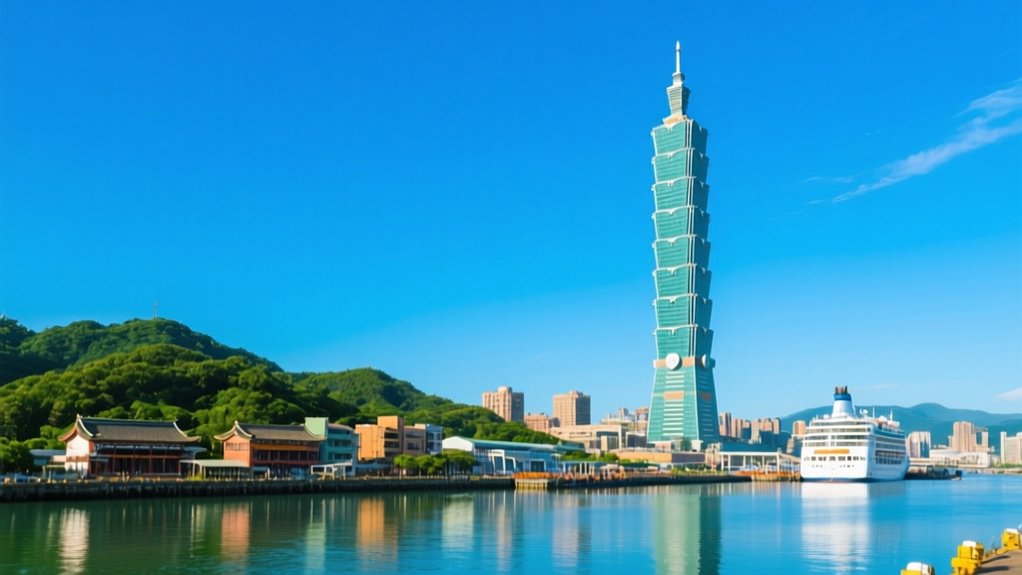
From the memorial hall, a short metro ride takes you to the Taipei 101 neighbourhood, which puts you close enough to the landmark to photograph it without wasting money or time actually entering the building. If your port window stretches beyond a few hours, book an independent tour to Yangmingshan in advance instead of figuring it out yourself—the viewpoints justify the effort, the operators know what fits into a cruise day, and good ones book up quickly during busy months. The cost sits well below what the ship charges for the same route.
Get yourself back to the port area by late afternoon using the straightforward train connection from Taipei Main Station to Keelung, rather than pushing your luck and discovering the taxi queue has grown twice as long as it was this morning. Consider arranging professional drivers for your return journey to avoid unpredictable wait times and ensure you arrive back with plenty of time to spare before departure.
🗺️ Tours & Experiences at This Port
Skip the ship’s overpriced excursions — browse top-rated independent tours trusted by thousands of cruise passengers.
History Culture and the Top Sights
Taipei’s cultural landmarks become more valuable when you understand their context rather than simply visiting them. The Chiang Kai-shek Memorial Hall operates as more than a ceremonial changing of the guard—the plaza layout is intentional, the building’s proportions reflect Taiwan’s political history, and experiencing it without crowds fundamentally changes what you actually see.
The National Palace Museum holds one of the world’s most significant Chinese art collections, but a cruise stop is generally the wrong time to visit. Queues are long, the exhibition halls need hours to justify entry, and you’ll spend your afternoon indoors when you could be in neighbourhoods that actually show how Taipei operates. If classical Chinese artefacts genuinely matter to your trip, arrange an independent guided tour beforehand—specialists can structure the experience efficiently and solve logistical problems that work within your port window.
Temples scattered throughout the city—Longshan, Confucius, and others—offer better access and often more atmosphere than major museums. You’ll see active worship, architectural details worth examining closely, and costs that amount to a donation rather than a ticket. These spaces reveal genuine Taiwanese religious practice without the tourist machinery surrounding dedicated attractions.
The distinction that matters is between sights worth experiencing and sights worth experiencing during a cruise stop. Your time is the real limitation, not your patience for queues.
Beyond the Centre: Day Trips and Alternatives
Taipei’s suburban neighbourhoods matter far more than the overcrowded central landmarks that organised tours push onto every itinerary. Jiufen’s teahouses, Shifen’s sky lanterns, and Beitou’s hot springs operate on a completely different scale from the standard tourist circuit—they’re places where Taipei actually functions as a city rather than a checkbox. The difference is immediate once you step outside what the cruise lines consider safe territory.
The choice between a ship excursion and independent travel comes down to practical constraints rather than confidence. Organised tours guarantee you’ll return to the ship on time, which matters when missing the ship is genuinely catastrophic, but you’ll pay substantially more for the privilege and move through stops designed to funnel tourists toward overpriced merchandise. Independent travel via the train from Keelung and Taipei’s metro costs far less and lets you control when you leave each location and how long you stay. The metro is straightforward enough—English signage exists, the system makes sense, and you won’t be herded through predetermined stops.
If you go independent, book specific experiences beforehand instead of hoping to sort logistics on the day itself. Cable car rides to viewpoints and specialist tea houses fill during cruise season, so advance booking eliminates the friction of queuing and guarantees your port hours go toward actual experience rather than frustrated waiting. The train from the port to Taipei takes around 40 minutes to an hour, after which you’re genuinely free to build an itinerary that reflects what you actually want to see. Consider purchasing a local eSIM data plan before arrival to ensure seamless navigation and communication throughout your exploration.
The real advantage of travelling alone is access to neighbourhoods that organised tours skip entirely—the lantern markets, the street food stalls, the functioning temples where locals outnumber cruise passengers. That’s where the city reveals itself rather than performs for visitors.
Shore Excursion or Going It Alone
The port operates on cruise passenger time, which means the first hour after disembarkation is chaos—queues for taxis, crowds at the railway station, and tour operators calling out predetermined itineraries that cost considerably more than they should. Skip this entirely by downloading the metro app beforehand and having your destination pinned before you step off the ship. This single preparation removes the pressure that makes rushed decisions feel necessary.
Keelung railway station near the port can feel overwhelming during peak cruise hours, but the rail system’s English signage is genuinely reliable—follow it without second-guessing yourself. Avoid asking ship staff which direction to go; they default to recommending paid excursions regardless of what suits your interests. Instead, trust the system itself and move through confidently.
One genuine advantage of independent travel reveals itself later: the ability to eat where locals eat rather than where cruise passengers congregate. Temple night markets and neighbourhood restaurants cost a fraction of the price you’d pay in central tourist zones, and the food quality gap is substantial. Book a tea house experience or specialised tour in advance through independent tour operators rather than the ship—popular slots fill within days of a cruise docking, but booking online beforehand secures better availability and considerably lower pricing than ship desk alternatives.
The essential decision point isn’t whether to go independent, but whether you’re willing to commit preparation time before you dock. That investment translates directly into actual freedom once you’re ashore.
Before You Leave the Ship: Taipei Practicalities
Keelung’s cruise terminal is a short walk from the railway station, with trains on to Taipei’s metro system, but the ship desk steers you toward their coach tours instead of mentioning you can reach the city centre independently for minimal cost. Understanding which neighbourhoods people actually live in rather than visit for photographs gives you a genuine advantage over the standard excursion route.
Jiufen Old Street sells itself as essential, and it is, but the crowds make it nearly unbearable during peak hours. Go when locals do and you’ll see functioning businesses and residences rather than just a backdrop for tourists. The temples throughout Taipei’s districts operate as actual places of worship where you can observe practice without any commercial pressure or expectation to spend money.
Your choices split clearly between activities that genuinely need advance booking and those you can handle spontaneously. Tea ceremonies and private guide services fill quickly, so booking these independently online gives you availability and better rates than the ship offers. Markets, temples, and local restaurants all work fine with flexible timing—the ship profits from convincing you everything requires their pre-planning, but independent travel demands far less certainty.
🗺️ Tours & Experiences at This Port
Skip the ship’s overpriced excursions — browse top-rated independent tours trusted by thousands of cruise passengers.
Your Port Day: A Sample Itinerary
Most cruise passengers queue for the ship’s shuttle during their first hour when Keelung railway station is minutes away on foot. Skip the coach and head straight to the station—you’ll be in the city centre while excursion groups are still boarding.
Get to Chiang Kai-shek Memorial Hall early before the crowds arrive. You’ll watch the changing of the guard and see the scale of the place without fighting for space in photographs. Jiufen Old Street is not on the metro, so reach it by bus from the city or by train to Ruifang and a short bus ride, aiming to arrive before the afternoon crush.
Walk through the neighbourhood above the main tourist strip where locals actually eat and shop. The snacks cost considerably less when you’re not on the primary pedestrian drag, and you’ll see how the place actually functions rather than how it’s been packaged for visitors.
By midday, pick any functioning temple in a residential district—Longshan Temple works if you’re still near the old streets, but the principle applies anywhere. Grab lunch from a restaurant where people are actually eating rather than one you’ve read about online, and you’ll spend a fraction of what the port area charges.
Your afternoon depends on what you’ve arranged beforehand. If you’ve booked a tea ceremony or private guide, head to that appointment now; if not, explore the neighbourhood around your temple, visit a local market, or take the metro to Taipei 101 for the observation deck if you want something structured. Leave plenty of time for the metro back to Taipei Main Station and the train to Keelung before the ship departs.
For trips that need transport and a guide, see what is on offer in Taipei.
🗺️ Tours & Experiences at This Port
Skip the ship’s overpriced excursions — browse top-rated independent tours trusted by thousands of cruise passengers.
Book your Taipei day
Tours for this port, compare before you book
Getting around in port