San Juan Cruise Port Guide
Find insider secrets to maximize your San Juan cruise day—learn what most tourists never discover about this Caribbean port.
In this guide
- San Juan Cruise Port: Two Separate Port Areas, Not One
- Getting From the Pier Into Old San Juan
- The Two Forts: The One Thing Not to Skip
- The Walled City: What Is Actually Worth Your Time
- Beyond the Walls: El Yunque, the Beaches and Cataño
- Ship Excursion or Doing It Yourself: How to Decide
- San Juan: The Details Nobody Mentions at the Port Talk
- A Port Day That Actually Fits
Try one free personalised day plan — built around your ship’s actual arrival and departure times. Then get every port on your cruise done the same way from £7.99 (about $10).
San Juan Cruise Port: Two Separate Port Areas, Not One
San Juan is one of the few Caribbean calls where the name of your berth changes the shape of the whole day. The port runs as two districts. The Old San Juan district — Piers 1, 3, 4 and 6 — sits on the southern edge of the walled colonial city, and from those berths you step off the gangway onto the waterfront with the historic quarter in front of you. The Pan American piers at Isla Grande sit across the bay on the far side of the shipping channel, nearer the airport than the old city, with nothing within walking reach. There is no pedestrian bridge and no shoreline footpath around the bay. If you are berthed at Pan American, every part of your day starts with a vehicle.
Which berth you get depends on ship size and on whether your call is a turnaround or a transit. San Juan is primarily a homeport: well over a million cruise passengers pass through each year, many of them starting or finishing a voyage. Turnaround ships are frequently worked at the Pan American berths, which take vessels up to 1,184 ft over 34 ft of water. Transit calls and smaller luxury ships take the Old San Juan piers, where Pier 1 accepts hulls up to 1,346 ft over 36 ft at low tide and Pier 3 West has been rebuilt for Icon-class tonnage.
That split is why the standard line that “Old San Juan is a five-minute walk from your ship” is right for many calls and flatly wrong for the rest. Check your berth on the daily programme before you commit to anything; assignments are published the evening before and can move if another vessel runs late. Global Ports Holding runs the terminals under a long concession, and while pier works are under way, hoardings and diverted walkways at the terminals are normal. If you would rather fix the day either way, comparing guided tours and shore excursions in advance lets you pick something with pier pick-up rather than gambling on where you land.
Puerto Rico is a United States territory, which removes most of the friction of a Caribbean call. US citizens need no passport — a government photo ID is enough, and a Real ID-compliant licence is the safe choice for the flight home. The currency is the US dollar, with no exchange desk to find. US mobile plans work on the local networks with no roaming charge, mains power is 110 volts on standard US sockets, and tap water is safe to drink. The island keeps Atlantic Standard Time and does not observe daylight saving, so it sits one hour ahead of New York in winter and level with it in summer.
Getting From the Pier Into Old San Juan
From Piers 1, 3 and 4 the walk into the historic quarter is roughly 400 m and takes about five minutes on the flat, putting you out at Plaza de la Marina and the start of the Paseo de la Princesa. The National Park Service puts most cruise berths at a 10 to 15 minute walk from Castillo San Cristóbal: north up the hill, past Plaza Colón, to Calle Norzagaray. Castillo San Felipe del Morro is a further 15 minutes west along Norzagaray. Reckon on about 2 km and 25 to 30 minutes on foot from gangway to El Morro’s ticket point, plus five minutes across the esplanade to the fort itself. The streets are laid with blue cobbles, the adoquines, on a consistent slope, and they punish smooth-soled shoes.
From the Pan American piers none of that applies. Old San Juan is roughly 4 km by road around the head of the bay, a 10 to 15 minute drive in light traffic and much longer when two or three ships turn around together. There is no scheduled public shuttle you can rely on; some lines lay one on for their own passengers on changeover days, which is a question for your ship rather than a service the port guarantees. Budget a vehicle each way.
Taxis from the piers are taxis turísticos working a fixed-zone tariff across five San Juan tourism zones rather than a meter. The piers and the old city sit in the same zone; the airport, Condado and Isla Verde are separate zones, with luggage and airport surcharges added per piece. Confirm the zone before you get in. Uber operates across metropolitan San Juan and is generally cheaper than the rank. Lyft does not operate in Puerto Rico at all, so do not arrive expecting it. Pre-booked private drivers and port transfers remove the pier-side scramble and are the sensible default from Pan American.
Public buses are usable if you have patience. The Metropolitan Bus Authority (AMA) runs from the Covadonga terminal next to Pier 4: trunk routes head east along Ponce de León, Fernández Juncos and Barbosa avenues, one route reaches Luis Muñoz Marín airport via Isla Verde, and an express links to Sagrado Corazón. The main routes run often at peak and thin out outside it. Note what the Tren Urbano does not do: the 16-station, 17.2 km metro opened in December 2004 and terminates at Sagrado Corazón in Santurce. It has never reached Old San Juan, the extension has never been built, and any guide implying you can take a train into the walled city is wrong.
The Cataño ferry, AcuaExpreso, leaves from the San Juan terminal at Pier 2, a minute from the Old San Juan berths, and crosses the bay in 7 to 18 minutes depending on boat and swell. It sails frequently through the day, seven days a week, sea state permitting. The former Old San Juan to Hato Rey route has been discontinued.
The Two Forts: The One Thing Not to Skip
Castillo San Felipe del Morro and Castillo San Cristóbal make up San Juan National Historic Site, and with La Fortaleza they were inscribed as a UNESCO World Heritage Site in 1983. One entrance pass covers both forts and stays valid for 24 hours, so there is no reason to choose between them. Visitors aged 15 and under go free, the America the Beautiful federal pass is accepted, and the park takes cards only, no cash.
El Morro was begun in 1539 on the headland at the mouth of the bay and was under near-continuous rebuilding for 250 years afterwards. It stands 43 m (140 ft) above the sea across six levels, with seaward walls that started at 5.5 to 6.1 m thick and were reinforced to as much as 12.2 m by 1765; the lighthouse on top sits 55 m above sea level. The approach is what people underestimate: the fort is reached across an open grass esplanade forming part of a 28-hectare (70-acre) green space, with no shade and a steady Atlantic wind. The US Army held the site as Fort Brooke until 1961, which is why the seaward batteries look twentieth-century rather than Spanish.
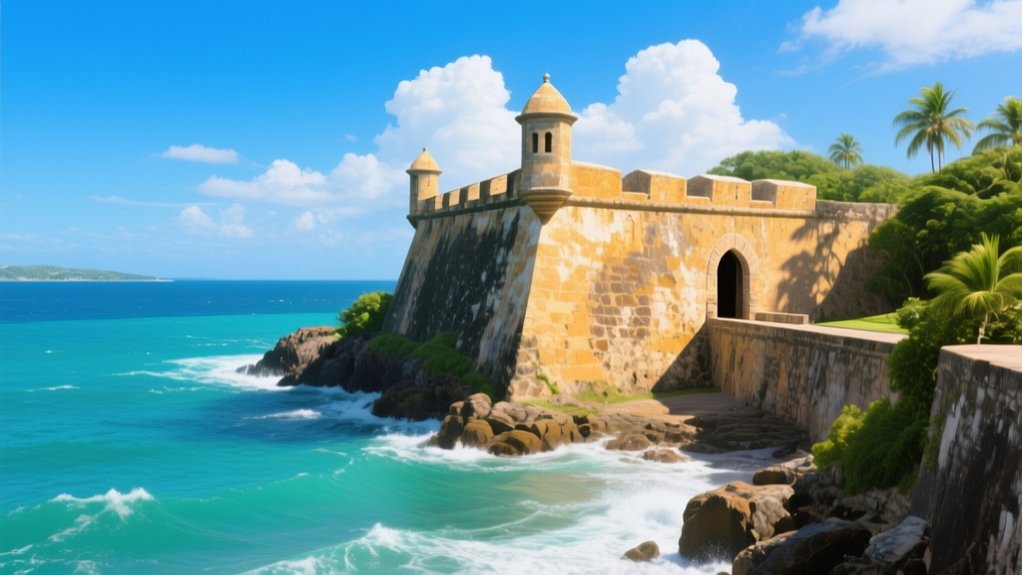
Castillo San Cristóbal is the one most passengers skip and it is the bigger of the two. Built in stages from 1634, with the great expansion carried out between 1766 and 1783 by the engineers Tomás O’Daly and Juan Francisco Mestre, it covers 27 acres and rises 150 ft above the Atlantic shore. It is the largest fortification the Spanish built anywhere in the New World. It guarded the land approach rather than the sea, which is why it faces inland, and it is cut through with a tunnel system linking its outworks. The Garita del Diablo sentry box, dating from 1634, sits on the rocks below the main walls.
Do them in that order: San Cristóbal is the closer to the piers, El Morro is 15 minutes west along Norzagaray, and the reverse means climbing the hill twice. Allow 60 to 90 minutes at each.
🗺️ Tours & Experiences at This Port
Skip the ship’s overpriced excursions — browse top-rated independent tours trusted by thousands of cruise passengers.
The Walled City: What Is Actually Worth Your Time
Old San Juan occupies an islet roughly 1.2 km long, and the colonial core can be crossed on foot in 20 minutes. Work outward from the forts rather than treating each sight as a separate trip. The city walls were begun in 1634 and run to about 20 ft thick; of the four original gates only the Puerta de San Juan survives, at the bottom of Caleta de San Juan on the bay side, and walking up through it is the best two minutes in the city.
La Fortaleza, begun in 1533, sits above the same stretch of wall and has been in continuous use as the governor’s residence since, making it the oldest executive mansion still serving that purpose in the Western Hemisphere. It is a working government building, so access is limited and the street outside is often barriered. Catedral de San Juan Bautista, on Calle del Cristo, was founded in 1521 and rebuilt in its present form from 1540; the tomb of Juan Ponce de León is inside. Casa Blanca, built for the Ponce de León family in 1521, sits just below El Morro.
The Paseo de la Princesa runs west from the pier area along the outside of the south wall to the Raíces fountain, a level 800 m taking about 10 minutes, with the best ground-level view of the bay. It used to continue as the Paseo del Morro National Recreation Trail, hugging the base of the wall round to the tip beneath El Morro. That trail was closed after a water leak opened through the historic wall and is not a reliable route — check at the fort or at the La Casita visitor point by Pier 1 before planning to walk it, because many guides and maps still show it as open.
Treat the quarter as a walking city rather than a trolley route, and keep a rideshare app for the climb back up from the waterfront.
Beyond the Walls: El Yunque, the Beaches and Cataño
El Yunque is the headline day trip and the one most often misdescribed. It is the only tropical rainforest in the US National Forest system, covering nearly 29,000 acres across eight municipalities in the north-east, about 40 km (25 miles) east of San Juan via PR-3 and then PR-191 north from Río Grande. The drive is 45 to 60 minutes each way from the Old San Juan piers, longer from Pan American. On a transit call of eight or nine hours that is workable but tight; on a short call it is not.
The important point: entry is free and no reservation is required. The Recreation.gov ticketing system that guides still tell you to book has been suspended, along with its booking fee. Access is first-come, first-served on PR-191, and the gate closes once about 200 cars are inside, reopening as roughly 20 vehicles leave. The Forest Service specifically warns against using rideshare apps to be dropped at the La Coca gate or El Portal, because those services have no recognised pick-up point inside the forest and you can be left with a long walk out; private vehicles, taxis and permitted operators are the authorised ways in. Repair work along the main recreation corridor means individual trails and the El Portal centre close periodically, and a rainforest and waterfall day trip with a permitted operator takes that uncertainty off your hands.
For a beach, Condado is the closest stretch of sand, about 4 km east of the old city in Santurce — 10 to 15 minutes by car, or a local bus along Ponce de León. Isla Verde, wider and calmer, is roughly 11 km east in Carolina beside the airport approach, which makes it the obvious choice if you fly out the same evening after a turnaround; the AMA airport bus serves it. Both are public beaches, not private resort sand.
Cataño is the low-effort alternative: the AcuaExpreso from Pier 2 crosses in 7 to 18 minutes and lands you a short ride from Casa Bacardí, a round trip that fits inside three hours and is the only off-island excursion that works on a short call or a departure day. For wider options across the island, including bioluminescent bay trips and Culebra and Vieques sailings, compare what independent operators list on excursion marketplaces before the ship’s desk closes its bookings.
Ship Excursion or Doing It Yourself: How to Decide
This decision hangs on two variables here: your berth and your clock.
On a transit call at Piers 1, 3 or 4 with eight hours or more, the old city needs no excursion at all. Both forts, the cathedral, La Fortaleza, the city gate and the Paseo de la Princesa lie inside a 1.2 km islet, all on foot, and one 24-hour park pass covers the forts. Buying a guided walk over ground you can cover yourself 400 m from the gangway is the most common waste of money in this port.
Berthed at Pan American the arithmetic changes: 10 to 15 minutes of driving each way before anything starts, more in changeover traffic, and the worst taxi queue in the port. A pre-booked vehicle, or an excursion collecting from your actual pier, is worth the premium purely to remove the wait.
For El Yunque, weigh the round trip honestly: 90 to 120 minutes of driving plus the 200-car gate on a busy day. A permitted operator is not selling access you could get free anyway — it sells a parking slot, a driver who knows which trails are open that week, and a return tied to the ship. Independent hire lets you stop where you like on PR-191, but if the road backs up nobody holds the ship for you; only ship-operated excursions carry that guarantee.
🗺️ Tours & Experiences at This Port
Skip the ship’s overpriced excursions — browse top-rated independent tours trusted by thousands of cruise passengers.
San Juan: The Details Nobody Mentions at the Port Talk
Check your berth before you book anything. Everything here follows from whether you are at the Old San Juan piers or at Pan American 4 km round the bay, and most published guides describe only the first case.
Do not plan around the free trolley. It has been out of service, and older guides, maps and port write-ups still list its three routes and its stops at Pier 4 and Plaza de la Marina as though it runs daily.
There is no train to Old San Juan. The Tren Urbano’s western terminus is Sagrado Corazón in Santurce, 16 stations and 17.2 km of line stopping short of the islet. The extension has been proposed since the line opened in 2004 and has never been built.
El Yunque needs no reservation. The booking system was dropped and entry is free; what limits you is the 200-car parking cap at the gate, not a ticket. Guides telling you to reserve on Recreation.gov are out of date.
Buy one fort pass, not two. A single San Juan National Historic Site pass covers El Morro and San Cristóbal for 24 hours, and the park takes cards only.
Carry water and a hat for the forts. The El Morro esplanade is open grass with no shade for several hundred metres, and the Atlantic wind across it disguises how strong the sun is.
Expect the occasional power cut. Puerto Rico’s grid has not been fully rebuilt since Hurricane María in 2017, and island-wide outages still happen. Restaurants, hotels and the forts switch to generators and the day carries on, but lifts, card readers and traffic lights can drop out. The sights themselves — the forts, the old city, the port, El Yunque’s main corridor — have been repaired and work normally; it is the electricity supply, not the tourist infrastructure, that stays unreliable.
Hurricane season runs 1 June to 30 November, peaking in late August and September. That is when itinerary changes happen and it is the main reason a San Juan call turns into a sea day.
🗺️ Tours & Experiences at This Port
Skip the ship’s overpriced excursions — browse top-rated independent tours trusted by thousands of cruise passengers.
A Port Day That Actually Fits
This assumes a transit call at Piers 1, 3 or 4 with eight hours alongside. At Pan American, add 15 minutes at each end and cut one item.
Walk off early and go straight uphill: 10 to 15 minutes from the gangway, past Plaza Colón, to Castillo San Cristóbal. Buy the 24-hour pass here, since it covers El Morro too, and give the fort 60 to 90 minutes including the tunnels and the view down over the Garita del Diablo.
Walk west along Calle Norzagaray, a flat 15 minutes with the Atlantic on your right, and cross the esplanade to El Morro. Another 60 to 90 minutes covers the six levels and the lighthouse terrace. It is the most exposed point of the day; drink something here.
Drop south into the old streets rather than retracing Norzagaray. Casa Blanca sits just below the fort, the cathedral and Ponce de León’s tomb are five minutes down Calle del Cristo, and La Fortaleza is at the end of the same street. The Puerta de San Juan is at the bottom of Caleta de San Juan; through it, turn left onto the Paseo de la Princesa for a level 800 m, about 10 minutes, back towards the piers.
With three hours left, add Cataño: the AcuaExpreso from Pier 2 crosses in 7 to 18 minutes, with Casa Bacardí a short ride the other side. With less, stay in the quarter — the streets between Calle San Sebastián and Calle Fortaleza are the working part of the islet. Before heading out, a local eSIM data plan keeps maps, the ferry timetable and your rideshare app working without hunting for wifi.
Be back at the pier 60 minutes before all aboard if you have gone beyond the walls, 90 if you have been to El Yunque. Traffic on PR-26 into the city is the most common reason independent travellers cut it fine here.
Book your San Juan day
Tours for this port, compare before you book
Getting around in port
✈️ Before you sail: eSIM, insurance, luggage, flight delays
Ships In San Juan
Upcoming calls from our sailings tracker, updated regularly.
Rhapsody Of The Seas
Royal CaribbeanSat 10 Oct
⚓ 06:00–18:00
Icon Of The Seas
Royal CaribbeanWed 14 Oct
⚓ 07:00–15:00
Rhapsody Of The Seas
Royal CaribbeanSat 17 Oct
⚓ 06:00–18:00
Queen Elizabeth
CunardSun 18 Oct
⚓ 08:00–17:00
MSC World America
MSC CruisesTue 20 Oct
⚓ 09:00–23:00
Carnival Vista
CarnivalWed 21 Oct
⚓ 07:00–16:00