Bergen Cruise Port Guide
Make the most of your Bergen cruise port visit—discover insider tips that transform your day from ordinary to extraordinary.
In this guide
Try one free personalised day plan — built around your ship’s actual arrival and departure times. Then get every port on your cruise done the same way from £7.99 (about $10).
Cruise Port Overview: What to Expect
Bergen’s cruise terminal is close to the centre. Ships usually berth at Skolten, around ten minutes on foot from Bryggen, or at Jekteviken, further out but still walkable in about half an hour, so getting into town is simple. Rather than deciding on the quay between shuttle buses, local buses and taxis, you can arrange a private transfer or booking a walking tour operator beforehand that picks you up directly from the ship.
The actual harbour is where Bergen’s value sits—it’s a working fishing port with real activity rather than the manicured waterfronts you’ll see elsewhere in Scandinavia. You’ll encounter actual fishmongers, crab stalls, and locals conducting business instead of curated commercial spaces. The Bryggen warehouses in the medieval wharf district warrant your attention, but they become aggressively crowded whenever cruise ships are in port, so getting ashore within the first few minutes after disembarkation genuinely matters.
Bergen’s weather is notoriously erratic, with rain arriving frequently and without notice, so waterproof gear matters more here than anywhere else on your route. The rain doesn’t compromise your experience though—it’s integral to the place and often has the practical benefit of thinning out crowds.
The food quality here outperforms what you’d reasonably expect from a port of this scale. Fresh seafood at the market costs less if you eat standing up beside the stalls; restaurants positioned near the tourist precinct charge considerably more than their food justifies. Buy lunch components at the market and eat overlooking the water, or walk into the residential streets beyond Bryggen where actual residents eat lunch.
Getting From the Port to Town
Bergen’s cruise terminal sits close enough to town that walking in is the easy option from the central quays. Jekteviken adds a longer walk, so check which quay your ship uses before you decide how to get in.
Arranging a private transfer before departure costs more than public options but skips the queue that forms the moment your ship docks. You’ll arrive directly in Bryggen rather than at a bus station on the periphery, which matters because the medieval warehouses fill quickly with cruise passengers and your experience improves measurably with fewer crowds pressing around you.
The local bus system functions well enough if you buy tickets at the terminal kiosk instead of boarding—this costs significantly less and puts you among residents rather than funnelled into a dedicated shuttle. The journey takes longer than you might prefer, but that’s the trade-off for genuine transport rather than a sanitised cruise experience.
Taxis charge more than justified for this route, and Bergen’s drivers prioritise efficiency over conversation, so you won’t extract local knowledge during the ride. Walking tour operators who collect you directly from the ship solve the transport question while starting your time ashore from the moment you leave the gangway—this advantage remains invisible to most cruise passengers until they’ve already wasted their morning elsewhere.
The Must-Do Experience: Start Here
Most cruise passengers walk straight off the ship and head to Bryggen, the medieval waterfront district, which is exactly the mistake you should avoid. The narrow lanes and old warehouses pack with organised tour groups by mid-morning, turning what could be a useful look at the city into a bottleneck of people shuffling past overpriced shops.
Start instead at Fløibanen, the funicular railway that rises up Mount Fløyen from near the harbour. You ascend through forest and emerge with an actual sense of how the city is organised—wedged between mountains and water, shaped by geography rather than marketing. This solves the real problem cruise passengers face: arriving without any mental map of where things actually are.
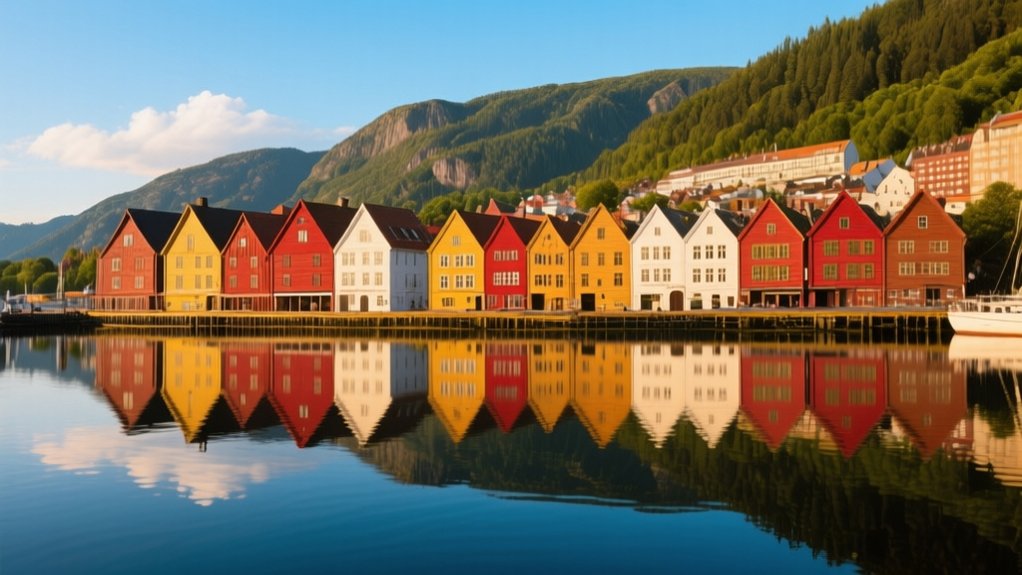
Come down to Bryggen around lunchtime when most other passengers are either still aboard ship or stuck in the terminal queue. The Hanseatic warehouse buildings are easy to identify, narrow wooden structures in ochre and red that date back centuries, and they deserve a proper walk rather than rushed photography. The spaces between the buildings show how the merchants actually worked and lived, which tells you more than any postcard could.
From there walk inland to Torget, the central market square, where real fishmongers and produce sellers operate alongside the tourist stalls. This is where Bergen functions as an actual working city, and where your food costs less and tastes better than anything served at the waterfront restaurants. Consider booking guided excursions with local operators in advance, as independent guides offer better knowledge than the cruise line’s standard package tours during the busy season.
History Culture and the Top Sights
Bergen’s history museums demand more time than they repay. The Bryggen Museum is built over the remains of Bergen’s oldest buildings and displays medieval artefacts from the Bryggen excavations—acceptable if you’re passing through the neighbourhood anyway, pointless if you’re travelling specifically to see it. Skip it.
Walk through Bryggen itself instead. The medieval street layout has remained unchanged since the 14th century, and the buildings still function as working shops, galleries and offices rather than static displays. You learn how the Hanseatic League actually operated far more effectively by observing genuine commercial activity than by reading interpretive panels.
The Hanseatiske Museum makes better use of your time. It’s a merchant’s house preserved as an 18th-century residence, complete with period furnishings and a functional kitchen where you can see how wealthy traders lived without the artifice common to most heritage attractions. The rooms feel inhabited rather than arranged.
Book a walking tour with a local guide beforehand rather than joining a group assembled on the quay. Most tours address Bergen’s medieval trading prominence and later dominance in the fish trade, though quality varies widely. Seek out guides who explain the 1702 fire and the subsequent reconstruction using medieval techniques—this detail clarifies why Bryggen appears authentically medieval compared to restored quarters elsewhere in Europe. Tours fill during cruise season, so securing your spot online in advance guarantees availability and typically costs less than booking through the ship.
Beyond the Centre: Day Trips and Alternatives
The ship’s fjord excursion costs roughly twice what you’d pay booking independently, and you’ll spend more time on a coach than actually on the water. The guide will be competent enough, but the experience follows a set itinerary with little flexibility. Independent operators based in the harbour offer the same fjord scenery at half the price, departing from central meeting points rather than keeping you tethered to a group all day. You board an actual boat, see the Sognefjord, and typically stop in a village where you can walk around freely rather than stick to scheduled stops. The economics work because these operators cut out the cruise line’s markup entirely.
The Flåm Railway sells out weeks ahead during cruise season, so booking online independently rather than through your ship guarantees you a seat and costs considerably less. The journey justifies its reputation—a narrow-gauge line descending through fjord valleys with genuinely steep gradients that feel substantial. Combining it with a fjord cruise through a package operator gives you better rates than buying rail and boat separately.
Guided kayaking on the inner harbour keeps you close to port and operates year-round without requiring previous experience. The angle you get on Bryggen and the surrounding hills from the water differs entirely from what walking tours provide. Book several days ahead during peak season, as these trips fill quickly and represent one of the few paid activities in Bergen actually worth your time.
Shore Excursion or Going It Alone
The cruise desk will present pre-arranged shore excursions as your only practical option, but independence is entirely viable and often worthwhile. Most cruise excursions follow predictable patterns: crowded coach tours to the fjords or generic city walks that spend excessive time in shops where the cruise line receives commission. You’re paying for convenience and insurance, not better experience or value.
The ship’s markup on activities typically reaches fifty per cent or more, and you’re locked into departure times designed to get everyone back before sailing rather than allowing genuine exploration. Going independently isn’t reckless—it’s sensible. The harbour is compact and central, genuinely difficult to get lost in.
Local tour operators charge considerably less than the cruise desk and often provide better insight because they’re not managing fifty people simultaneously. Popular independent kayak tours and fjord cruises fill quickly during peak season, so book online several days before you arrive. The single advantage to booking through the ship is peace of mind if you’re travelling with elderly relatives or young children who need reassurance.
For everyone else, your time and money are better spent elsewhere. The real rewards—kayaking near Bryggen, taking the railway descent, experiencing the inner harbour without a group—come from moving at your own pace and making decisions as they arise, not from a coach seat.
🗺️ Tours & Experiences at This Port
Skip the ship’s overpriced excursions — browse top-rated independent tours trusted by thousands of cruise passengers.
Before You Leave the Ship: Bergen Practicalities
The restaurants lining the wooden wharf charge substantially more for inferior fish soup than the stalls operating nearby, yet most cruise passengers never notice the difference. The locals know this; the cruise desk doesn’t mention it because there’s no commission involved.
Your money stretches furthest away from the wharf itself. Walk inland toward the fish market and surrounding streets, where independent seafood restaurants and casual cafés operate at entirely different price points. You’ll eat better and spend considerably less—the sort of practical advantage that transforms a port day from tolerable to genuinely rewarding.
The railway station sits higher than most visitors expect, and the descent toward the harbour is considerably steeper than ascending it. Plan your walking route accordingly; many cruise passengers regret leaving the station visit until late afternoon when their legs protest the climb back uphill. Book the independent railway excursion online in advance rather than through the ship, as it costs considerably less and the operator manages smaller groups than the cruise desk’s crowded coach tours.
The inner harbour changes character dramatically between morning and afternoon. Arrive early when it’s calm and relatively quiet, before the tour groups materialise. By mid-afternoon the waterfront becomes congested; if you’ve seen it properly in the morning, you’re free to explore the neighbourhoods where actual Bergen residents spend their time, which is where the day becomes genuinely rewarding rather than merely pleasant.
🗺️ Tours & Experiences at This Port
Skip the ship’s overpriced excursions — browse top-rated independent tours trusted by thousands of cruise passengers.
Your Port Day: A Sample Itinerary
Bergen’s morning rhythm works against you if you stay near the water. The real texture of the city reveals itself inland, where the congestion that clogs the harbour by midday simply doesn’t exist.
Start at Bryggen while the medieval streets are still navigable, but keep it to an hour. The Hanseatic merchant houses matter because they shaped how the city functions, not because you need to photograph them all, and understanding the layout before crowds arrive lets you actually see what’s there rather than shuffle through it.
Walk uphill toward the fish market for breakfast at independent seafood stalls, which charge substantially less than the restaurants operating on harbour-front rent. The quality is higher because the traders aren’t relying on passing cruise passengers who’ll never return.
Book a funicular ticket online with an independent operator rather than through the ship’s desk. The smaller groups that result mean you’ll actually see the views across the harbour and fjords without standing three-deep behind other people, and you’ll descend by early afternoon when the cruise passenger masses are still queuing at waterfront attractions.
Spend your afternoon in the neighbourhoods where Bergen residents actually live and shop. Walk toward Lille Lungegårdsvandet and the quieter residential streets, or move through the galleries and independent shops near Nygårdsgaten, which removes you entirely from the cruise passenger circuit. Return to the ship with genuine time to spare rather than arriving in the rushed scramble that most passengers endure.
If you prefer a guide to a map, what is available in Bergen covers trips that fit a single day ashore in Bergen.
🗺️ Tours & Experiences at This Port
Skip the ship’s overpriced excursions — browse top-rated independent tours trusted by thousands of cruise passengers.
Book your Bergen day
Tours for this port, compare before you book
Getting around in port
✈️ Before you sail: eSIM, insurance, luggage, flight delays
Ships In Bergen
Upcoming calls from our sailings tracker, updated regularly.
MSC Preziosa
MSC CruisesFri 9 Oct
⚓ 08:00–18:00
MSC Preziosa
MSC CruisesTue 13 Oct
⚓ 08:00–18:00
ms Rotterdam
Holland AmericaThu 15 Oct
⚓ 08:00–17:00
ms Nieuw Statendam
Holland AmericaWed 28 Oct
⚓ 08:00–17:00
ms Nieuw Statendam
Holland AmericaThu 5 Nov
⚓ 08:00–17:00
ms Nieuw Statendam
Holland AmericaWed 18 Nov
⚓ 08:00–17:00