Corfu Cruise Port Guide
Skip the ship excursions and discover how locals really experience Corfu—but first, understand where to actually go.
In this guide
Try one free personalised day plan — built around your ship’s actual arrival and departure times. Then get every port on your cruise done the same way from £7.99 (about $10).
Cruise Port Overview: What to Expect
Corfu’s cruise terminal sits frustratingly close to the old town yet far enough that most passengers automatically book a taxi or ship excursion without realising how easily walkable it is. The port itself is straightforward—you’ll clear formalities quickly and find yourself with genuine flexibility, which is rare for a Greek island stop.
The old town rewards independent exploration rather than a guided tour, and this is where your time matters most. Narrow Venetian streets contain authentic local life and affordable tavernas precisely because cruise crowds haven’t overwhelmed everything yet. The fortress overlooks the town and costs a small fee to enter; the views justify it, but only if you want them—the town itself is the real draw.
Beach access is easier than you’d expect if you’re willing to walk or take a local bus rather than join a packaged excursion. The waterfront near the terminal offers moderate-cost options, but venturing slightly further gives you considerably fewer tourists and better value for money on food and drinks.
Most passengers waste their port hours on unnecessarily expensive taxis or waiting for ship tours when they could be sitting in a proper taverna ordering lunch at a fraction of cruise-ship prices. Your advantage is that Corfu rewards slow exploration over tick-box sightseeing, and you have just enough time to do it properly if you start moving immediately after disembarking. Time management here is everything.
Getting From the Port to Town
The taxi rank outside the terminal operates on cruise-ship economics. Drivers there know you’re pressed for time and price accordingly, so you’ll pay a premium for convenience. If you walk five minutes past the terminal perimeter and flag down a taxi on the main road where locals actually live, you’ll pay a fraction of that cost and reset your mindset before exploring properly.
Walking to the old town takes longer but gets you oriented faster than any vehicle could. You’ll pass local shops, see where residents actually eat breakfast, and develop a genuine sense of the town’s layout rather than jumping from taxi to tourist site. Following the waterfront path removes navigation guesswork, and starting your port day on foot rather than behind a windscreen leaves your mind clearer for what comes next.
The local bus system costs very little and reaches points the old town doesn’t cover, including beaches further out. Buses follow their own schedules rather than cruise-ship departure times, so checking your route beforehand prevents frustration and missed connections. For most of your day spent in the old town and waterfront, walking or one outbound taxi journey covers everything you actually need, leaving your budget and energy for what matters.
The Must-Do Experience: Start Here
Corfu’s old town reveals itself properly only when you walk through it without a destination in mind. The actual character of the place—peeling Venetian facades, neighbourhood tavernas where locals actually sit, squares that catch light at particular angles—only surfaces when you’re moving at a pace dictated by curiosity rather than a guidebook checkpoint.
Most cruise passengers make straight for the Spianada, treat the esplanade as something to tick off, then leave. It functions adequately as open space where you can breathe, but the narrow backstreets matter far more. The lanes between faded townhouses with worn shutters and washing lines contain what actually distinguishes this town, and wandering through them deliberately rather than accidentally leads you to small cafés run by families where your money stretches further and you’ll sit among people who live here rather than people passing through.
If you want structure, independent walking tours operating from the old town cost considerably less than cruise ship excursions, fill up quickly during season, and require advance booking rather than hoping for last-minute slots. A tour covering the Venetian fortress and the town’s layered history—Greek, Venetian, French, British—provides context that solo exploration sometimes lacks, particularly useful if your time ashore is constrained. What matters most isn’t ticking off a specific location but spending three hours without rushing to understand how the place actually functions.
🗺️ Tours & Experiences at This Port
Skip the ship’s overpriced excursions — browse top-rated independent tours trusted by thousands of cruise passengers.
History Culture and the Top Sights
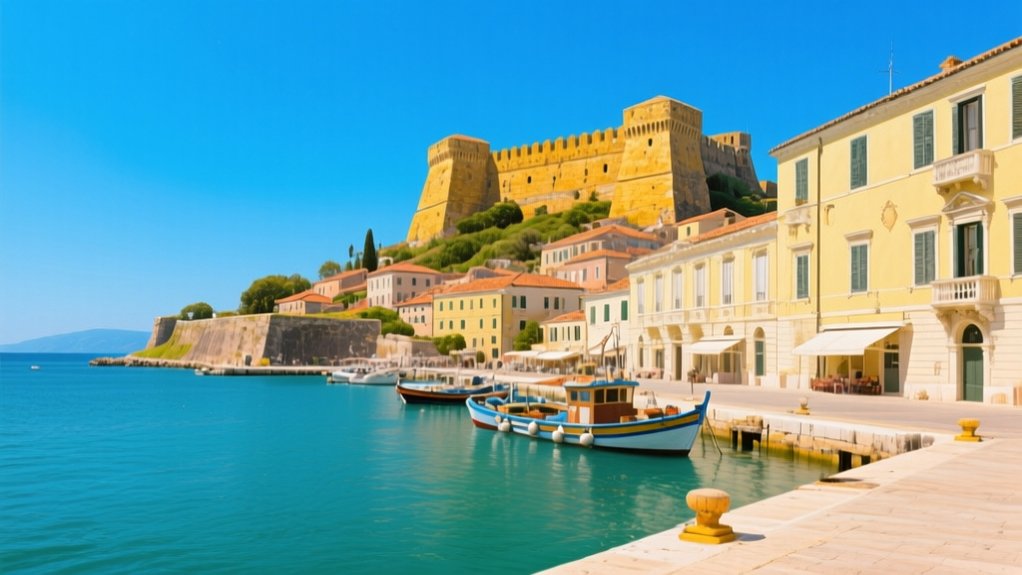
Corfu’s architecture layers itself visibly across the town—centuries of Venetian, French, and British occupation sit alongside Greek structures, making the place readable as history rather than merely picturesque. The Old Fortress rises above everything and dominates cruise itineraries, though what matters isn’t time spent inside the walls but rather the spatial understanding you gain from the top. Substantial steps and exposed sections mean the climb demands reasonable fitness; the actual payoff comes from seeing how the town organises itself below rather than from the fortress interior.
The Venetian legacy matters far more than any individual building you might visit. Walk the narrow streets of the Campiello district and you’ll see how neighbourhoods actually functioned before tour operators sorted them into attractions—shuttered windows, tight courtyards, the genuine texture that photographs smooth away. San Spyridon Church holds real significance for local people rather than functioning as a cruise checkpoint, and visiting during non-service hours shows you actual community life instead of heritage packaged for passing ships.
Independent walking tours covering Corfu’s Venetian, French, and British periods deliver considerably better understanding than organised ship excursions. You can book tours and activities beforehand online since reliable guides fill quickly during peak season, and you’ll finish with genuine comprehension of what you’ve seen rather than rushing between predetermined stops. Three hours walking with someone explaining the actual history transforms Corfu from background scenery into a place you genuinely understand.
Beyond the Centre: Day Trips and Alternatives
Most cruise passengers never leave the Old Town because the port sits within walking distance of the main attractions, but Corfu’s actual character only emerges once you move into neighbourhoods where locals spend their time and money. The ship excursions take you to the same three beaches that every cruise operator visits, delivering groups to sections where vendors have already calculated your arrival time and adjusted prices accordingly. Going independently means you set the pace, access genuinely quieter spots, and pay considerably less for both food and transport.
The worthwhile villages and beaches spread across the island, but your limited time ashore requires strategic choices rather than chasing distance. Kassiopi to the north draws organised groups in predictable surges, while the quieter eastern coast villages take deliberate effort to reach but offer actual community tavernas instead of tourist-facing menus. Local buses run frequently and cost substantially less than cruise excursions, though routes need basic planning—download offline maps beforehand and ask port staff or your accommodation for current timetables rather than relying on information that often lags behind reality.
Booking an independent driver or small group tour beforehand through established local operators works better and fills quickly during peak season, though it still costs considerably less than ship excursions while giving you genuine flexibility over where you stop and how long you stay. Professional drivers provide reliable transportation that allows you to explore remote areas without the constraints of organised group schedules. You’ll return to the ship having encountered actual Corfu rather than the version organised specifically for passing cruise passengers. This approach requires more initial effort but produces a fundamentally different experience of the island.
Shore Excursion or Going It Alone
The ship’s excursion desk frames this as a safety question, but it’s fundamentally about cost versus control. You’ll pay three times what locals pay for a predetermined route that moves in groups toward identical photo locations and restaurants where the owner has already built in the cruise commission. Your food and time feel managed rather than spontaneous.
Independent travel requires more planning upfront—booking transport, finding actual lunch spots, understanding how long things take—but the difference in what you encounter and what you pay becomes obvious the moment you’re ashore. You arrive at beaches before tour groups, eat at tavernas where locals sit, and can linger over coffee or change direction without a coordinator watching their watch. Transport through local buses or a pre-booked independent driver costs substantially less than ship excursions because you’re not subsidising operator margins and port fees.
The ship excursion makes sense only if you’re elderly, mobility-restricted, or genuinely unable to manage independently—otherwise you’re paying significantly for convenience you don’t need. Book an independent driver or small-group tour through established local operators well before your cruise, as the best ones fill quickly during peak season and offer considerably better value than anything sold onboard. You’ll see the same essential sights but on your terms, at your pace, with money remaining in your pocket.
🗺️ Tours & Experiences at This Port
Skip the ship’s overpriced excursions — browse top-rated independent tours trusted by thousands of cruise passengers.
What Experienced Cruisers Know About Corfu
Corfu Town becomes overwhelmingly crowded between mid-morning and early afternoon, which means your best strategy involves working around this surge rather than fighting it. Going out early or staying late lets you move through the narrow streets at a reasonable pace instead of shuffling along with hundreds of other cruise passengers all wearing the same coloured lanyard.
Restaurants near the port charge significantly more than places a few streets back where locals actually eat. Walking inland from the waterfront, you’ll find tavernas with proper pricing and food that suggests someone cared about preparing it—the gap between what you’d pay at the port and what a local pays for the same meal is usually stark enough to notice immediately.
The shuttle bus from the terminal costs more than makes sense for a walk that most people could manage comfortably on foot. Walking also teaches you the town’s actual layout and reveals the side streets where something resembling ordinary Corfu exists—small squares, local bakeries, modest museums that never make it into cruise documentation.
Booking an independent driver or local guide before your cruise gives you access to operators who actually know their work rather than those fishing for last-minute clients through your ship. You’ll have room to spend time somewhere genuinely interesting instead of being moved along a predetermined route designed to maximise the operator’s efficiency rather than your experience.
🗺️ Tours & Experiences at This Port
Skip the ship’s overpriced excursions — browse top-rated independent tours trusted by thousands of cruise passengers.
Your Port Day: A Sample Itinerary
Corfu’s Old Town works better early in the morning when you can actually walk through the Venetian streets without constant negotiation. The narrow passages open up differently when they’re not packed, and you’ll see how locals use the space rather than how it’s been arranged for visitors.
Start at the Esplanade once you’ve left the terminal. This is where people from Corfu actually drink coffee, so sit at the Liston arcade for your first hour and let the town’s rhythm become clear before the cruise crowds arrive. From there, head inland through the backstreets toward the Church of Saint Spyridon, which teaches you the town’s layout as you walk. You’ll pass ordinary neighbourhood spots and bakeries that matter more than any official landmark, and once you’ve seen the church and the silver reliquary inside, you’ve grasped what Corfu’s history actually consists of.
By midday, leave the centre. Find a quieter neighbourhood square like Campiello where a taverna will feed you at what locals pay rather than what the port area charges for the same plate. This is also when you should eat, since the afternoon brings crowds that make moving through the Old Town pointless.
What you do in your afternoon depends on what you’ve arranged beforehand. If you’ve booked an independent driver or local guide in advance—and the best ones do fill quickly—use this time for somewhere like Achilleion Palace or a village outside the main town. If you haven’t organised anything, spend the late afternoon in the quieter parts of town or visit smaller museums that won’t have queues while everyone else lines up elsewhere. You’ll return to your ship with an actual sense of Corfu rather than photographs of the places everyone stops at.
Independent tours are an alternative to the ship’s excursions. You can compare them at the tours running in Corfu.
🗺️ Tours & Experiences at This Port
Skip the ship’s overpriced excursions — browse top-rated independent tours trusted by thousands of cruise passengers.
Book your Corfu day
Tours for this port, compare before you book
Getting around in port
✈️ Before you sail: eSIM, insurance, luggage, flight delays
Ships In Corfu
Upcoming calls from our sailings tracker, updated regularly.
Carnival Legend
CarnivalThu 8 Oct
⚓ 09:00–18:00
Enchanted Princess
Princess CruisesThu 8 Oct
⚓ 07:00–16:00
MSC Sinfonia
MSC CruisesFri 9 Oct
⚓ 09:00–19:00
Marella Voyager
Marella CruisesFri 9 Oct
⚓ 07:30–23:00
MSC Fantasia
MSC CruisesSat 10 Oct
⚓ 13:00–21:00
Norwegian Pearl
Norwegian Cruise LineWed 14 Oct
⚓ 07:00–17:00